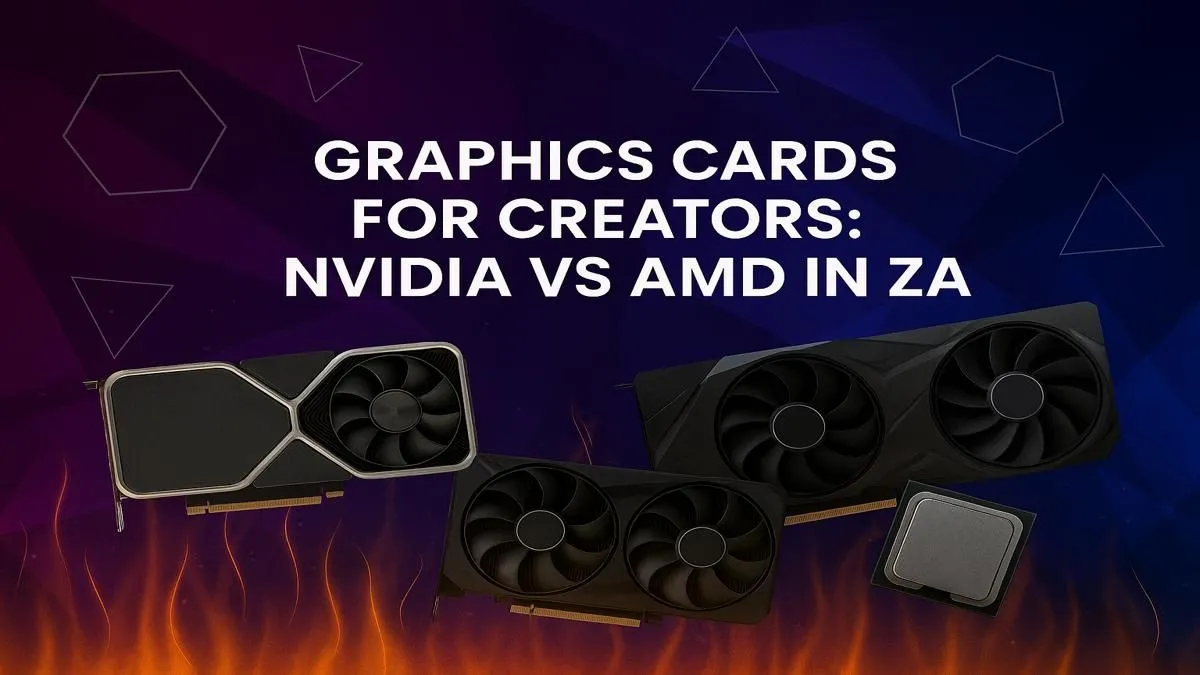
Your render is crawling, your timeline is stuttering, and that deadline is looming. Sound familiar? For South African creators, choosing the right GPU isn't just a tech choice... it's a business decision. The big question on everyone's mind: in the heavyweight battle of NVIDIA vs AMD for content creation, which brand delivers the best performance for your rand? Let's dive in and find out which GPU is the best for ZA creators like you. 💻
Understanding the Core Technologies
Before we compare benchmarks, it's crucial to understand the magic behind the silicon. The debate between Team Green and Team Red often comes down to their core software ecosystems.
NVIDIA's secret weapon is CUDA (Compute Unified Device Architecture). For years, CUDA has been the industry standard, with the vast majority of professional creative applications—from Adobe Premiere Pro to Blender's Cycles renderer—being heavily optimised to use its power. This gives NVIDIA a significant head start in terms of stability and raw performance in many popular apps.
AMD, on the other hand, champions open standards like OpenCL and their own ROCm platform. While support is growing steadily, it's still playing catch-up. For some applications, AMD offers incredible raw performance for the price, but you might find that the specific software you rely on every day simply runs better on NVIDIA's established platform.
NVIDIA vs AMD for Video Editing & Motion Graphics
For video editors in South Africa, speed is everything. When you're working with 4K or even 8K footage, your GPU does the heavy lifting for timeline playback, effects rendering, and final exports.
This is where NVIDIA's NVENC (NVIDIA Encoder) really shines. It's a dedicated part of the GPU that handles video encoding, freeing up the rest of your card to handle other tasks. This results in incredibly fast export times in apps like DaVinci Resolve and Premiere Pro. If your day-to-day involves a lot of video exports, the efficiency of NVENC is a massive advantage. While AMD has its own encoder, it generally hasn't matched NVENC's performance and quality in recent generations. For a deep dive into what Team Green offers, you can explore the latest NVIDIA GeForce lineup to see the options available.
Driver Pro Tip 🎨
If you're using an NVIDIA GPU for creative work, always install the Studio Driver, not the Game Ready Driver. Studio Drivers are specifically tested and optimised for creative applications like Adobe Creative Cloud, Blender, and DaVinci Resolve, offering maximum stability and performance for your projects. You can download them via the GeForce Experience app.
The Showdown in 3D Rendering and Modelling
When it comes to 3D art and animation, the NVIDIA vs AMD for content creation debate gets even more interesting. For rendering, especially with ray tracing, NVIDIA's dedicated RT Cores give them a clear advantage.
In software like Blender, V-Ray, and OctaneRender, these RT Cores accelerate the process of simulating light, leading to much faster render times. This means you can see your final result sooner and iterate on your work more quickly.
However, if your work is more focused on raw modelling, sculpting, or rasterization-based rendering (which doesn't use ray tracing), AMD can be extremely competitive. Their cards often provide fantastic rasterization performance for the money, making them a powerful choice for budget-conscious 3D artists. It's always worth it to check out the powerful AMD Radeon graphics cards to see how their specs stack up for your specific needs.
The Price-to-Performance Equation for South Africans 🇿🇦
Let's be honest... budget is a massive factor for any creator in SA. You need the most power you can get for your hard-earned rands. This is where the choice becomes personal.
Often, at a similar price point, an AMD card might offer more VRAM or raw compute performance on paper. An AMD Radeon RX 7800 XT, for example, can be a beast for high-resolution texture work. But an NVIDIA GeForce RTX 4070 at a comparable price brings the entire ecosystem advantage—CUDA, NVENC, and RT Cores—which can provide a much smoother experience in a wider range of optimised creative apps.
The key is to analyse your primary workflow. Are you exporting videos all day? NVIDIA's NVENC might save you hours. Are you working in a less-optimised 3D program and need VRAM above all else? AMD could be the smarter buy. The best strategy is to identify your needs and then keep an eye on the latest graphics card deals to find the perfect intersection of price and performance.
The Verdict: The Best GPU for Your ZA Creative Workflow
So, after all that, what's the final answer in the NVIDIA vs AMD for content creation showdown? It truly depends on you. 🚀
- Choose NVIDIA if: Your workflow is built around the Adobe suite, DaVinci Resolve, ray-traced 3D rendering, or emerging AI tools. You value the industry's most stable drivers and the broadest software compatibility. The ecosystem is simply more mature for creative professionals.
- Choose AMD if: You're on a tighter budget and your work focuses on tasks where raw horsepower and VRAM are king (like high-res rasterization or specific OpenCL-accelerated apps). They offer exceptional value if your software of choice runs well on their architecture.
Ultimately, the best GPU for ZA creators is the one that removes bottlenecks and lets you create without friction.