Is Your Overclocked PC Secretly Holding You Back, Mzansi? 🇿🇦
Ever wonder why your high-spec rig sometimes stutters, even after you’ve pushed your CPU to its limits? You’re not alone. Many South African gamers and tech enthusiasts dive into overclocking, hoping for that extra edge, only to unwittingly create a performance bottleneck. It’s a common pitfall: seeking more power can, paradoxically, lead to less efficient system performance. Let's unpack how overclocking causes CPU bottlenecks in South African PCs, and what you can do about it.
Understanding How Overclocking Causes CPU Bottlenecks
Before we dive into the "how," let's clarify what a CPU bottleneck is. Simply put, it's when your central processing unit can't keep up with other components in your system, particularly your graphics card. Imagine a high-speed highway (your GPU) trying to feed into a single-lane road (your CPU). No matter how fast the highway is, traffic will slow down at the bottleneck.
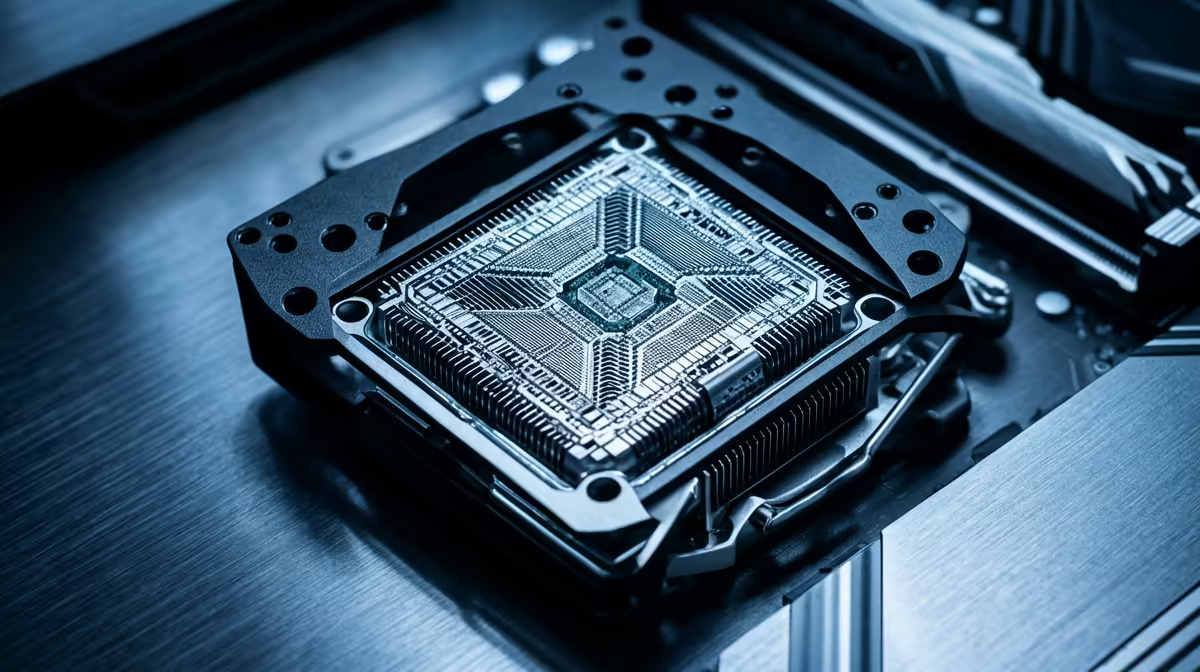
Overclocking, the process of manually increasing a CPU's clock speed beyond its factory settings, is often seen as a free performance boost. And while it can provide extra frames per second, it’s not always a magic bullet. If your CPU is already struggling to feed data to a powerful GPU at stock speeds, pushing it further might not alleviate the core problem. In fact, it can exacerbate it by introducing instability or thermal issues that force the CPU to throttle, effectively reducing its performance. This is a critical factor when considering how overclocking causes CPU bottlenecks, especially in systems where component synergy is already delicate.
The Overclocking Paradox: More Speed, More Problems?
When you overclock, you're essentially asking your CPU to do more work, faster. This requires more power and generates more heat. If your cooling solution isn't up to scratch, or your power delivery isn't stable (a common concern in regions with inconsistent power, even if you have a UPS), your CPU might hit thermal or power limits. When this happens, the CPU’s firmware automatically reduces its clock speed to prevent damage – a process known as throttling.
This throttling, often unnoticed by the user without monitoring software, can be intermittent and unpredictable. It means your CPU isn't consistently delivering its "overclocked" performance, leading to uneven frame rates and system stutters that feel suspiciously like a bottleneck. The irony is, the very act intended to boost performance ends up creating instability that manifests as a bottleneck, particularly if your CPU was already the weaker link in your gaming rig.
Monitor Your Core Temps
Always keep an eye on your CPU temperatures using tools like HWMonitor or MSI Afterburner. If your CPU frequently hits 90°C or higher under load, your cooling isn't adequate for your overclock, and throttling is likely occurring.
Spotting the Signs of an Overclocking-Induced Bottleneck ⚡
How do you know if your meticulously tuned overclock is actually causing a bottleneck? Look for these tell-tale signs:
- Inconsistent Frame Rates: Your FPS jumps wildly, rather than staying consistently high.
- GPU Underutilisation: Your graphics card usage hovers below 99-100% in demanding games, while your CPU usage is consistently high (near 100%).
- Micro-stutters: Brief, irritating pauses in gameplay that break immersion.
- System Crashes or Freezes: While often a sign of an unstable overclock, these can also point to a CPU struggling under load.
It’s not always easy to diagnose, but careful observation and monitoring can reveal if your efforts to gain performance are actually contributing to how overclocking causes CPU bottlenecks.
Optimising Your Rig: Beyond Just Overclocking
If you suspect your overclock is leading to a CPU bottleneck, don't despair. There are solutions.
First, consider dialling back your overclock to a stable, lower frequency, or even returning to stock settings. Sometimes, a stable, slightly lower clock speed delivers more consistent performance than an aggressively unstable one. Ensure your cooling is robust; investing in a better air cooler or an AIO liquid cooler can make a huge difference in maintaining stable clock speeds.
Secondly, evaluate your system balance. If your CPU is genuinely too weak for your GPU, no amount of overclocking will fix it. For instance, pairing an older quad-core CPU with a modern RTX 40-series card is almost guaranteed to create a bottleneck, regardless of clock speed.
Consider upgrading your processor. Evetech offers a wide range of powerful Intel CPUs engineered for gaming, designed to handle the most demanding titles without breaking a sweat. Similarly, if you're team red, explore our selection of cutting-edge AMD CPUs that deliver exceptional multi-core performance and gaming prowess. Investing in a CPU that’s appropriately matched to your GPU is the most effective way to eliminate bottlenecks and unlock your system’s true potential.
Ultimately, while overclocking offers a tantalising promise of free performance, it's crucial to understand its limitations and potential downsides. An improperly managed overclock can lead to the very issue it's meant to avoid: a CPU bottleneck. By understanding how overclocking causes CPU bottlenecks and taking a balanced approach to system optimisation, you can ensure your South African PC delivers smooth, consistent performance where it matters most. ✨
Upgrade Your Performance Today
Don't let a CPU bottleneck hold back your gaming experience. Discover the perfect processor for your rig and elevate your gameplay. Shop all CPUs at Evetech for performance that leaves lag in the dust.