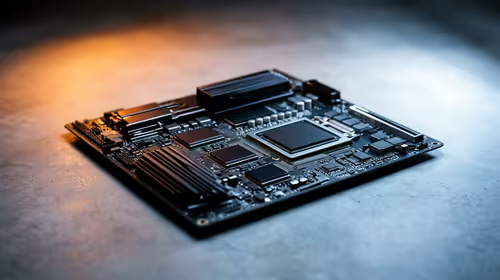
So, you've seen the hype around PCIe 5.0 SSDs. Speeds hitting over 12,000MB/s... games loading before you can blink... it’s the future of PC performance, available right now in South Africa. But before you rush to drop some serious ZAR on a new drive, there’s a crucial question: will it even work? Nailing the PCIe 5.0 SSD compatibility with modern motherboards is the key to unlocking that insane speed without the headache of a non-functional R5,000 component.
Understanding the Core Requirements for Gen5 SSDs
Getting a PCIe 5.0 SSD to run at its full potential isn't just about plugging it in. It requires a perfect handshake between your CPU and your motherboard. Think of it as a high-speed data highway… you need the right on-ramps and the right engine to get up to speed.
For a Gen5 setup, you need two things:
- A Compatible CPU: For Team Blue, this means an Intel 12th, 13th, or 14th Gen processor. For Team Red, you're looking at an AMD Ryzen 7000 series CPU or newer. These are the processors with the necessary built-in PCIe 5.0 lanes.
- A Compatible Motherboard Chipset: This is where it gets interesting. You'll need a motherboard from the Intel 600 or 700 series (like Z690, Z790) or the AMD 600 series (like X670E, B650E).
These components work together to provide the foundation for Gen5 speeds. Without both, your brand-new, blazingly fast SSD will either not be detected or will run at much slower Gen4 speeds. It’s essential to check these specs before browsing the latest solid state drives for sale.
How to Confirm Your Motherboard's Gen5 SSD Compatibility
Here’s a common trap many builders fall into. Just because a motherboard has a "Gen5-ready" chipset doesn't automatically guarantee it has a dedicated M.2 slot for a PCIe 5.0 SSD. �� Some boards might only offer a Gen5 PCIe x16 slot for the graphics card, leaving the M.2 slots at Gen4 speeds.
To be absolutely sure, you need to become a bit of a detective:
- Check the Official Spec Sheet: Go to the manufacturer's website for your specific motherboard model.
- Look for the "Storage" or "M.2" Section: The specs should explicitly state "1 x M.2 slot (Key M), type 2280/22110 (supports PCIe 5.0 x4 mode)". If it only says PCIe 4.0, then that’s your answer.
- Examine the PCB: Often, manufacturers print the specification right onto the motherboard next to the M.2 slot itself. Look for text like "PCIE 5.0 M.2".
This research is vital whether you're eyeing a drive from top brands like ADATA or looking at options from a reliable manufacturer like Kingston.
Watch Out for Lane Splitting 🔧
On many motherboards, the primary M.2 slot shares its PCIe 5.0 lanes with the main graphics card slot. This means that when you install a Gen5 SSD, your GPU slot might drop from x16 bandwidth to x8. For most gaming scenarios, the real-world performance difference is minimal, but it's a critical detail for enthusiasts to be aware of. Always check your motherboard manual for a 'lane distribution' diagram!
Common Pitfalls and Performance Considerations
Ensuring your Gen5 SSD and motherboard are compatible is the first hurdle. But there are a few other things to keep in mind to get the best experience.
That Thing Runs HOT! 🚀
PCIe 5.0 SSDs generate a significant amount of heat due to their incredible performance. Running one without proper cooling is a recipe for thermal throttling, where the drive slows down to protect itself. Most high-end motherboards with Gen5 support come with a chunky, pre-installed M.2 heatsink. Use it! If not, consider an SSD that includes its own robust cooling solution, something brands like CORSAIR are known for.
Is It Worth the Price in 2024?
Let's be honest. For the average South African gamer or content creator, a top-tier Gen4 NVMe SSD is still incredibly fast and offers far better value for money. The real-world difference in game load times between a fast Gen4 and a new Gen5 drive is often just a second or two.
For now, PCIe 5.0 is for the enthusiast who demands the absolute bleeding edge for tasks like 8K video editing or managing massive datasets. For everyone else, putting that budget towards a spacious 2TB Gen4 SSD is likely the smarter play, giving you ample space for your entire game library. ✨
Ready to Unleash Next-Gen Speed?
Understanding PCIe 5.0 SSD compatibility is the first step to a lightning-fast build. Whether you're ready for the bleeding edge or looking for incredible value with a Gen4 drive, we've got you covered. Explore our massive range of Solid State Drives and find the perfect storage to supercharge your PC.