

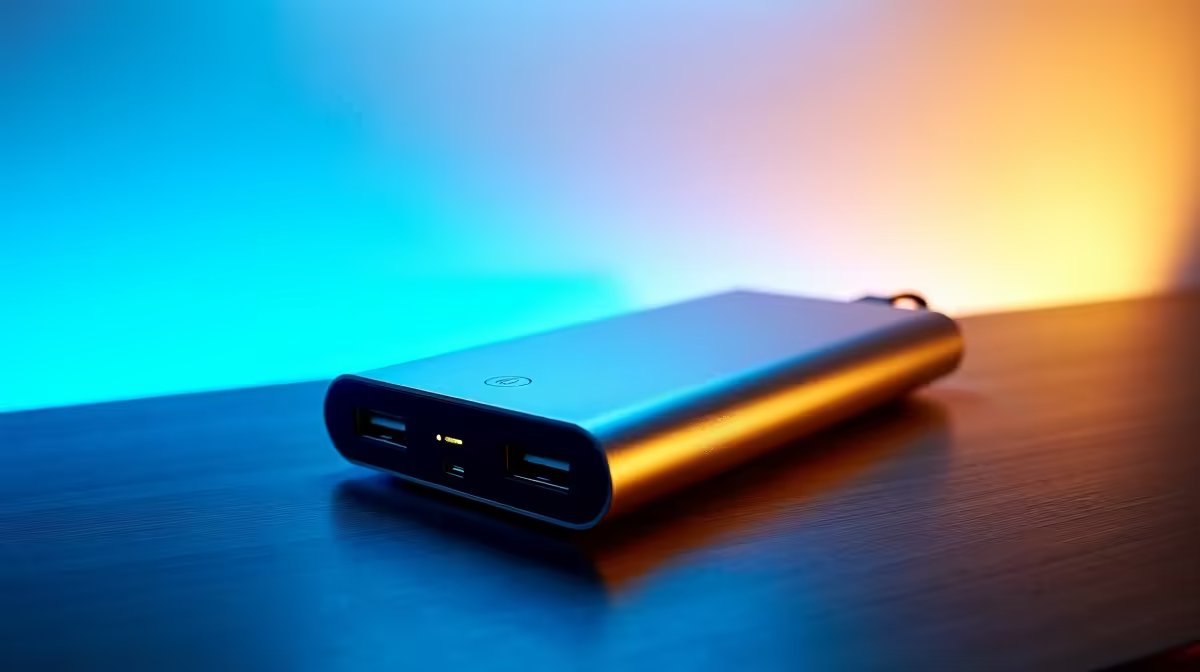
Picture this: Stage 4 load shedding hits. Your phone is on 5%, and you're waiting for that important OTP. You grab your trusty power bank, but... nothing. A dead brick. We've all been there. Choosing the right portable charger in South Africa is about more than just grabbing the cheapest option. The key is knowing the top signs of a quality power bank, ensuring you have reliable power when Eskom lets you down. Let's dive in.
Capacity vs. Reality: Understanding mAh
The first thing everyone looks at is the capacity, measured in milliampere-hours (mAh). A 10,000mAh or 20,000mAh label looks impressive, but it's not the full story. A crucial sign of a quality power bank is its efficiency.
Due to voltage conversion and heat loss, no power bank delivers 100% of its advertised capacity to your device. High-quality units typically have an efficiency of 80-90%, while cheaper, no-name models can drop as low as 60%. This means a cheap 10,000mAh brick might only deliver 6,000mAh of actual charge. For everyday top-ups, a solid power bank under R500 can still be a lifesaver if you choose a reputable brand.
Real-World Charging Maths
A simple way to estimate is:
(Power Bank Capacity x Efficiency) / Your Phone's Battery Capacity = Number of Charges
So, a quality 10,000mAh power bank (at 85% efficiency) will give you about two full charges on a modern 4,000mAh smartphone.
Output Power & Charging Speed ⚡
What’s the point of massive capacity if it takes all day to charge your phone? This is where output power—measured in Watts (W)—comes in. It's a combination of Voltage (V) and Amperage (A).
Look for features like Power Delivery (PD) for USB-C devices and Quick Charge (QC) for others. These technologies allow the power bank to communicate with your device and deliver power at a much faster rate. A standard USB port outputs 5W, while a PD-enabled port can push 18W, 45W, or even more... charging your phone from 0 to 50% in around 30 minutes.
Check Your Device's Input
Look for the tiny text on your phone's original charger. If it says '9V 2A', that's 18W. To get the fastest charge, you need a power bank that can output at least 18W from a single port. Mismatching means a much slower top-up!
Finding the right balance of capacity and speed is key. You can browse our full range of power banks to find the perfect match for your gadgets.
Build Quality and Safety Features 🛡️
A power bank is essentially a big battery, and safety should be non-negotiable. This is one of the most important yet overlooked signs of a quality power bank.
Cheaper models often cut corners on safety circuitry. A good power bank will have built-in protections against:
- Overcharging: Prevents damage to your device's battery.
- Short-circuiting: Protects both the power bank and your device.
- Over-discharging: Preserves the power bank's own lifespan.
- Temperature Control: Shuts down if it gets too hot.
Look for a sturdy casing made from durable ABS plastic or aluminium. If it feels flimsy or creaks when you squeeze it, that's a red flag. Brands like Promate build their devices with these protections in mind, giving you peace of mind.
Final Checks: Ports and Portability
Finally, consider the practical stuff. Does it have the ports you need? A modern power bank should have at least one USB-C port (ideally for both input and output) and a couple of USB-A ports.
Think about how you'll use it. A massive 30,000mAh unit is great for a weekend away but might be too bulky for your pocket. A slim 10,000mAh model is often the sweet spot for daily use. Making the right choice means you'll actually carry it with you when you need it most. ✨
Ready to Power Up with Confidence? Don't get left in the dark. Now that you know the signs of a quality power bank, it's time to upgrade to a reliable companion. Explore our premium selection and never get caught powerless again.











