

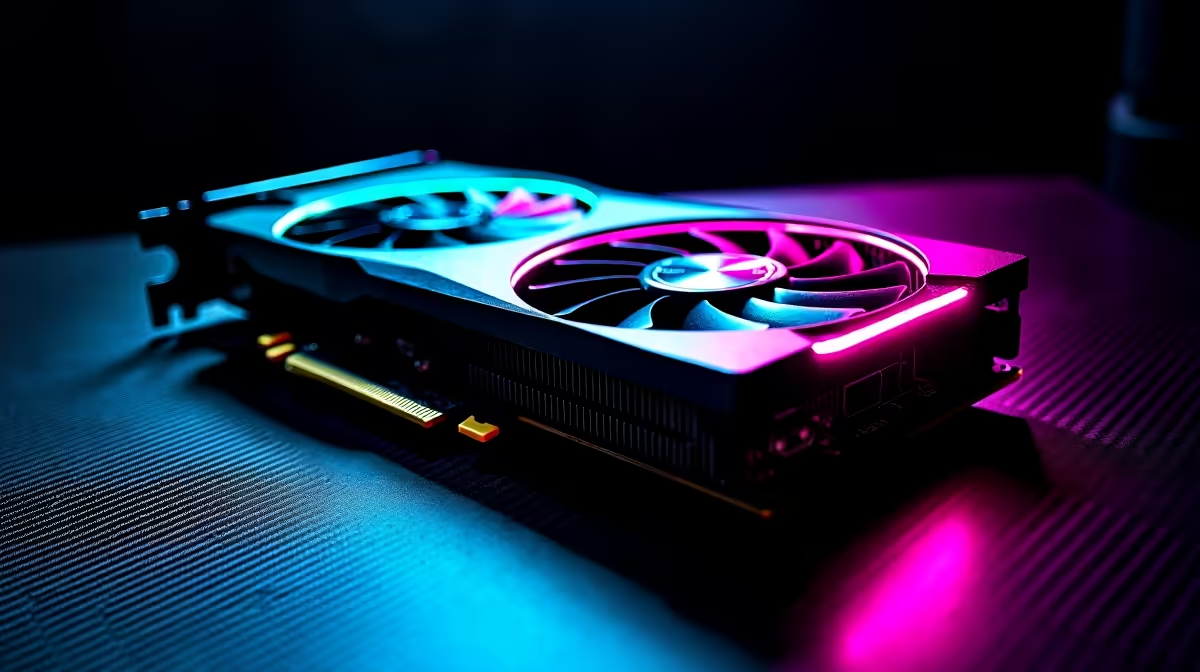
In the sweat-drenched final circle of your favourite battle royale, every millisecond counts. For South African gamers battling high ping, shaving off system latency isn’t a luxury… it’s a necessity. This brings us to the ultimate 1440p GPU showdown: the AMD Radeon RX 7800 XT vs the NVIDIA GeForce RTX 4070. Which card gives you the sharpest competitive edge when every single frame is the difference between a clutch win and a trip back to the lobby? ⚡
The Core Specs Showdown
Before we dive into latency, let's get the on-paper specs out of the way. The battle of the RX 7800 XT vs RTX 4070 starts with two very different philosophies.
AMD's RX 7800 XT comes out swinging with a hefty 16GB of GDDR6 VRAM on a 256-bit bus. This is a huge plus for future-proofing and handling high-resolution textures. It's built on the RDNA 3 architecture, focusing on delivering incredible rasterization (non-ray-traced) performance for your money.
On the other side, NVIDIA's RTX 4070 packs 12GB of faster GDDR6X VRAM on a 192-bit bus. Its strength lies in the Ada Lovelace architecture, which is a powerhouse of efficiency, AI-driven features like DLSS 3, and superior ray tracing capabilities. Both are fantastic cards, but their spec sheets tell a story of different priorities.
Raw FPS: Who Wins the Bragging Rights?
When it comes to pure, unadulterated framerates in traditional games, the RX 7800 XT vs RTX 4070 debate often leans in AMD's favour, especially considering its price point in ZAR. In titles like Call of Duty or Cyberpunk 2077 (with ray tracing off), the 7800 XT frequently matches or slightly beats the 4070 at 1440p.
For gamers who want the most raw power for every rand spent, AMD's offering is incredibly compelling. It’s a testament to the RDNA 3 architecture's rasterization prowess. If you're looking to maximise your frames in a wide variety of titles without breaking the bank, you should check out the latest AMD Radeon graphics cards to see their full family of performers.
Optimise for Latency, Not Just FPS
Cranking all settings to Ultra looks great, but for esports, turn down shadows, effects, and post-processing. This reduces the load on your GPU, lowering render time and system latency. Capping your FPS just below your monitor's refresh rate (e.g., 142 on a 144Hz screen) can also provide a smoother, more responsive experience.
Latency Tested: The Real Esports Decider 🎯
Here’s where the conversation gets critical for competitive players. We aren't talking about your internet ping; we're talking about system latency—the time it takes for your mouse click to register as an action on-screen. This is where the RTX 4070 vs RX 7800 XT comparison gets interesting.
NVIDIA Reflex is a technology built specifically to reduce this system latency in supported games. When activated in titles like Valorant, Apex Legends, or CS2, it synchronises the CPU and GPU, clearing the render queue and delivering inputs with minimal delay. For many esports athletes, this is a non-negotiable feature, and the entire lineup of GeForce graphics cards supports it.
While AMD has its own Anti-Lag technology, numerous independent tests have shown that NVIDIA Reflex often provides a more significant and consistent latency reduction. In a high-stakes match, that 5-10ms advantage provided by the RTX 4070 can be the deciding factor.
Beyond FPS: Features and Future-Proofing
A modern GPU is more than just a framerate machine. NVIDIA's DLSS 3 with Frame Generation uses AI to create entirely new frames, dramatically boosting FPS in supported games. AMD's FSR is an open-source alternative that works on a wider range of hardware, but DLSS is often considered the gold standard for image quality. The RTX 4070 also holds a commanding lead in ray tracing performance.
It's clear these two cards are built for demanding gaming, and it’s important not to confuse these beasts with workstation graphics cards, which are designed for entirely different tasks like CAD and 3D rendering. The gaming GPU market is fiercely competitive, and with new contenders like Intel Arc graphics cards entering the scene, innovation is constant.
The Verdict: Which GPU for an SA Esports Rig? 🏆
So, after testing latency and performance, where do we land in the RX 7800 XT vs RTX 4070 debate?
- Choose the AMD RX 7800 XT if: You are a value-focused gamer who plays a wide variety of titles. Its raw performance and 16GB of VRAM offer incredible longevity and power for the price, making it a fantastic all-round 1440p champion.
- Choose the NVIDIA RTX 4070 if: You are a dedicated esports player where every millisecond is crucial. The competitive advantage from NVIDIA Reflex, coupled with superior ray tracing and DLSS performance, makes it the specialist's tool for climbing the leaderboards.
For South African gamers, the choice comes down to your primary goal. Do you want the best all-round value, or the ultimate competitive edge? Both are winners, but only one is the perfect fit for your rig.
Ready to Dominate the Leaderboard? Stop letting system lag dictate your K/D ratio. Explore our massive range of graphics cards and find the perfect upgrade for your competitive needs.











