

Tired of spinning out at the Kyalami Grand Prix Circuit because your brake pedal feels more like a light switch than a precision instrument? You're not alone. For many South African sim racers, the journey to faster, more consistent lap times isn't about the wheel or the screen... it's about what's under your feet. Upgrading your sim racing pedals is the single most impactful change you can make to feel connected to your virtual car.
Why Your Sim Racing Pedals Matter More Than You Think
Forget what you've been told. While a fancy direct-drive wheel provides incredible feedback, your pedals are your primary point of control for speed and balance. They dictate how smoothly you apply the throttle out of a corner and, crucially, how you trail-brake into an apex without locking up.
Basic, entry-level pedals often use potentiometers, which measure travel distance. This is unrealistic. In a real car, you modulate the brakes by pressure, not by how far your foot moves. This is the fundamental difference that separates good sim racing pedals from great ones, and it's the key to unlocking true muscle memory and consistency on the track.
Understanding the Different Types of Sim Racing Pedals
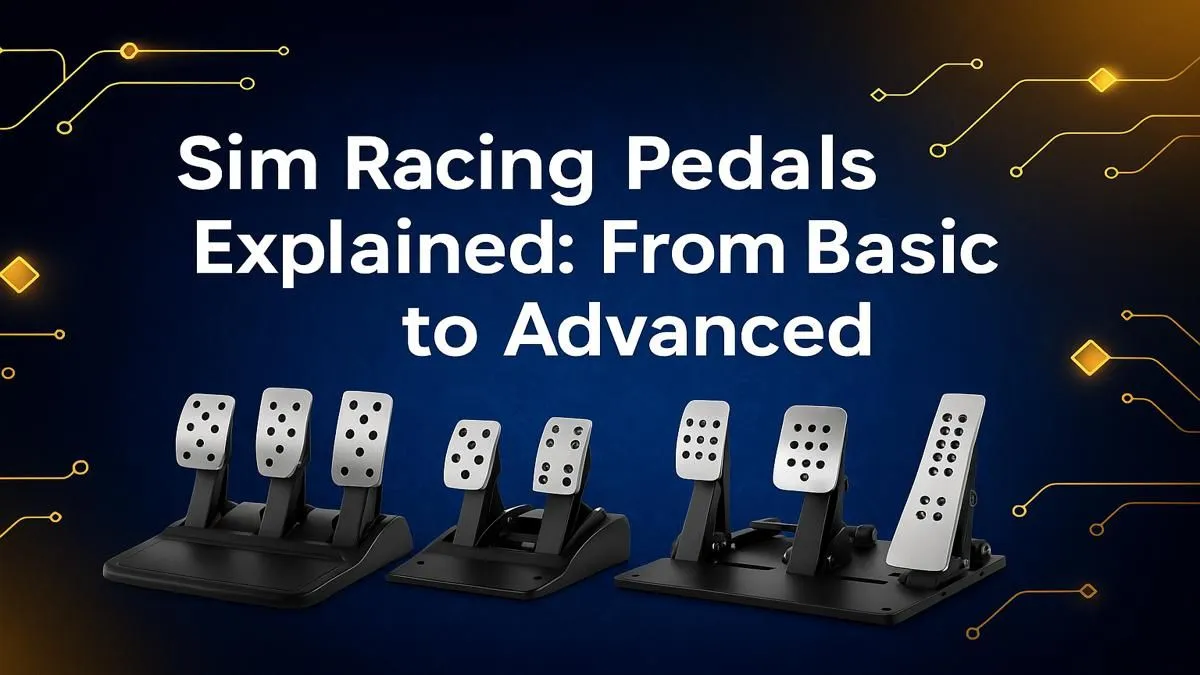
Navigating the world of sim hardware can be daunting, but pedals generally fall into three categories. Your choice will depend on your budget and how deep down the rabbit hole you want to go.
Potentiometer Pedals: The Starting Grid
These are the pedals that typically come bundled with entry-level wheelsets. They use a sensor to measure the physical distance the pedal has travelled.
- How they feel: Often spring-loaded, they lack the progressive resistance of a real brake pedal. It's an "on/off" feeling that makes precise braking difficult.
- Best for: Absolute beginners or casual racers on a tight budget. They get the job done, but you'll quickly find their limits.
Load Cell Pedals: The Proving Grounds 🚀
This is the most significant upgrade for any serious sim racer. A load cell pedal measures pressure—how hard you're pressing—not how far the pedal moves.
- How they feel: This system mimics a real car's hydraulic brake system, allowing for incredible precision. Your brain and muscles learn the force required to brake at 50% or 80%, leading to incredible consistency. Brands like Thrustmaster offer fantastic load cell options that provide a huge leap in performance.
- Best for: Anyone serious about improving their lap times and immersion.
Stability is Key 🔧
fancy new load cell pedals are useless if they're sliding around on the floor. To handle the high forces required, you need to mount them securely to a proper rig. A wobbly setup kills consistency. Investing in a solid cockpit from a brand like [Playseat](https: www.evetech.co.za PC-Components playseat-chairs-312.aspx) ensures your pedals, wheel, and seat are a single, unmoving unit, letting you focus purely on your driving.
Hydraulic Pedals: The Podium Finish
For those chasing ultimate realism, hydraulic sim racing pedals are the top tier. They use a real master and slave cylinder system with hydraulic fluid, perfectly replicating the feel of a high-performance race car's brake system.
- How they feel: Unmatched realism. The resistance, feedback, and travel feel indistinguishable from the real thing.
- Best for: Hardcore enthusiasts and professional esports drivers for whom every millisecond and nuance of feeling counts.
Finding the Right Pedals for Your Rig
Choosing the best sim racing pedals comes down to your goals. If you're just starting, a solid potentiometer set is fine. But if you find yourself getting frustrated with inconsistent braking and want to get serious, a load cell upgrade is the undeniable next step. It bridges the gap between playing a game and simulating a real driving experience.
By focusing on pressure-based braking, you'll build real-world muscle memory that translates into faster, more reliable performance on any virtual track. It’s the upgrade that truly lets you push the limits of your car. Explore the full range of sim racing gear available in South Africa to find the perfect foundation for your setup. ✨
Ready to Shave Seconds Off Your Lap Times? Upgrading your pedals is a bigger leap in performance than you can imagine. Stop guessing your braking points and start feeling the car. Explore our massive range of PC gaming hardware and find the perfect components to build your ultimate racing rig today.











