Ever felt that heart-in-your-throat moment when your car goes light over the crest at Kyalami? Or the subtle vibration through the wheel as your tyres start to lose grip? That feeling isn't just graphics... it's the magic of sim racing physics. This complex science is what separates a simple arcade racer from a truly immersive driving simulator, turning your gaming session into a genuine training tool. Understanding it is the first step toward building a truly epic sim racing setup.
What Exactly Is Sim Racing Physics?
At its core, sim racing physics is a complex engine of mathematical models constantly calculating how a virtual car should behave. Developers use real-world data to simulate everything from tyre behaviour to aerodynamics. It’s not just one thing, but a collection of systems working together to create a believable experience.
The Tyre Model: Where Rubber Meets the Virtual Road
This is the holy grail of realism. A sophisticated tyre model simulates how the rubber flexes, heats up, wears down, and interacts with the tarmac. It calculates the "slip angle"—the tiny difference between where the wheel is pointing and where the car is actually going. When you feel your car starting to understeer or oversteer, you're feeling the tyre model at work.
Suspension and Aerodynamics
Every bump, kerb, and elevation change is processed through the suspension model, affecting how the car’s weight shifts. At the same time, the aerodynamics model calculates downforce, drag, and the effect of drafting behind another car. These unseen forces are crucial for how a car feels at high speed and are a key part of realistic racing physics.
The Gear That Brings Physics to Life ✨
All this incredible digital science would be wasted if you couldn't feel it. This is where your hardware becomes the bridge between the game's code and your senses. The feedback you get is the only way to truly understand what the sim racing physics engine is telling you.
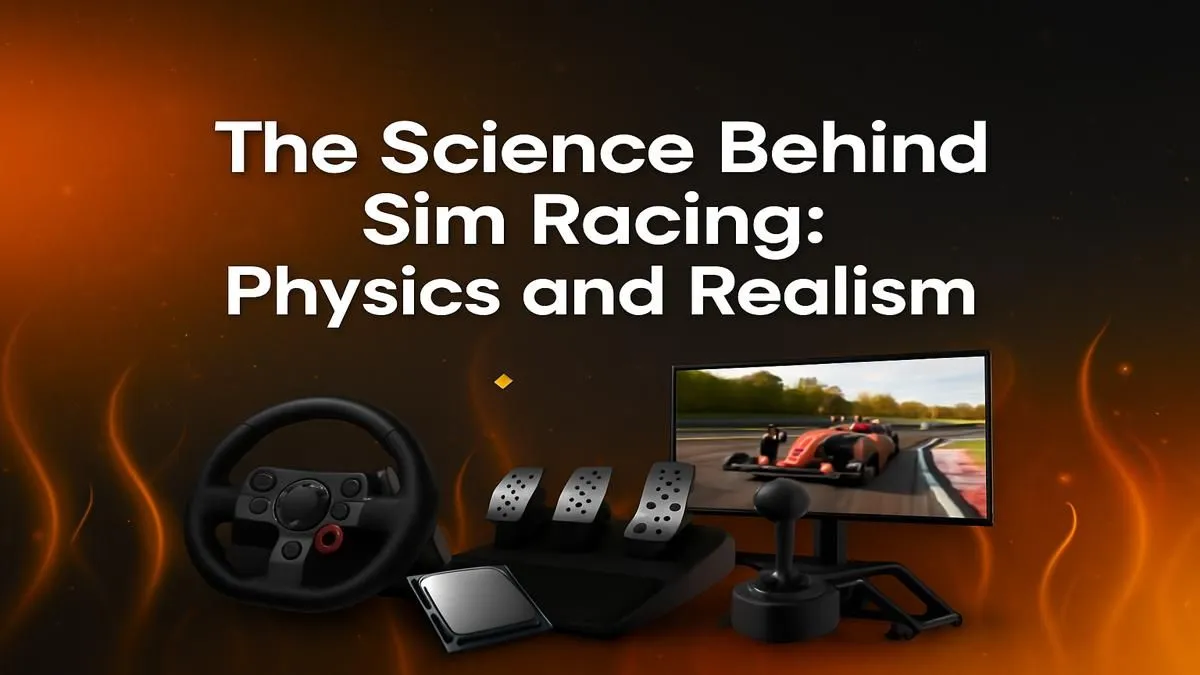
A powerful force-feedback wheel from a brand like Thrustmaster is essential. It doesn't just rumble; it communicates the loss of traction, the texture of the road, and the forces loading up on the chassis during a corner. But all that detailed feedback is lost if your gear is wobbling on a desk. That's why a rigid frame, like those from Playseat, is so crucial. It provides a stable platform, ensuring every subtle vibration is transferred to your body.
Pro Tip: Dial In Your FFB 🔧
Don't just stick with default Force Feedback (FFB) settings. Spend time in-game adjusting FFB strength, road effects, and damping. A good starting point is to turn the main FFB strength up until you feel 'clipping' (a loss of detail) on heavy corners, then back it off by 5-10%. This ensures you feel the full range of forces without losing crucial information about tyre grip.
Why Good Physics Matter More Than Graphics 🚀
In the world of simulation, immersion is king. While stunning 4K graphics are impressive, they don't help you catch a slide or nail a braking point. The science of sim racing is what creates true immersion.
Feeling the car squirm under braking or sensing the moment the rear tyres are about to let go is what makes you feel connected to the machine. It’s what builds muscle memory and makes you a faster, more consistent driver. This focus on physical realism is why many pro drivers use simulators for practice… they rely on the physics, not just the visuals.
Ready to Feel the Difference?
Ultimate realism isn't just about pixels; it's about physics you can feel. From your first wheel to a full-motion rig, the right gear makes all the difference. Explore our complete range of sim racing gear and start building your ultimate driving experience today.