You’ve lined up the perfect shot. Your crosshair is locked on the enemy’s head in Valorant, you click… and nothing. A split-second later, you’re the one staring at a respawn timer. Sound familiar? For many South African gamers exploring the world of streaming services, this isn't just bad luck; it’s cloud gaming latency. This invisible enemy can turn a surefire victory into a frustrating loss, making sync issues the biggest challenge for competitive play.
Understanding Cloud Gaming Latency
Before we dive deeper, let's clear something up. The lag you feel in cloud gaming is different from the typical network lag you might blame on your ISP. Traditional lag is the time it takes for your PC to talk to the game server. Cloud gaming latency is a much longer journey. 🚀
Here’s the breakdown:
- Input Lag: You press a key on your keyboard.
- Upload Journey: That command travels from your home in SA, across undersea cables, to a server farm in Europe.
- Server Processing: The powerful server renders the next frame of your game.
- Download Journey: That new frame is compressed and streamed back to your screen.
Each step adds milliseconds of delay. When all combined, this total delay can make fast-paced games feel sluggish or unresponsive. While cloud services are amazing for playing single-player epics on a modest machine, competitive multiplayer demands near-instant feedback that even the best budget gaming PCs can provide locally.
How Sync Affects Your Competitive Edge
In a competitive shooter or fighting game, timing is everything. A delay of even 50-80 milliseconds can be the difference between winning and losing a duel. This is where cloud gaming latency becomes a real problem, creating a "desync" between what you see and what the server registers.
Imagine you duck behind cover on your screen, but because of the delay, the server still thinks you're out in the open. To your opponent, you're an easy target. This is the core frustration of sync issues in cloud gaming. You're playing catch-up with reality. For games where every frame counts, a powerful local machine, even one from our selection of PCs under R20k, gives you the raw power to process every frame instantly, ensuring what you see is what you get.
Test Your Own Latency ⚡
Curious about your connection to cloud servers? Open Command Prompt on Windows (search for 'cmd') and type ping 8.8.8.8 to test your general latency. For a more specific test, find the IP address of a server hub in Europe (like London or Frankfurt) and ping it directly. Anything consistently over 150ms will be very noticeable in fast-paced games!
Can You Fix Latency in Cloud Gaming?
While you can't change the physical distance to servers in Europe, you can take steps to optimise your connection from home. These small tweaks can help reduce your overall cloud gaming latency and improve sync.
Tips for a Smoother Experience
- Go Wired: Ditch the Wi-Fi. An Ethernet cable provides a more stable, lower-latency connection than any wireless signal. It’s the single most effective change you can make.
- Close Background Apps: Make sure no other devices or applications are hogging your bandwidth. Stop those large downloads and tell your flatmate to pause their 4K streaming.
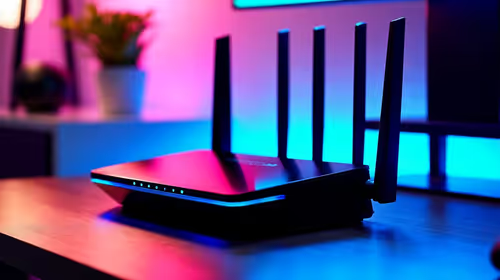
- Optimise Your Router: Log into your router’s settings and look for Quality of Service (QoS). Prioritising traffic for your gaming device can make a real difference.
Even with these optimisations, the fundamental challenge of distance remains. For South African gamers who refuse to compromise on performance, investing in local hardware is the only guaranteed way to slash latency. High-performance rigs from our range of pre-built PC deals eliminate the entire round-trip to an overseas server.
The Unbeatable Advantage of a Local Rig
Cloud gaming is a fantastic technology with a bright future. It opens up high-end gaming to more people than ever before. However, for the competitive player, the laws of physics are hard to beat. The delay, however small, will always be there. ✨
A dedicated gaming PC processes everything right there in your room. Your input is registered instantly. The graphics are rendered by your GPU and sent straight to your monitor. There's no trans-continental data trip, no video compression, and no fighting for server time. It’s the purest, most responsive experience you can get.
Whether you're looking at our top-tier PCs above R20k for ultimate 4K performance or exploring the best gaming PC deals in South Africa, you're investing in zero-compromise performance. You're taking control of your sync and ensuring your skill is the only thing that determines the outcome of the match.
Ready to Eliminate Lag for Good?
Cloud gaming is incredible, but for the ultimate competitive edge, nothing beats the raw, instant power of a local gaming PC. Explore Evetech's massive range of gaming PCs and build a rig that puts you back in control of every single frame.