You’ve just unboxed your shiny new laptop. You see that familiar, small oval port and think, "Sweet, USB-C." But hold on... is it just USB-C, or is it the lightning-fast, do-everything Thunderbolt port? In South Africa, where every rand counts, choosing the right port can make a massive difference to your gaming and productivity. This guide cuts through the confusion, comparing Thunderbolt 5 vs USB-C so you can buy the right machine for your needs.
Understanding the Basics: Not All USB-C Ports Are Equal
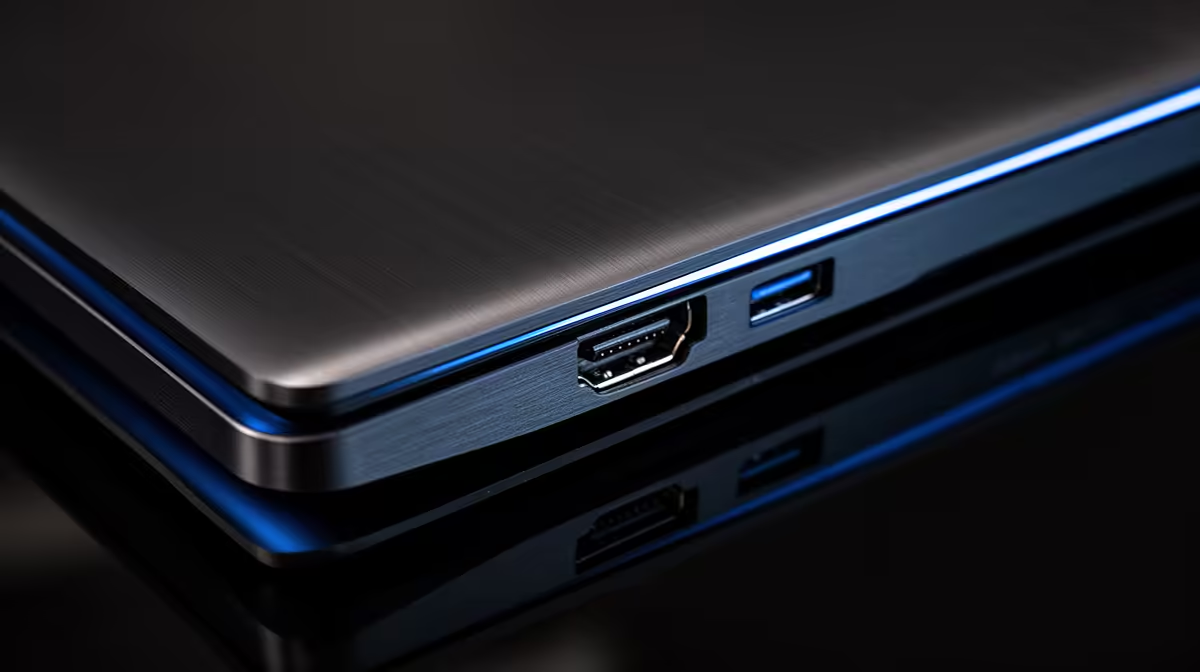
Think of USB-C as the physical plug shape—the connector. It's brilliant because it's reversible. But what that port can actually do depends on the technology, or protocol, running through it. A basic USB-C port might just handle data transfer at modest speeds, while a more advanced one can carry video signals and charge your device.
This is the first source of confusion. A port might be labelled "USB-C with DisplayPort," meaning it can connect to a monitor. Another might support Power Delivery (PD) for charging. Many of the best deals on Intel laptops on special feature these versatile ports, but the real power lies with its supercharged sibling.
Enter Thunderbolt: The All-in-One Powerhouse ⚡
Thunderbolt is a protocol developed by Intel that uses the USB-C connector to do... well, almost everything. It bundles the fastest data transfer (PCIe), video output (DisplayPort), and power delivery into a single, powerful cable.
For years, Thunderbolt 4 has been the gold standard, offering a guaranteed 40 Gigabits per second (Gbps) of bandwidth. This is enough to run two 4K monitors, connect ultra-fast external SSDs, and even hook up an external graphics card (eGPU) to turn a thin-and-light notebook into a proper gaming rig. You'll find it on many premium laptops, including a wide selection of Intel Core i7 laptops designed for serious performance.
The Main Event: Thunderbolt 5 vs USB-C
This is where the real performance gap shows. While "USB-C" is a broad term, its high-end competitor is USB4. However, the newly announced Thunderbolt 5 is set to blow everything else out of the water. Let's break down the Thunderbolt 5 vs USB-C battle.
Speed and Bandwidth
- Standard USB-C (USB 3.2): Typically 5 to 20 Gbps. Fine for a mouse or external hard drive, but it will bottleneck high-performance gear.
- USB4: Matches Thunderbolt 4's 40 Gbps, but manufacturer implementation can vary, sometimes resulting in lower minimum performance.
- Thunderbolt 5: This is the leap. It delivers a staggering 80 Gbps of bi-directional bandwidth. Even better, its "Bandwidth Boost" feature can push up to 120 Gbps for video, which is massive for next-gen displays. This kind of speed is perfect for the raw power found in top-tier Intel Core i9 laptops.
Display and Gaming Dominance 🚀
For gamers and creators, this is crucial.
- Standard USB-C: Usually supports a single 4K monitor at 60Hz.
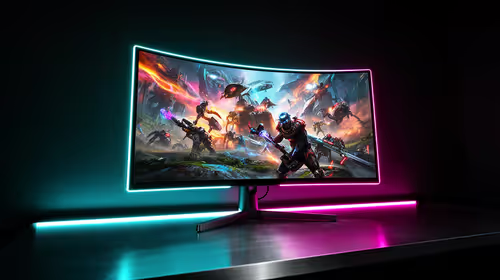
- Thunderbolt 5: Can drive multiple 8K displays or gaming monitors at extreme refresh rates (like 4K at 240Hz). That's a level of performance that future-proofs your setup for years and is a key feature to look for in the latest Intel Core Ultra 7 laptops.
Cable Check! 🔧
Your port is only as good as your cable. To get full Thunderbolt speeds, you need a certified Thunderbolt cable, often marked with a lightning bolt symbol. Using a standard, cheap USB-C charging cable will severely limit your data transfer speeds, even if your laptop has the best port in the world. Always use the right tool for the job!
So, Which Port is Best For Your Laptop?
The answer depends entirely on you. The Thunderbolt 5 vs USB-C debate isn't about one being "bad," but about matching the tool to the task.
- For the Everyday User: If you're browsing, streaming, and using standard peripherals, a laptop with good USB-C 3.2 ports is perfectly adequate and cost-effective.
- For the Hardcore Gamer: Thunderbolt is non-negotiable. The ability to connect an eGPU for a massive performance boost, or hook up to a high-refresh-rate 4K monitor with a single cable, is essential.
- For the Creative Professional: Video editors, 3D artists, and producers need Thunderbolt's massive bandwidth for transferring huge files from external SSDs in seconds, not minutes. When your workflow depends on speed, only the best will do, making it a key feature on flagship devices like new Intel Core Ultra 9 laptops.
Ultimately, while a standard USB-C port gets the job done, a Thunderbolt port opens up a new world of performance, expansion, and convenience. ✨
Ready to Harness the Power?
Choosing the right port future-proofs your investment. For maximum performance and versatility in South Africa, a Thunderbolt-equipped laptop is the clear winner. Explore our massive range of Intel laptop specials and find the perfect machine to conquer your world.