



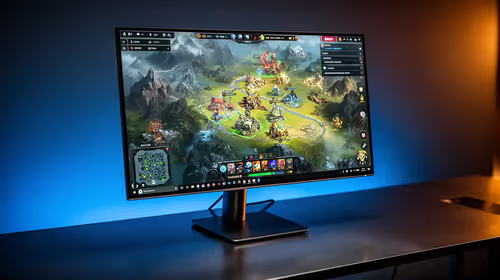
IPS vs VA for Strategy and Sim Games in SA
IPS vs VA for strategy and sim games should be judged by fit, not a single winner. Compare compatibility, latency, capacity, upgrade path, cost planning, and South African setup needs.
Read moreEver wondered what is NAT and why it matters for your home internet in South Africa? 🤔 This guide breaks down Network Address Translation, explaining how it works, its impact on your online gaming and security, and how to manage it for a smoother connection. 🚀

Ever been booted from a game lobby for no reason? Or stared at that dreaded "Strict NAT Type" error on your console, wondering what it even means? If you're a gamer in South Africa, you've likely battled connection issues that a simple speed test can't explain. The culprit is often a misunderstood little piece of network magic called NAT, and learning how it affects your SA home network is the key to a smoother online experience.
NAT, or Network Address Translation, is essentially the super-smart receptionist for your home network. Imagine your house is an office building. The single address the post office knows is your public IP address, given to you by your ISP. Inside, you have multiple "desks"—your PC, console, phone, and smart TV—each with its own private internal address (like 192.168.1.10).
NAT’s job is to take all the outgoing traffic from your devices, stamp it with the single public address, and send it out to the internet. When traffic comes back, it knows exactly which device requested it. This system is crucial because it allows many devices to share one IP address, a clever solution to the shortage of available IPv4 addresses. This entire process is managed by your router, making the quality of that device vital for a stable connection. A powerful unit can handle these translations much more efficiently, which is why choosing from a solid range of wireless routers is the first step to a better network.
For everyday browsing, NAT works flawlessly in the background. But for gaming, it's a different story. The way your router handles NAT determines your "NAT Type," which directly impacts your ability to connect with other players. 🎮
Here’s a quick breakdown:
In South Africa, where we already contend with higher latency to international servers, a Strict NAT type pours salt in the wound. It adds another layer of complication that can make online gaming feel impossible. Sometimes, the problem isn't just the router's settings but also the signal strength to your console or PC; if you're far away, consider using wireless range extenders to ensure a strong, stable link.
So, what can you do to fix a restrictive NAT type? Thankfully, you have a few options. The first step is to check your current status, which you can usually find in the network settings of your PlayStation, Xbox, or within the game itself on PC. If it’s Moderate or Strict, it’s time to get your hands dirty. 🔧
Start by logging into your router's admin panel (usually by typing 192.168.1.1 or 192.168.0.1 into your browser). Look for a setting called UPnP (Universal Plug and Play) and make sure it’s enabled. UPnP allows your console or PC to automatically request the ports it needs, often solving NAT issues without any manual configuration.
If UPnP doesn’t work, the next step is Port Forwarding. This is a more manual process where you tell your router to send specific gaming-related traffic directly to your gaming device. You’ll need to find the specific ports for your game (a quick Google search will help) and assign them to your device's IP address. For PC gamers, the quality of your network interface card also matters. Upgrading to one of the latest wireless adapters can provide a more stable foundation for these settings to work correctly.
For port forwarding to work reliably, you should assign a static IP address to your console or PC. In your router's DHCP settings, you can usually reserve an IP address for your device's MAC address. This ensures its internal IP never changes, so your port forwarding rules will always apply to the correct machine.
Fixing your NAT type is a huge step, but it's just one part of creating a truly optimised gaming setup. Think of your home network as a chain; it's only as strong as its weakest link. A fast fibre line is great, but it won't matter if your internal network is slow, unstable, or poorly configured. ✨
To truly banish lag, you need to look at the whole picture. This means having a modern router that can handle multiple devices, ensuring strong Wi-Fi coverage throughout your home, and using high-quality network hardware in your PC. Investing in your home network is one of the best upgrades a gamer can make, delivering tangible improvements not just in gaming but in streaming, downloading, and everyday browsing too. If you're ready to overhaul your setup, exploring a complete range of wireless networking gear is the perfect place to start.
Ready to Optimise Your Connection? Understanding what NAT is and how it affects your SA home network is the first step. The next is ensuring your hardware can keep up. Don't let a weak signal or an old router be the reason you lose the match. Explore our massive range of PC components and build the ultimate home network today.
The main purpose of NAT (Network Address Translation) is to conserve IPv4 addresses by allowing multiple devices on a private network to share a single public IP address.
Yes, NAT provides a basic level of security by acting as a firewall. It hides your private IP addresses from the public internet, preventing direct unsolicited connections.
To improve your NAT type for gaming, you can enable UPnP on your router, set up port forwarding for your console, or place your console in the router's DMZ settings.
NAT translates private IPs to one public IP for outbound traffic. Port forwarding is a rule you create on your router to direct specific incoming traffic to a device on your network.
A Double NAT issue occurs when you have two routers on your network both performing NAT. This often happens when you add your own router behind the one provided by your ISP.
CGNAT (Carrier-Grade NAT) is used by ISPs to share one public IP among many customers. In South Africa, this can make hosting servers or getting an Open NAT type difficult.
IPS vs VA for strategy and sim games should be judged by fit, not a single winner. Compare compatibility, latency, capacity, upgrade path, cost planning, and South African setup needs.
Read more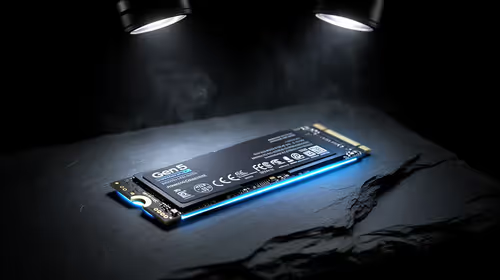
Gen 5 NVMe SSD guide for Bloemfontein gamers should be shortlisted around the job it must do. South African buyers should compare capacity, speed, thermals, and motherboard support, warranty path, and upgrade room before treating any pick as best.
Read more
Skip the RTX 5070 if your first-time builder budget needs better balance. Better SA picks can free room for the right CPU, PSU, case, monitor, storage, and cooling while still giving a strong first gaming PC experience this year in South Africa.
Read more
RTX 5080: weighing the pros and cons for SA should be shortlisted around the job it must do. South African buyers should compare GPU tier, VRAM, cooling, and PSU headroom, warranty path, and upgrade room before treating any pick as best.
Read more
Core i5-13400F gives South African PC builders a capable mid-range CPU choice with clear limits. Check its gaming fit, discrete GPU requirement, LGA1700 platform costs, and upgrade path before locking in your parts list.
Read more
Pros and cons of the Wi-Fi 7 routers for SA should be shortlisted around the job it must do. South African buyers should compare WiFi standard, coverage, latency, and device support, warranty path, and upgrade room before treating any pick as best.
Read more
Steam content servers unreachable needs a download-path check, not an immediate reinstall of every game. Restart the client, inspect download settings and compare another connection when practical. Clearing the download cache is separate from deleting installed games.

Keychron G6 HE has built-in and swappable battery versions with different weights. The product brief lists 42g and 46g respectively, each with a 3g tolerance. Choose by grip and battery preference before treating one headline weight as universal.

Corsair HS80 v2 MAX supports 2.4GHz wireless and Bluetooth. Its maximum battery figures use RGB-off conditions and differ by connection. Check microphone routing, comfort and the exact device support before assuming every wireless mode behaves alike.

Windows taskbar notification badges can be shown or hidden in Taskbar behaviours. This changes the small app indicators, not the underlying messages. Choose a calmer desktop while keeping a deliberate routine for checking important conversations and app updates.
Windows taskbar notification badges can be shown or hidden in Taskbar behaviours. This changes the small app indicators, not the underlying messages. Choose a calmer desktop while keeping a deliberate routine for checking important conversations and app updates.
Windows USB device in use can mean a program still has the drive open. Finish transfers and close files before retrying ejection. Better performance caching requires safe removal; a replacement drive is not the first fix for an open-file warning.

Windows Nearby Sharing not working starts with feature, Bluetooth and visibility checks on both PCs. My devices only depends on matching Microsoft accounts. Test a small harmless file before buying networking hardware or changing your home router.
Windows hardware reserved RAM is different from memory used by applications. Compare installed memory with firmware detection and the usable amount before buying modules. Reservations and reporting limits vary by system; no universal setting restores every byte.

Windows title bar window shake can minimise other open windows when you shake the active window by its title bar. Inspect the Multitasking setting and switch it off if that gesture interrupts your work. The preference costs R0 and does not require new hardware.

Windows Print Screen opens Snipping Tool when its keyboard preference is enabled. Change the option under Accessibility, Keyboard to choose another workflow. Test whether you need a clipboard image or a saved file.

Windows desktop icons missing may be a visibility setting. Right-click the desktop, choose View and inspect Show desktop icons. If only system icons are absent, use Desktop icon settings. Check the Desktop folder before assuming files were deleted.

Windows set time zone automatically greyed out calls for a location and device-policy check. Automatic time-zone selection relies on location services. A manual time-zone choice is separate from synchronising the clock; check both before replacing hardware.