Is your fibre connection feeling sluggish during a crucial Apex Legends match? Before you blame your ISP, look closer to home. Your neighbour might just be “borrowing” your bandwidth to stream Netflix in 4K. An unsecured or poorly secured WiFi network is an open invitation for trouble. This simple guide to WiFi encryption standards in South Africa will help you lock down your network, protect your data, and keep your pings low. 🔒
What Are WiFi Encryption Standards Anyway?
Think of WiFi encryption as the digital lock on your home’s internet connection. It scrambles the data flying between your router and your devices (like your PC, phone, or console) so that only authorised users with the password can understand it.
Without it, anyone nearby could potentially see what you’re doing online or, worse, use your connection for free. Strong encryption is your first line of defence against lag-inducing bandwidth thieves and data snoops. It’s a fundamental part of keeping your digital life private and secure.
The Evolution of WiFi Security: From Weak to Warrior
Wireless security has come a long way. Understanding the different types helps you see why choosing the right one is so important for a modern home network.
WEP (Wired Equivalent Privacy): The Old & Busted
This was the original standard, and it’s now completely obsolete. WEP is incredibly easy to crack, often in minutes, with freely available software. If your router is still using WEP, you essentially have no security. It’s a relic from a different era of the internet, and no device should be using it today.
WPA & WPA2: The Long-time Champions
WPA (Wi-Fi Protected Access) was a quick fix to replace WEP, but it was soon followed by its much stronger successor, WPA2. For over a decade, WPA2 has been the gold standard for home networks, using powerful AES encryption. It’s still a solid choice for most South African homes.
However, WPA2 isn't perfect and has known vulnerabilities. To make the most of it, your devices need to be up to scratch. Ensuring you have modern wireless adapters in your PCs can help maintain a stable and secure connection.
WPA3: The New Standard for Security in South Africa 🛡️
WPA3 is the latest and greatest in wireless security. It offers several key advantages over WPA2, making it the clear choice for anyone buying new gear. It provides more robust protection against password-guessing (brute-force) attacks and offers stronger, individualised data encryption, even on open public networks.
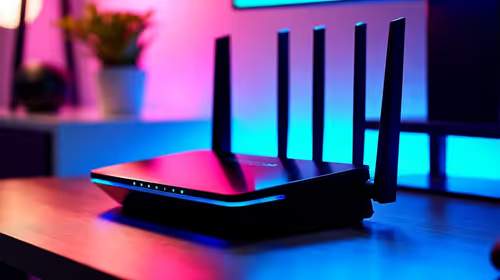
To benefit from this superior protection, your hardware needs to support it. The best way to future-proof your home network is by investing in one of the latest wireless routers that comes with WPA3 enabled out of the box.
How to Check and Optimise Your WiFi Encryption
So, how do you know which standard you're using? You’ll need to log in to your router’s administration panel.
Typically, you do this by typing an IP address like 192.168.1.1 or 192.168.0.1 into your web browser. The login details are often on a sticker on the router itself. Once you’re in, look for a section called “Wireless,” “Security,” or “WLAN.” There, you should see an option for the security mode or encryption type.
Quick Router Check ⚡
On the router's wireless security page, you'll see a dropdown menu. If you see WPA3 as an option, select it! If the best you have is WPA2-AES (also called WPA2-PSK), choose that and make sure you are using a very strong, unique password. If you only see WEP or the original WPA, your router is dangerously outdated and needs an urgent replacement.
If you have a large home, ensuring your security extends everywhere is crucial. Modern wireless range extenders can broaden your coverage while maintaining the high encryption standard set by your main router.
Why Modern WiFi Security Matters for Gamers 🚀
For gamers, a secure network is a fast network. When your WiFi is properly locked down with WPA3, you prevent unauthorised devices from hopping onto your network and stealing precious bandwidth. This means a more stable connection, lower latency, and fewer of those infuriating lag spikes during a final boss fight.
Beyond gaming, strong encryption protects your personal information, from banking details to private messages. Upgrading your setup is not just about speed; it's about peace of mind. Taking a holistic look at your wireless networking components ensures every part of your system is secure and performing at its best.
Ready to Lock Down Your Network?
The world of WiFi encryption standards in South Africa can seem complex, but upgrading your gear is simple. For a faster, safer online experience, a modern router is your first line of defence. Explore our range of high-speed wireless routers and keep your connection secure.