Quick Answer
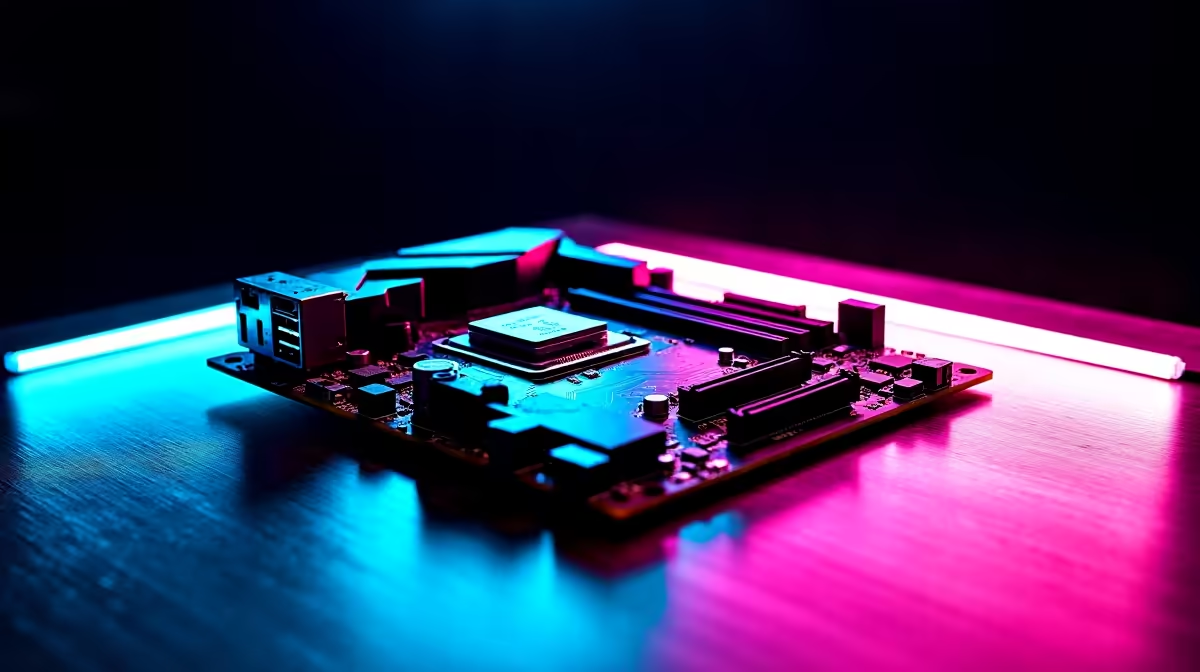
The best gaming motherboards between R5,000 and R8,000 in South Africa in 2026 are mid-to-high-end ATX and mATX boards from ASUS, MSI, and Gigabyte that support DDR5 memory, PCIe 5.0, and the latest Intel and AMD platforms.
What to Expect at the R5,000 to R8,000 Motherboard Price Point
The R5,000 to R8,000 motherboard bracket in South Africa is where gaming builds start getting serious. At this price, you move beyond entry-level chipsets into boards that offer robust VRM (Voltage Regulator Module) designs capable of handling overclocked processors, multiple M.2 NVMe slots, high-speed USB connectivity, and enhanced audio solutions. These boards are built for sustained gaming sessions and are future-proofed for component upgrades over the next several years.
For AMD builds, this price range puts you firmly into the X670 and X870 chipset territory. These boards support AMD Ryzen 7000 and Ryzen 9000 series processors, offer PCIe 5.0 lanes for next-generation GPUs and NVMe drives, and support DDR5 memory. The extra spend compared to B650 boards typically buys you better power delivery, more M.2 slots, better connectivity including USB4, and improved thermal management. For a build anchored by a Ryzen 7 or Ryzen 9 processor with an RTX 4070 or higher GPU, stepping up to this board tier makes sense.
For Intel builds, Z790 boards feature strongly in this bracket. Z790 provides full overclocking support for Intel's 13th and 14th generation processors and offers comprehensive PCIe 5.0 support. Intel's platform also benefits from Thunderbolt 4 connectivity on many boards in this range, which is useful for content creators and professionals who work with high-speed external storage or displays. With Intel's 15th generation Arrow Lake processors gaining traction in 2026, Z890 boards have also entered this price range and offer forward compatibility.
Top Boards to Consider in South Africa in 2026
The ASUS ROG Strix B650E-F Gaming WiFi has been a strong performer in this bracket, offering the extended feature set of the B650E chipset - which includes PCIe 5.0 for both the GPU slot and at least one M.2 slot - at a price that dips into the lower end of this range when stock conditions are favourable. It features a robust 16+2 power stage design, a 2.5G LAN port, Wi-Fi 6E, and three M.2 slots. For a Ryzen 7 9700X or Ryzen 9 9900X build, this board provides excellent headroom.
MSI's MAG X670E Tomahawk WiFi is another board that regularly appears in this price range and is popular among SA builders for its accessible BIOS, solid overclocking performance, and competitive feature set. MSI's EZ M.2 clips and the clean layout make it a builder-friendly option that does not compromise on performance. The board ships with a good set of fan headers and temperature sensors, making it capable for water-cooled builds as well.
Gigabyte's Aorus Elite boards in the X670 and X870 families also land in this bracket and offer Gigabyte's DualBIOS feature, which provides a backup BIOS that can recover from a failed update - a genuinely useful safety net for PC builders who enjoy pushing firmware updates.
For Intel, the MSI MAG Z790 Tomahawk WiFi and the ASUS TUF Gaming Z790-Plus WiFi D4 both compete in this range. The TUF Z790-Plus D4 is particularly notable because it supports DDR4 memory, allowing builders to reuse existing RAM kits and allocate more budget to the CPU and GPU. This flexibility is a meaningful cost advantage for South African builds where the rand-to-dollar exchange rate affects component pricing.
Key Features to Prioritise When Buying
When evaluating motherboards in the R5,000 to R8,000 range for gaming, VRM quality should be at the top of your checklist. A board with 12 or more high-quality power stages and solid heatsink coverage will keep your processor stable under sustained gaming loads, especially during South African summers when ambient temperatures inside a case can climb significantly. Thermal throttling from an inadequate VRM undermines everything else in the build.
M.2 slot count matters more in 2026 than it did a few years ago. Operating system drives, game storage, and capture or scratch drives all benefit from NVMe speeds, and a board with three or four M.2 slots gives you room to grow without adding a PCIe expansion card. Confirm whether these slots share bandwidth with SATA ports before buying, as this can limit your storage configuration.
Wi-Fi is standard at this price point, but verify the generation. Wi-Fi 6E is the current benchmark, offering access to the 6GHz band for cleaner wireless gaming in environments with many competing networks - particularly relevant in dense urban areas like Johannesburg and Cape Town. Some boards at the lower end of this bracket still include Wi-Fi 5, which is a noticeable downgrade.
BIOS quality and update frequency from the manufacturer is an underrated consideration. ASUS, MSI, and Gigabyte all have active BIOS support for their flagship boards, and regular updates can improve memory compatibility, CPU performance, and system stability well into a board's lifecycle. Checking community forums for a specific board model before purchasing can reveal common issues or excellent community support that tips the scale.
Frequently Asked Questions
Q: Is it worth spending R7,000 on a motherboard for a mid-range GPU like the RTX 4060?
A: For an RTX 4060 build, spending R7,000 on a motherboard is generally not justified. A B650 or B760 board in the R2,500 to R4,000 range provides everything you need. Reserve the R5,000 to R8,000 board budget for builds centred on RTX 4070 or higher GPUs and overclockable CPUs.
Q: Does a more expensive motherboard improve gaming FPS directly?
A: Not directly. FPS is primarily determined by the GPU and CPU. However, a better motherboard enables overclocking that extracts more performance from a capable CPU, improves memory stability for higher speeds, and reduces bottlenecks through better PCIe bandwidth - all of which contribute to smoother, more consistent frame delivery.
Q: Are Z790 boards still worth buying in 2026, or should I wait for Z890?
A: Z790 boards are still excellent platforms for Intel 13th and 14th gen CPUs and can often run Arrow Lake with a BIOS update. If you're building around a 13th or 14th gen CPU, Z790 boards at discounted prices in 2026 represent strong value. If you're committed to Arrow Lake or newer Intel processors, Z890 is the correct platform.
Q: Can I use a R6,000 motherboard with only 16GB of RAM to start?
A: Absolutely. Many builders start with 16GB and upgrade to 32GB or 64GB later. High-end motherboards often have four DIMM slots precisely for this reason. Just ensure you install your initial two sticks in the correct dual-channel slots as specified in your board manual.
Also at Evetech: All Motherboards | Graphics Card Deals
Ready to Find Your Perfect Match? Shop at Evetech