Quick Answer
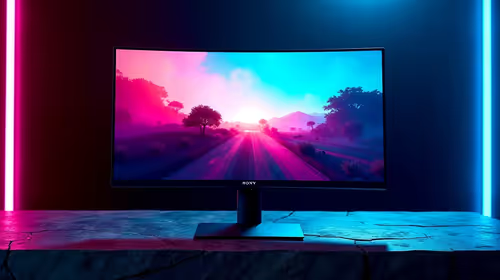
The best monitor setup for FPS gaming in South Africa combines a high-refresh-rate display, the right panel technology for fast response, and a GPU that can feed it consistent frame rates. For most SA gamers in 2026, a 27-inch 1440p 165Hz IPS monitor with G-Sync Compatible or FreeSync Premium Pro is the optimal choice for FPS titles.
Why Refresh Rate Is the Most Important FPS Monitor Specification
In a first-person shooter, the number that matters most is not resolution or HDR support. It is refresh rate. Higher refresh rates mean the image on screen updates more frequently per second, which reduces the time between when you move your mouse and when you see the result reflected on screen. This is perceived as snappiness and responsiveness, and it directly affects competitive performance. For SA gamers:
- 60Hz: The floor. Playable but clearly inferior in any competitive context. - 144Hz: The standard for competitive play. Motion is smooth, enemies are trackable, and the jump from 60Hz is immediately obvious. - 165Hz: Common among 1440p IPS panels and offers a modest improvement over 144Hz without a significant price premium. - 240Hz: The competitive tier. At this refresh rate, the image updates so frequently that fast tracking and flick shots benefit from the additional visual feedback. - 360Hz: Reserved for professional esports setups. The difference from 240Hz is small enough that most players cannot perceive it without direct comparison. For FPS gaming specifically, the jump from 60Hz to 144Hz is massive. The jump from 144Hz to 240Hz is meaningful but smaller. The jump from 240Hz to 360Hz is marginal for most players. ## Resolution and Response Time: Balancing Visuals with Performance
Resolution and response time are the two remaining variables after you have decided on refresh rate. Resolution options for FPS in SA:
1080p at 1920x1080 remains popular for competitive players because it is easier to push to very high frame rates even with mid-range GPUs. At 27 inches the pixel density starts looking soft up close, but at 24 inches 1080p is sharp enough for fast-paced gaming. 1440p at 2560x1440 is the recommendation for 2026. It looks significantly sharper than 1080p at 27 inches, allowing you to spot enemies at distance more reliably. The performance cost is real but manageable on current mid-range hardware like the RTX 4070 or RX 7700 XT. Response time for FPS monitors: Gray-to-gray response time should be 1ms or listed as 1ms (MPRT). Most modern IPS gaming panels achieve 1ms grey-to-grey with overdrive enabled. VA panels achieve similar numbers on paper but often show more motion smear in fast transitions, which appears as ghosting behind fast-moving objects. For pure FPS gaming where pixel transitions happen constantly, IPS remains the preferred technology. ## Panel Size and Ergonomics for Competitive Play
Size affects more than aesthetics. For FPS gaming, the size determines how much head and eye movement is required to survey the full field of view, which has a measurable impact on performance. 24 inches at 1080p: The esports standard. Compact, requires minimal eye movement, and can run at very high frame rates on modest hardware. 27 inches at 1440p: The balanced all-rounder for SA gamers in 2026. The resolution is sharp enough to see distant targets clearly, and the size is comfortable without requiring excessive head movement in FPS titles. 32 inches at 1440p or 4K: Better suited to single-player immersive games than competitive FPS. At this size, looking across the field of view in a shooter requires noticeable head movement, which some players find disorienting under pressure. Desk depth matters too. Monitors this size should be placed at arm's length, roughly 60 to 70cm from your eyes for 27-inch panels. If your SA student desk is shallow, a 24-inch panel may actually suit your setup better ergonomically. For SA student accommodation in res or digs with shared desk space, the 24-inch 1080p 144Hz monitor remains a practical choice that does not dominate the entire desk surface. ## Adaptive Sync, Input Lag, and Additional Features for FPS
Beyond the main specs, a few additional features determine how polished the FPS experience feels:
Adaptive Sync: FreeSync Premium Pro for AMD GPU users, G-Sync Compatible for NVIDIA GPU users. These technologies synchronise the monitor's refresh rate to the GPU's output, eliminating screen tearing and reducing stutter without the fixed frame rate required by V-Sync. For FPS gaming where frame rates can fluctuate between 80 and 200 FPS across different scenes, Adaptive Sync is essential. Input lag: Separate from response time, input lag is the delay introduced by the monitor's internal processing between receiving a signal and displaying it. Gaming monitors operate in low-latency modes that reduce this to under 1ms of processing delay. Enable Gaming Mode or Low Input Lag mode in your monitor's OSD menu to ensure this is active. Crosshair overlay: Many gaming monitors include a built-in crosshair overlay that displays a small reticle on screen even in games that do not display one in certain modes. Useful for titles where custom crosshairs give a competitive edge. Black equalizer / shadow boost: Brightens dark areas of the image without washing out bright areas, making enemies hiding in shadowed corners more visible. Useful in tactical FPS titles where map lighting creates unfair dark zones. ## Frequently Asked Questions
Is 1440p worth it for competitive FPS gaming in South Africa? Yes, if your GPU can support it. 1440p allows you to see distant enemies more clearly than 1080p, which is a genuine competitive advantage in open-map shooters. In tight corridor FPS titles the benefit is smaller, but the overall sharpness improvement makes the gaming experience better across the board. What GPU do I need for 144Hz at 1440p in FPS games in SA? An RTX 4070 or RX 7700 XT is the minimum recommendation for consistent 144+ FPS at 1440p in most popular FPS titles with high settings. For maximum settings in demanding titles at high FPS, step up to the RTX 4070 Ti Super or RX 7900 XT. Does monitor choice affect FPS performance in South Africa's loadshedding environment? Yes, indirectly. Gaming monitors consume 25 to 40 watts, which adds to UPS draw during loadshedding. A 24-inch 1080p monitor draws less power than a 32-inch panel, making your UPS battery last longer during a power outage gaming session. Should I buy a 240Hz monitor if my GPU can only maintain 144 FPS in most games? Not primarily for the refresh rate benefit. If your average frame rate rarely exceeds 144 FPS, a 240Hz monitor's extra headroom goes mostly unused. A better quality 144Hz panel with superior colour accuracy, brightness, or panel uniformity is a smarter spend than a 240Hz panel at the same price point when your GPU cannot feed it consistently. {
{CALLTOACTION:
Ready to Find Your Perfect Match? Find your ideal FPS gaming monitor at Evetech with options for every budget and refresh rate target. }}