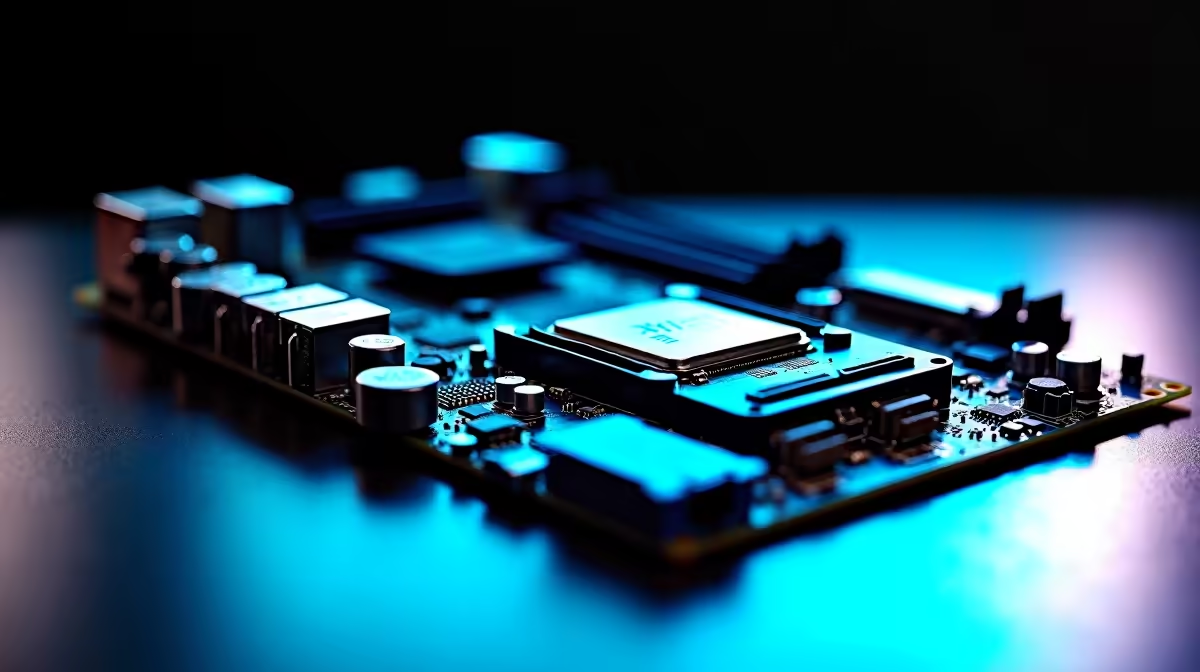
Pairing the right motherboard with AMD's Ryzen 9 10900X is one of the most important decisions in a high-end build - get it wrong and you'll leave significant performance on the table. The 10900X is a powerful 24-thread processor that demands a board with robust power delivery, PCIe 5.0 support, and enough connectivity to justify the premium you're paying.
Quick Answer
What is the best motherboard for the Ryzen 9 10900X? The Ryzen 9 10900X uses the AM5 socket and requires an X870E or X670E motherboard for full feature support, including PCIe 5.0 and DDR5. For most users, a high-quality X670E board hits the best balance of VRM strength, thermal headroom, and expansion options. Budget-focused builders can manage with a B650E, though some features will be locked off.
🔧 Understanding the Ryzen 9 10900X's Platform Requirements
The Ryzen 9 10900X (Granite Ridge) sits on AMD's AM5 platform, which means it only works with DDR5 memory - there is no DDR4 option on this socket. The processor supports PCIe 5.0 lanes natively, both for the primary GPU slot and M.2 NVMe storage, so you want a board that can actually expose those lanes rather than routing them through a hub chip.
AMD's chipset hierarchy for AM5 currently runs X870E at the top, followed by X670E, then B650E, and the non-E variants. The “E” designation means the board provides PCIe 5.0 from the CPU directly to the primary slot - this is worth having if you plan to run a PCIe 5.0 GPU or an ultra-fast Gen 5 SSD.
For a processor in the R9 10900X class, you genuinely need a board with at least a 16+2 power stage configuration with 60A or higher per phase. Skimping here causes thermal throttling under sustained all-core loads, which directly hurts rendering, compilation, and multi-threaded workloads.
📊 Top Motherboard Tiers for the Ryzen 9 10900X
Flagship Tier - X870E (R12,000–R20,000+) X870E boards offer everything the 10900X can use: reinforced 20+ phase VRMs, PCIe 5.0 x16 primary slot, PCIe 5.0 M.2 slots, USB 4 (40Gbps), and comprehensive overclocking tooling. These boards are built for enthusiasts running custom liquid cooling loops, heavy 3D workloads, or content creation pipelines that need maximum I/O.
Mainstream High-End - X670E (R7,500–R12,000) X670E represents the sweet spot for most Ryzen 9 10900X builds. These boards deliver PCIe 5.0 support, strong VRM configurations typically in the 16–18 phase range, and comprehensive connectivity without the extreme pricing of flagship X870E. DDR5 overclocking headroom is excellent, and most boards support speeds beyond DDR5-6000 with EXPO kits.
Value Option - B650E (R4,500–R7,500) A B650E is technically compatible with the 10900X but represents a compromise. VRM quality varies widely across the price range, some boards cap power limits in ways that handicap the processor under sustained load, and USB 4 is generally absent. If you are on a strict budget and need PCIe 5.0, verify the specific board's VRM spec before buying - not all B650E boards handle 170W TDP chips without throttling.
💡 Key Features to Prioritise
VRM Quality: Look for 70A or higher DrMOS phases in a 16+2 or better configuration. Boards from reputable manufacturers publish phase counts and rated amperage - use that data.
Memory Support: The 10900X officially supports DDR5-5600 but scales well beyond that with EXPO memory profiles. Boards with validated QVL (qualified vendor lists) for high-speed DDR5 kits save you troubleshooting time.
Cooling Layout: A 10900X build benefits from boards with heatspreaders on all M.2 slots and substantial VRM heatsinks. Thermal headroom matters more than it did in previous generations due to the increased power density of Zen 5.
Connectivity: At minimum, look for 2.5GbE LAN, USB 3.2 Gen 2x2 (20Gbps) front panel support, and at least two M.2 slots at PCIe 5.0 speeds. WiFi 7 is becoming standard at this tier and is worth having.
BIOS Maturity: AM5 boards received significant BIOS updates through 2024 and 2025. Check that the board you are targeting has a stable, mature UEFI with EXPO support and AGESA updates rolled out. First-gen AM5 BIOS releases had notable memory compatibility issues that have since been patched.
❓ Frequently Asked Questions
Does the Ryzen 9 10900X work with X570 or B550 boards? No. The 10900X uses the AM5 socket, which is physically incompatible with older AM4 boards like X570 and B550. You need an AM5 board - X870E, X670E, B650E, or B650.
Do I need X870E, or is X670E good enough? For the majority of Ryzen 9 10900X builds, X670E is entirely sufficient. X870E adds USB 4 Gen 3 (80Gbps), improved BIOS features, and marginally better VRM configurations at flagship pricing. Unless you have specific USB 4 or extreme overclocking needs, X670E delivers the same PCIe 5.0 platform at lower cost.
What RAM speed should I pair with the Ryzen 9 10900X? AMD's Zen 5 architecture responds well to DDR5-6000 in its primary performance mode (1:1 FCLK). DDR5-6000 CL30 EXPO kits offer the best performance-per-rand ratio. Beyond DDR5-6400 the gains diminish rapidly unless you are overclocking for benchmarks.
Evetech carries AMD Ryzen 9 Processors and All Motherboards — check live stock and pricing before you buy.
Ready to Find Your Perfect Match? Shop at Evetech