

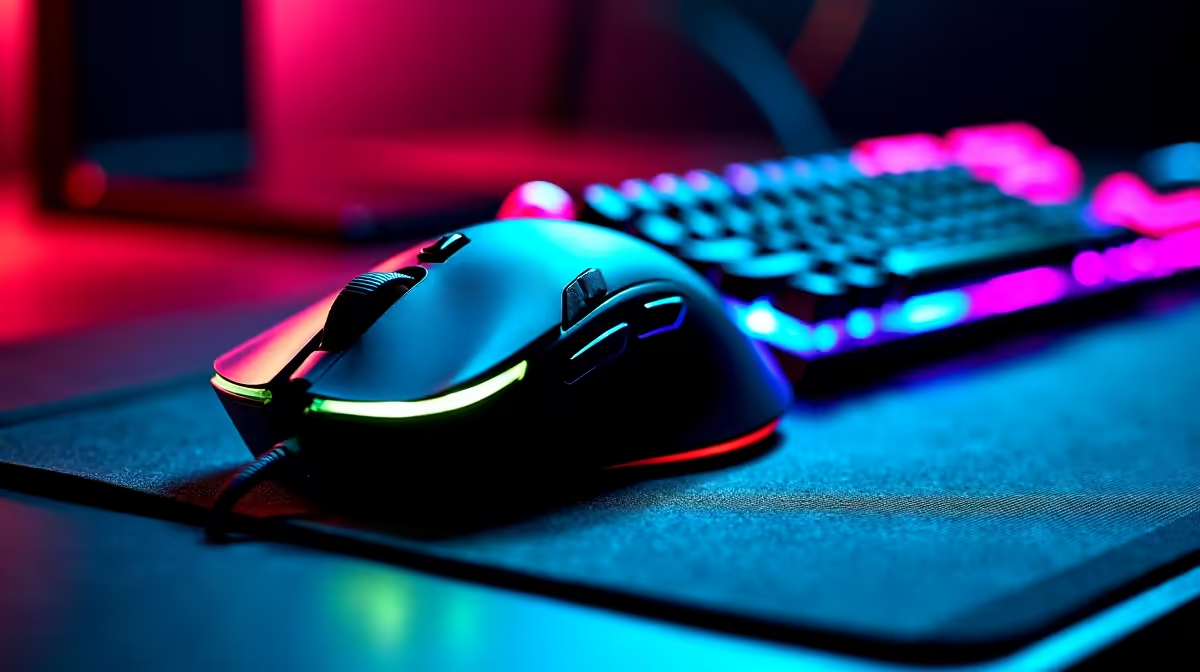
South African esports has matured significantly heading into 2026, with dedicated players competing at regional and international level across titles like CS2, Valorant, League of Legends, and Fortnite. The equipment choices that SA esports athletes make are increasingly informed by professional standards, local availability, and the specific demands of competing in a country where latency to international servers matters.
Quick Answer
What peripherals do SA esports athletes use in 2026? Competitive SA players typically use a lightweight wired mouse (under 70g), a mechanical keyboard with linear switches, a 144Hz or 240Hz monitor, a low-latency headset with a dedicated microphone, and a large desk mat. The emphasis is on consistent, low-input-lag peripherals over RGB aesthetics.
🔧 The Mouse: Speed and Precision
The mouse is the most personal peripheral choice in competitive gaming. SA esports athletes across titles favour lightweight wired mice in the 50–80g range. The reason is simple: lighter mice reduce fatigue over long practice sessions and allow faster wrist micro-adjustments that precision aiming demands.
For FPS titles like CS2 and Valorant, mice with high-accuracy optical sensors (3360, 3395, or equivalent) and at least 800DPI resolution without interpolation are standard. Most competitive SA players use DPI settings between 400 and 1600, with the majority sitting at 800DPI and compensating with in-game sensitivity settings.
Honeycomb shell designs (the grid-cut holes in the mouse body) reduce weight effectively. These have become a mainstream competitive design rather than a niche preference. Their main disadvantage is that they can feel less comfortable against the skin over very long sessions - this is where personal testing matters.
Polling rate increasingly matters at the competitive level. 1000Hz polling rate (1ms report rate) is the standard. Some advanced mice now offer 4000Hz or 8000Hz polling rates, which reduce micro-stuttering in cursor tracking. For most SA players the difference is perceptible only at high sensitivity and high frame rate combinations.
📊 Keyboards for Competitive Play
The SA esports keyboard preference has shifted decisively toward TKL (tenkeyless) and 65% form factors. These eliminate the numpad and right-side cluster to allow the mouse arm a more centred, natural position - particularly important for low-sensitivity players who need large mouse movement range.
Linear switches (Red or Speed variants) dominate in competitive FPS gaming. They actuate without a tactile bump or audible click, which reduces the force needed for rapid multi-keystroke inputs. Tactical and strategy players often prefer tactile switches for clearer keystroke feedback.
Hot-swap keyboards are popular in the SA competitive scene as they allow switch experimentation without additional hardware investment. As local retailers have expanded switch variety, more players are experimenting with lighter linear options (35–40g actuation force) for faster keypresses in titles where reaction time is decisive.
Per-key anti-ghosting and N-key rollover are non-negotiable for competitive play. These allow every key combination - regardless of how many keys are held simultaneously - to register correctly. Any keyboard marketed for gaming in 2026 includes these features, but it is worth verifying on budget options.
💡 Monitor Selection for SA Esports
The monitor is the output device that feeds everything else. In SA competitive gaming, 1080p at 144Hz or 240Hz is the dominant choice, not because players cannot afford 1440p but because the lower resolution allows more consistent high frame rates even on mid-range hardware.
Response time (GTG) should be 1ms or less. IPS panels balance colour accuracy with competitive response times, while TN panels prioritize response time at the cost of viewing angles and colour accuracy. In 2026, most competitive SA players use 1080p IPS 144–240Hz panels as their primary setup.
G-Sync Compatible or FreeSync support eliminates screen tearing without requiring V-Sync, which adds input lag. Even at high frame rates where tearing is minimal, variable refresh rate technology removes the need to choose between perfect image output and input lag.
For online play against international servers, note that SA connections to European and North American servers typically show latency of 150–220ms. This means peripheral input lag becomes more critical - every millisecond saved in the hardware chain between intention and on-screen action compounds with existing network latency. Low-latency peripherals matter more in high-ping environments.
🎧 Audio and Microphone Setup
Headsets for competitive SA gaming serve two roles: positional audio for in-game sound cues and communication with teammates. Open-back headphones provide more natural soundstage for positional audio but leak sound and provide no passive noise isolation - fine for a dedicated setup, less practical for shared spaces.
Closed-back gaming headsets are the standard choice for SA players competing from home. They isolate external noise, present directional audio clearly enough for competitive use, and integrate a microphone. Teams using Discord or in-game voice comms benefit from microphone isolation - cardioid polar patterns that reject background noise keep team comms clean.
For players who stream or content-create alongside competing, a separate boom microphone on a desk arm delivers dramatically better voice quality than any integrated headset microphone. The combined investment in a solid closed-back headset plus a USB microphone serves both competitive and content use cases.
📦 The Complete Peripheral Budget for SA 2026
A full competitive peripheral setup for SA esports in 2026 can be assembled across several price tiers. An entry competitive setup targeting 1080p/144Hz costs approximately R4,000–R6,000 covering mouse, keyboard, monitor, and headset. A mid-tier setup with 240Hz monitor, higher-grade switches, and a better audio solution lands around R8,000–R12,000. A premium setup with a 360Hz monitor, flagship mouse, enthusiast keyboard, and dedicated audio chain can reach R15,000–R20,000+.
For SA university and varsity esports athletes, the mid-tier range represents the best competitive investment. The diminishing returns above 240Hz and premium peripheral prices are meaningful at the international pro level but minimal for regional competition.
❓ Frequently Asked Questions
What DPI should SA esports athletes use? Most competitive players use 400–800DPI and adjust in-game sensitivity to achieve their preferred hand movement distance per 360-degree turn. Lower DPI with higher in-game sensitivity is equivalent to higher DPI with lower sensitivity, but the precision floor is lower with higher DPI sensors in practice.
Is a mechanical keyboard mandatory for competitive gaming? Not mandatory, but widely used among competitive players for consistency and switch longevity. High-quality mechanical keyboards register keypresses at a consistent actuation force throughout the switch's lifespan. Membrane keyboards can develop inconsistencies over time that affect competitive performance.
How important is monitor refresh rate for SA competitive play? Very important. At 60Hz, each frame persists on screen for 16.7ms, creating motion blur and making fast-moving targets harder to track. At 144Hz, each frame lasts 6.9ms, dramatically sharpening motion clarity. At 240Hz, 4.2ms per frame provides the smoothest target tracking available at mainstream price points. The jump from 60Hz to 144Hz is far larger than from 144Hz to 240Hz.
Do wireless peripherals work for competitive gaming in SA? Yes, modern 2.4GHz wireless mice and keyboards have latency equivalent to wired alternatives in controlled environments. The main risk with wireless in competitive play is battery management - a mouse dying mid-match is a serious interruption. Many SA competitive players stick to wired peripherals to eliminate this variable entirely.
Check out Graphics Card Deals and Evetech Best Sellers at Evetech — South Africa's home for gaming gear.
Ready to Find Your Perfect Match? Shop at Evetech











