

Quick Answer
The Ryzen 9 9950X is a 16-core, 32-thread desktop processor designed for demanding professional and creative workloads. For South African students, it is most relevant for postgraduate researchers, engineering students, 3D animation and VFX students, and those running computationally intensive software. It is significantly more powerful - and more expensive - than what most undergraduate students need.
Most student laptop and desktop guides focus on mid-range processors that handle lectures, assignments, and light creative work. The Ryzen 9 9950X is a different conversation entirely. If you''re a South African student whose work involves rendering, simulation, machine learning training, large dataset processing, or professional 3D content creation, the question isn''t whether the 9950X is good - it obviously is - but whether it''s the right tool for your specific academic and financial situation.
What the Ryzen 9 9950X Is Built For
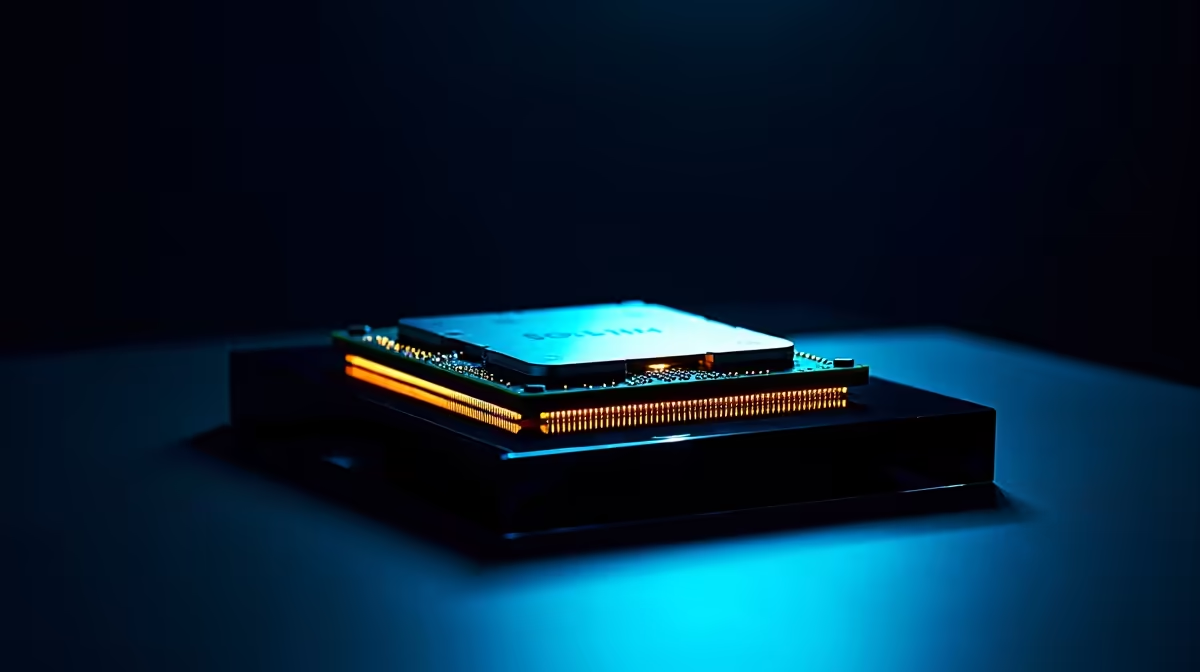
AMD''s Ryzen 9 9950X is the flagship consumer-grade desktop processor in the Zen 5 generation. With 16 cores and 32 threads, a high boost clock, and support for DDR5 memory, it delivers leadership-class performance in heavily threaded workloads: video rendering, 3D scene computation, scientific simulation, software compilation, and AI model training on CPU.
In single-threaded tasks - the kind most common in everyday student use like web browsing, document editing, and standard coursework software - the 9950X is fast, but so are far cheaper processors. The value of the 9950X is unlocked specifically when work can be parallelised across many threads simultaneously. If your software can use 16 cores, you will feel the difference. If it cannot, you will be paying a flagship premium for performance that sits idle.
Relevant Student Use Cases in South Africa
South African universities offer several programmes where the 9950X makes genuine sense. Architecture and industrial design students working in Blender, 3ds Max, or Autodesk software spend significant time waiting for render jobs - cores directly translate to faster turnaround. Engineering and applied sciences students running MATLAB simulations, FEA analysis, or computational fluid dynamics tasks will find more cores enable more complex models in acceptable time.
Postgraduate students and researchers working in bioinformatics, econometrics with large panel datasets, or machine learning research - where local compute is preferable to cloud spending or queue-constrained university cluster access - have a legitimate case for investing in a 9950X workstation that can run jobs overnight efficiently.
For undergraduate students in business, humanities, law, or even most computer science programmes, a Ryzen 5 or Ryzen 7 system delivers more than enough performance for a fraction of the price. Spending money on a 9950X when a Ryzen 5 7600X serves the same workflow is money that could go toward storage, a better display, or simply staying within a budget that doesn''t strain finances.
Building a 9950X System That Makes Sense Financially
The 9950X pairs with the AM5 platform, requiring DDR5 memory and a 600-series or 800-series AMD motherboard. Memory is important: the Zen 5 architecture benefits from fast DDR5 - at minimum DDR5-6000 in a dual-channel configuration. For workstation use, 32 GB is a practical starting point and 64 GB is worth planning for if your workloads involve large datasets held in memory.
Cooling is non-negotiable at this tier. The 9950X has a 170 W TDP and boosts aggressively under multi-core load. A 240 mm AIO liquid cooler is the minimum recommendation; a 360 mm AIO or a high-end air cooler like the Noctua NH-D15 is preferable for sustained workloads. South Africa''s loadshedding context adds another consideration: a quality UPS that can carry your workstation through a 2–2.5 hour loadshedding stage protects both your hardware and your in-progress compute jobs.
Frequently Asked Questions
Q: Is the Ryzen 9 9950X worth it for a student budget in South Africa? A: Only if your specific workload parallelises across many CPU threads and you have the budget to build the full platform correctly. For most students, a Ryzen 5 or Ryzen 7 system is a better financial decision.
Q: Can a Ryzen 9 9950X system handle machine learning training? A: For CPU-based training and inference on smaller models, yes - the 9950X is excellent. For deep learning on large neural networks, a dedicated GPU (ideally an RTX 4090 or professional GPU) accelerates training far more effectively than even a 16-core CPU.
Q: What motherboard is best for the Ryzen 9 9950X? A: The 9950X uses the AM5 socket and is compatible with X670E and B650 series motherboards, as well as the newer X870E and B850 boards. For a student workstation, a mid-range X670 or X870 board with good VRM quality balances cost and long-term platform stability.
Q: How does the Ryzen 9 9950X compare to the Ryzen 7 9700X for students? A: The 9700X has 8 cores and runs at a lower TDP, making it less expensive to buy and cooler to run. In applications that fully utilise 16 cores, the 9950X is substantially faster. In single-threaded and lightly threaded student workloads, the difference is minimal. Most students are better served by the 9700X.
Ready to Find Your Perfect Match? Shop AMD Ryzen processors and systems at Evetech.











