You’re deep in a final-round clutch in Valorant. You need to quickly crank up the brightness to spot that last enemy hiding in a dark corner. You reach under your screen, fumbling with a row of identical, tiny buttons... and accidentally open the colour temperature menu instead. Sound familiar? For years, navigating a monitor’s On-Screen Display (OSD) has been a frustrating experience. But which is truly better in the monitor joystick control vs. wheel debate? Let's find out.
The Classic Conundrum: Buttons and Wheels
For the longest time, a cluster of buttons or a scroll wheel was the standard way to adjust your display. You’d press one button to open the menu, another to navigate up or down, one to select, and another to go back. It’s a system that works, but is it efficient?
The Case for Buttons & Wheels
The main advantage is familiarity. We've used this system for decades on everything from TVs to microwaves. However, they are often slow, require multiple presses for simple tasks, and can be incredibly confusing to use without looking. This is especially true for the sleek, bezel-less designs of modern PC monitors that hide buttons out of sight.
The Downside in the Heat of the Moment
For gamers, speed is everything. Fiddling with a sequence of five buttons to change your input or activate a crosshair overlay is far from ideal. While some high-end displays use a scroll wheel, which is a definite improvement, the real evolution in OSD navigation is the joystick.
Enter the Joystick: A Faster, More Intuitive Way 🕹️
A small, multi-directional nub, usually found on the back or bottom of the monitor, is fast becoming the new standard, especially on premium gaming monitors. Instead of multiple buttons, a single joystick handles everything.
Push it in to open the menu, tilt it up/down/left/right to navigate, and push it in again to select. It’s a simple, fluid motion that mirrors how we use a controller’s thumbstick. This single point of control makes changing settings mid-game a lightning-fast process.
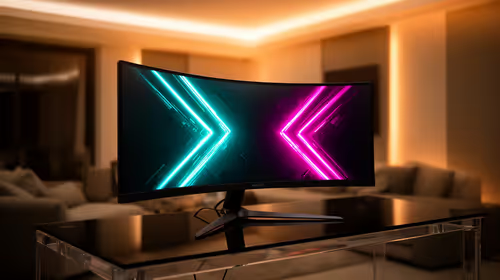
The debate over monitor joystick control vs. wheel often comes down to personal preference, but the speed advantage of the joystick is hard to ignore. You’ll find this intuitive design on many of today's best displays, from immersive curved monitors to pixel-perfect 4K monitors. Even some compact portable monitors are adopting this user-friendly feature.
Pro Tip: Control Your Monitor From Your Desktop 💡
brands like Dell, LG, and MSI offer free software (e.g., Dell Display Manager, OnScreen Control) that lets you adjust all your monitor settings using your mouse and keyboard. It's a fantastic alternative to physical controls, allowing you to create presets, manage inputs, and even set up window layouts without ever touching your monitor. It pairs perfectly with other useful [monitor accessories](https: www.evetech.co.za PC-Components buy-monitor-accessories-368.aspx).
The Verdict: Which Control Scheme Wins?
So, when it comes to monitor joystick control vs. wheel or buttons, which is better for South African gamers?
- For Speed & Gaming: The joystick wins, hands down. Its intuitive, all-in-one design allows for rapid adjustments without taking you out of the game.
- For Simplicity: Again, the joystick. The learning curve is practically zero if you’ve ever held a gamepad.
- For Traditionalists: If you prefer a more deliberate, tactile feel, the classic button or wheel layout might still appeal.
Ultimately, while buttons get the job done, the joystick is a superior, modern solution that respects your time and reduces frustration. When you're browsing the best PC monitor deals, keep an eye out for that little nub—it’s a small feature that makes a massive difference in daily use. ✨
Ready to Find Your Perfect Match? The debate over controls is just one piece of the puzzle. The right monitor can elevate your entire gaming experience. Explore our massive range of gaming monitors and find the perfect screen to conquer your world.