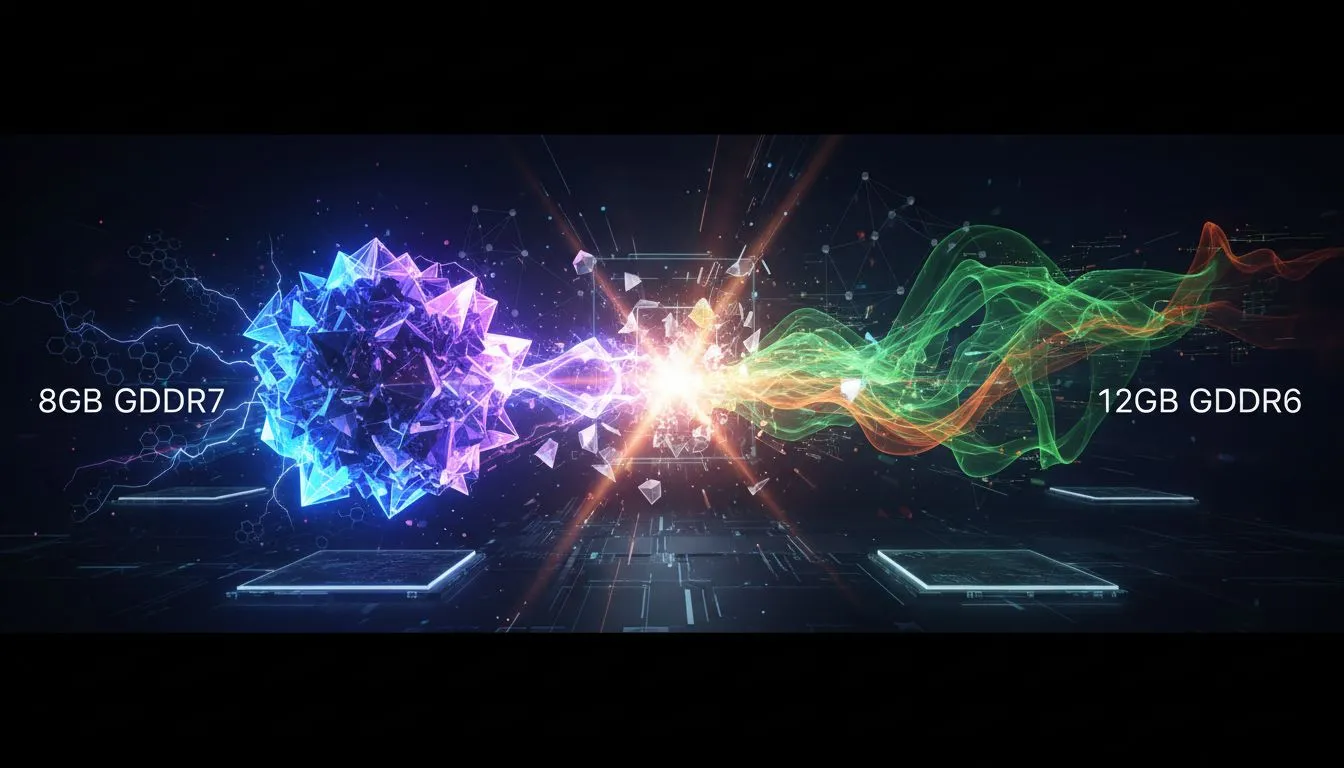
Shopping for a new graphics card in Mzansi? It's a minefield of specs. You see two options: one with 8GB of brand-new, lightning-fast GDDR7, and another with a beefy 12GB of trusted GDDR6. More is usually better, right? Not always. The debate of 8GB GDDR7 vs 12GB GDDR6 is about more than just numbers... it's about raw speed versus sheer capacity. Let's break down which memory truly performs better for your gaming rig.
GDDR7 Speed vs. GDDR6 Capacity: The Core Difference
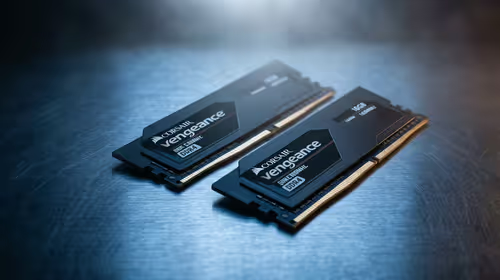
Before we dive deep, let's clarify what we're talking about. VRAM (Video RAM), like GDDR6 or GDDR7, is your graphics card's dedicated high-speed memory. It stores textures, shaders, and other crucial game data for instant access. Think of it as your GPU's personal workspace.
- GDDR6: This is the current, battle-tested standard found in most of the latest graphics cards. It's reliable, mature, and available in larger capacities (like 12GB or 16GB) at reasonable prices. It’s like a wide, multi-lane highway... dependable and gets the job done well.
- GDDR7: This is the new challenger. Its primary advantage is a massive increase in bandwidth and efficiency. This means it can move data in and out of the GPU's core much, much faster. It's the bullet train to GDDR6's express bus. 🚀
The central question in the 8GB GDDR7 vs 12GB GDDR6 comparison is this: is it better to have a smaller, faster workspace or a larger, slightly slower one?
When 8GB of GDDR7 Outperforms 12GB of GDDR6
Faster isn't just a number on a spec sheet; it translates to real-world performance in specific scenarios. An 8GB GDDR7 card will likely pull ahead when the GPU needs to process frames as quickly as possible, rather than storing massive amounts of texture data.
High Refresh-Rate Gaming ⚡
Playing competitive titles like Valorant or Apex Legends at 1080p or 1440p? Here, frame rates are king. At these resolutions, textures aren't overwhelmingly large, so 8GB is often plenty. The superior bandwidth of GDDR7 allows the GPU to feed frames to your high-refresh-rate monitor faster, giving you a smoother, more responsive experience. Many of NVIDIA's GeForce graphics cards are built precisely for this kind of high-speed gaming.
Advanced Features like Ray Tracing
Modern features like Ray Tracing and AI-driven upscaling (think DLSS or FSR) are computationally intensive. They require rapid data processing, where GDDR7's lower latency and higher speeds provide a tangible benefit, resulting in more stable performance when these eye-candy settings are enabled.
The Case for 12GB of GDDR6: When Capacity is King
Sometimes, there's just no replacement for displacement. A larger VRAM pool is essential when you're dealing with massive amounts of data, which is increasingly common in modern AAA games.
Check Your VRAM Usage 🔧
Most modern games have a graphics settings menu that shows estimated VRAM usage. Before you buy, check your favourite games. If you're consistently pushing past 8GB on your desired settings, a higher capacity card might be the smarter long-term buy. Tools like MSI Afterburner also provide real-time monitoring.
4K Gaming and Ultra Textures
This is where 12GB of GDDR6 truly shines. 4K resolutions have four times the pixels of 1080p, and "Ultra" texture packs are huge. If your game's assets exceed your card's 8GB of VRAM, the system has to fetch data from your much slower system RAM, causing horrible stuttering and performance drops. That extra 4GB on a 12GB card acts as a vital buffer, keeping your experience smooth. Both NVIDIA and the latest Radeon graphics cards offer excellent high-capacity options.
Future-Proofing Your Rig ✨
Game developers are targeting higher VRAM capacities. A game that runs fine on 8GB today might demand 10GB or more in a year. Opting for a 12GB card gives you more headroom for future titles, ensuring your investment lasts longer before you need to turn down those texture settings.
The Verdict: Which One Should You Buy?
So, 8GB GDDR7 vs 12GB GDDR6... which is the winner? The honest answer is: it depends entirely on you.
- Choose 8GB GDDR7 if: You're a competitive gamer playing at 1080p or 1440p, you prioritise maximum frame rates, and you want the absolute latest memory technology.
- Choose 12GB GDDR6 if: You're a 4K gamer, you love cranking every graphical setting to its maximum, or you want a card with a bit more longevity for upcoming AAA titles.
Ultimately, your monitor's resolution and the types of games you play should guide your decision. By looking at the specs and considering your own needs, you can find incredible value in top-tier options from brands like MSI, whether you prioritise speed or capacity.