

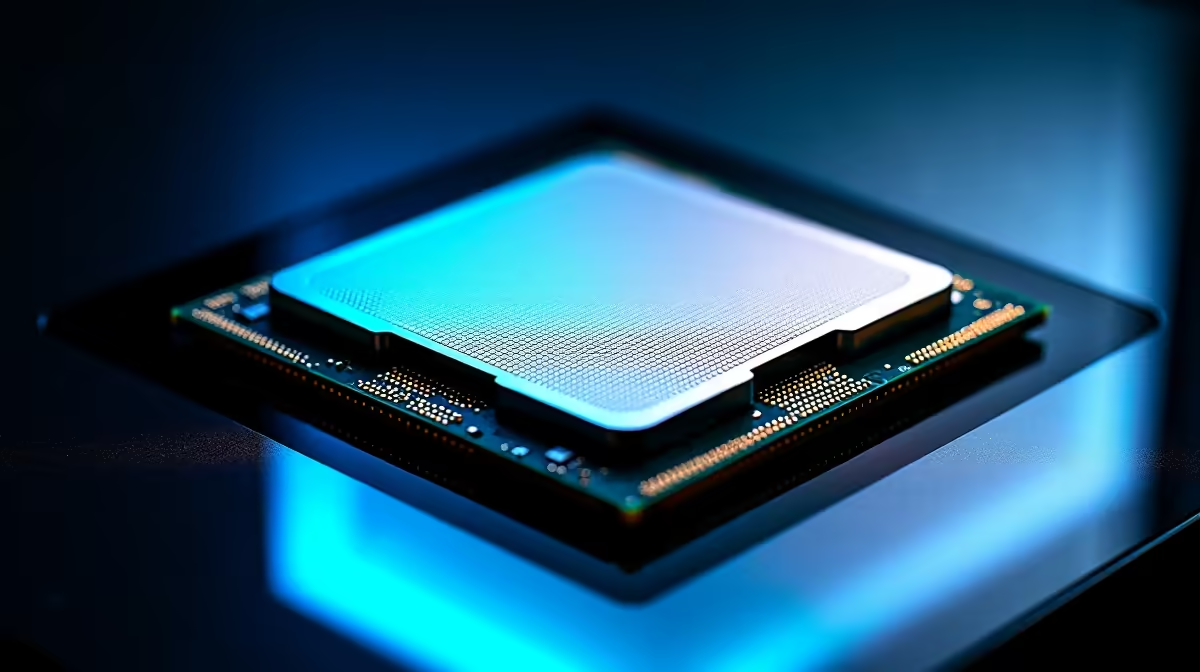
Apple Silicon and x86 are fundamentally different processor architectures, and understanding why explains a lot about Mac performance, software compatibility, and why Apple made the switch. The core difference is not just branding - it is about how instructions are processed at the hardware level. Here is a clear, technical explanation of what makes Mac processors genuinely different.
Quick Answer
Apple Silicon vs x86 - Why Mac Processors Are Different: Apple Silicon uses the ARM instruction set architecture (ISA), which processes simpler instructions more efficiently using less power. x86, used by Intel and AMD, uses a more complex instruction set (CISC) designed historically for raw compatibility and performance. Apple’s shift to ARM-based Silicon gave Macs dramatically better power efficiency and integrated chip design benefits, at the cost of some software compatibility.
🔧 What is x86 Architecture?
x86 is the instruction set architecture originally developed by Intel in 1978 and later licensed to AMD. It is a CISC (Complex Instruction Set Computing) architecture, meaning it can execute complex, multi-step operations in a single instruction.
The strength of x86 is its decades of software compatibility. Every major Windows application, legacy enterprise tool, and game engine is compiled for x86. Intel and AMD have iterated on x86 for 45+ years, adding extensions like SSE, AVX, and AVX-512 for specific workloads.
The weakness is efficiency. Complex instructions require more transistors, more power, and more heat to execute. Modern x86 chips are enormously capable but require active cooling and draw significant power - hence the cooling requirements you see in any gaming PC build.
📊 What is Apple Silicon?
Apple Silicon refers to Apple’s in-house chips (M1, M2, M3, M4 series) based on the ARM (Advanced RISC Machine) instruction set. RISC means Reduced Instruction Set Computing - simpler instructions that execute faster and more efficiently per clock cycle.
Apple’s key advantage is vertical integration. They design both the chip and the operating system (macOS), which allows them to optimise at every level. The result is an SoC (System on Chip) design where the CPU, GPU, Neural Engine, memory controller, and media engines all share the same die and unified memory pool.
Unified Memory Architecture (UMA) is particularly significant. On a Mac with Apple Silicon, the CPU and GPU share the same physical RAM. There is no discrete GPU with its own VRAM. This eliminates data transfer bottlenecks between CPU and GPU memory, which is why even base M-series chips handle video editing and creative workloads so efficiently.
💡 Key Differences Compared
| Feature | Apple Silicon (ARM) | x86 (Intel/AMD) |
|---|---|---|
| Instruction Set | RISC (ARM) | CISC (x86-64) |
| Memory | Unified (shared CPU/GPU) | Separate system + VRAM |
| Power Efficiency | Exceptional | Good (improving) |
| Thermal Output | Very low | Higher, requires active cooling |
| Software Compatibility | macOS/iOS native, Rosetta 2 for legacy | Full Windows/Linux legacy support |
| User Upgradeability | None (soldered) | Modular (CPU, RAM, GPU separate) |
| Gaming Ecosystem | Limited native titles | Extensive via DirectX/Vulkan |
For SA users considering a Mac for creative work, Apple Silicon’s efficiency is a genuine advantage. For gaming, x86 Windows PCs remain the dominant platform with vastly more native game support.
❓ Frequently Asked Questions
Can Apple Silicon Macs run Windows natively? No, not natively. Apple Silicon no longer supports Boot Camp. Windows on ARM can be virtualised using Parallels Desktop, but native x86 Windows gaming is not possible on Apple Silicon Macs. This is a significant limitation for gamers.
Is Apple Silicon faster than Intel or AMD for video editing? For ProRes video editing and Final Cut Pro workflows, yes - Apple’s dedicated media engines make M-series chips exceptionally fast. For general creative work in Premiere Pro or DaVinci Resolve, the performance gap varies by task.
Why do gaming PCs still use x86 if ARM is more efficient? Software ecosystem inertia. Every major game engine, DirectX, Vulkan, and billions of lines of game code are written and compiled for x86. Porting the entire gaming ecosystem to ARM is a massive undertaking. AMD and Intel have also significantly closed the efficiency gap with recent architectures.
Evetech carries All CPUs & Processors and Graphics Card Deals — check live stock and pricing before you buy.
Ready to Find Your Perfect Match? Shop at Evetech











