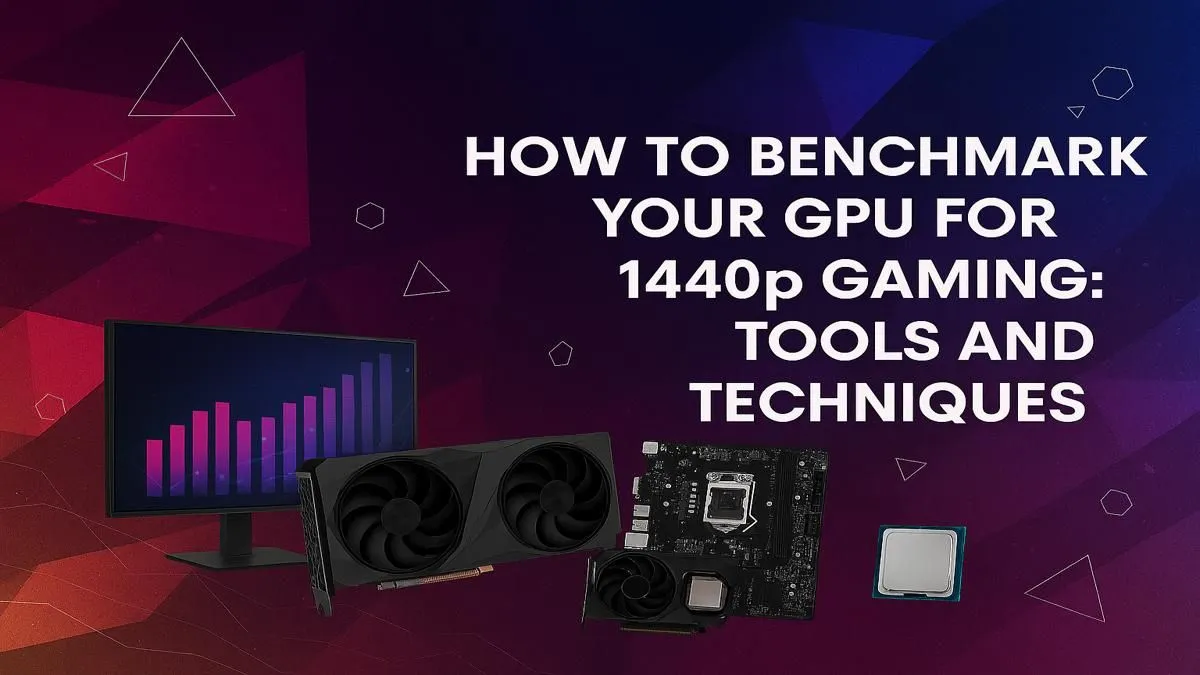
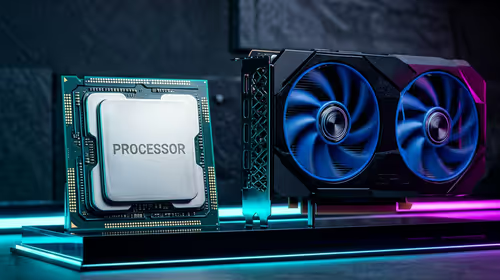
So, you’ve ascended to the 1440p master race. Congrats! The visuals are crisp, the detail is stunning... but is your new AAA title stuttering? Before you start tweaking every setting, it’s time to get scientific. Knowing how to properly benchmark your GPU for 1440p is the key to unlocking buttery-smooth gameplay. It’s not just for pro overclockers; it's for every South African gamer wanting to ensure their hardware delivers the performance they paid for. 🚀
Why You Should Benchmark Your GPU at 1440p
Think of a GPU benchmark as a health check for your graphics card. It’s a standardised test that pushes your hardware to its limits and spits out cold, hard data. Why is this so important for 1440p gaming?
- Identify Bottlenecks: Is it really your GPU holding you back, or is your CPU struggling to keep up? A proper benchmark helps you find the weak link in your system.
- Verify Performance: Did you get the performance you expected from that shiny new card? Benchmarking confirms your rig is running as it should, free from thermal throttling or driver issues.
- Plan Your Next Upgrade: The results from a 1440p GPU benchmark provide a clear baseline. This data is your best friend when deciding if an upgrade will give you the FPS boost you crave in titles like Alan Wake 2 or Cyberpunk 2077.
Choosing Your Benchmarking Tools
There are two main ways to test your rig: synthetic tests and real-world, in-game analysis. For a complete picture, you should ideally use a bit of both.
Synthetic Benchmarks (The Lab Test)
These are purpose-built applications designed to stress-test your GPU with intense, repeatable scenes. They are excellent for comparing the raw power of different graphics cards in a controlled environment.
Popular choices include:
- 3DMark: The industry standard, with tests like Time Spy (for DirectX 12) and Port Royal (for ray tracing).
- Unigine Superposition: A great-looking and demanding benchmark that can push even high-end cards to their limits.
In-Game Benchmarks (The Real-World Test) ✨
This is where the magic happens. Testing within the games you actually play gives you the most relevant performance data. Many modern games have built-in benchmark modes. If they don’t, you can use software like MSI Afterburner with RivaTuner Statistics Server to monitor your frame rates during a typical gameplay session. This method is perfect for seeing how your favourite AMD Radeon cards handle specific game engines.
Reading the Numbers 📊
Average FPS is great, but the real story is in the 1% and 0.1% lows. These numbers show you the worst-case stutters. If your average is 80 FPS but your 1% low is 30 FPS, you'll feel those jarring drops. A smooth experience has high and stable lows, not just a high average. This is crucial when you benchmark a GPU for 1440p.
A Simple Guide to Running Your First 1440p Benchmark
Ready to get some numbers? It’s easier than you think. Follow these steps for a clean and reliable test.
- Prep Your Rig: Close all unnecessary background applications (Chrome is a notorious resource hog!). Make sure your graphics drivers are up to date for the best performance and compatibility.
- Set Your Scene: Launch your chosen game or synthetic tool. In the settings, select the 2560x1440 resolution. Choose a graphics preset you’d realistically play at, like "High" or "Ultra". Turn off V-Sync and any frame rate caps to let the GPU run wild.
- Run the Test: Start the benchmark. If you're testing in-game without a built-in tool, play a demanding and repeatable section of the game for 5-10 minutes.
- Repeat for Consistency: Run the test at least three times and calculate the average result. This helps to smooth out any random performance dips and gives you a more accurate final number. For many gamers, a reliable card from the lineup of NVIDIA GeForce GPUs is often the go-to for consistent results.
Analysing Your Results: What Now?
So you have your results. What do they mean? Compare your scores to online reviews of the same GPU. Are your numbers in the same ballpark?
If your scores are significantly lower, it could point to an issue like overheating (check your fan curves and case airflow!) or a driver problem. If the numbers are where they should be but you still want more performance... it might be time for an upgrade. New contenders like the latest Intel ARC GPUs are offering competitive performance at compelling price points, shaking up the market.
Just remember, a gaming GPU is a different beast entirely from specialised workstation graphics cards, which are optimised for professional applications like CAD and 3D rendering, not high frame rates.
Ultimately, a good GPU benchmark for 1440p empowers you with knowledge. It turns guesswork into data, helping you optimise your current setup or confidently choose your next big upgrade. 🔧
Ready to Crush 1440p?
If your current card isn't hitting the mark, we've got your back. A solid GPU benchmark at 1440p shows you exactly what you need. Explore our massive range of graphics cards and find the perfect upgrade to dominate your favourite games.