Staring at a render bar that moves slower than rush-hour traffic on the N1? We've all been there. A choppy timeline in Adobe Premiere Pro can kill your creative flow and your deadlines. But what truly makes the best PC for Premiere Pro in 2025? It’s not just about grabbing the most expensive parts; it’s about a balanced system where every component works together to accelerate your workflow. Let's dive into the benchmarks and specs that matter.
The CPU: Your Editing and Exporting Engine
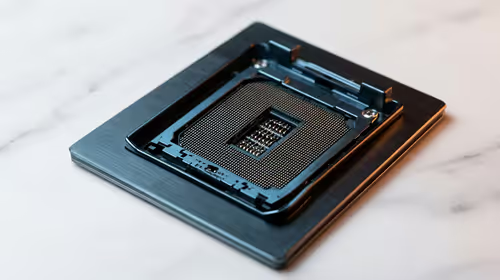
The Central Processing Unit (CPU) is the heart of your editing rig. For Premiere Pro, two things are critical: high clock speeds and a healthy number of cores.
High clock speeds (measured in GHz) improve the responsiveness of the application itself… think smooth timeline scrubbing and quick effect adjustments. More cores, on the other hand, slash your export times by handling multiple rendering tasks simultaneously.
So, which brand wins?
- Intel: Processors like the Core i7 and i9 series often boast excellent single-core performance, making the editing experience feel incredibly snappy. They are a fantastic choice for editors who prioritise a fluid workflow. You can find a wide variety of powerful Intel PC deals configured for high performance.
- AMD: Ryzen 7 and Ryzen 9 CPUs typically offer an incredible number of cores for their price in ZAR, making them rendering beasts. If your biggest bottleneck is long export times, an AMD-powered machine can be a massive productivity boost. Check out the latest AMD Ryzen PC deals to see the multi-core value on offer.
For a Premiere Pro PC in 2025, aim for at least an 8-core CPU, with 12-cores or more being the sweet spot for 4K and higher resolution workflows.
The GPU: More Than Just for Gaming 🚀
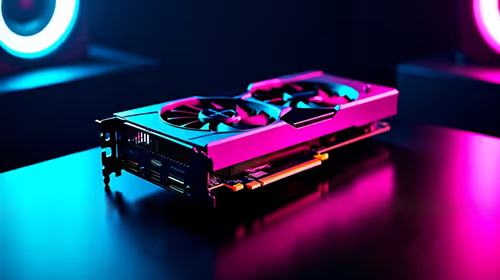
While the CPU does the heavy lifting for many tasks, the Graphics Processing Unit (GPU) is your secret weapon for a smooth editing experience. Premiere Pro’s Mercury Playback Engine uses the GPU to accelerate real-time playback, colour grading with Lumetri, and processing GPU-accelerated effects.
The key here is CUDA cores (for NVIDIA) and VRAM.
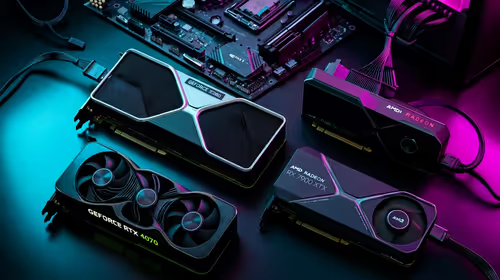
- NVIDIA GeForce: Thanks to their powerful CUDA architecture, NVIDIA GPUs are widely considered the industry standard for Premiere Pro. Features like NVENC (NVIDIA Encoder) can also dramatically speed up H.264 and H.265 exports. A solid NVIDIA GeForce gaming PC often doubles as a phenomenal editing rig.
- AMD Radeon: While historically lagging in Premiere Pro optimisation, modern AMD Radeon gaming PCs offer competitive performance, especially for their price. They are a viable option, though most professional workflows still lean towards NVIDIA for maximum stability and feature support.
For 4K editing, a GPU with at least 8GB of VRAM is recommended. For 6K or 8K footage, you'll want to step up to 12GB or more.
Storage Pro Tip ⚡
For the best performance, use a multi-drive setup. Install your OS and Premiere Pro on one NVMe SSD. Use a second, larger NVMe SSD for your project files and active media. Finally, assign your media cache and scratch disks to a third fast drive (SATA SSD is fine here). This prevents bottlenecks and keeps your timeline buttery smooth.
RAM and Storage: The Unsung Heroes
Don't let your powerful CPU and GPU get starved for data. RAM and storage speed are crucial for a responsive Premiere Pro PC.
How Much RAM is Enough?
In 2025, 16GB of RAM is the absolute minimum, but it's not ideal. For smooth 1080p and light 4K editing, 32GB is the new standard. If you're working with complex timelines, After Effects compositions via Dynamic Link, or 6K+ footage, jumping to 64GB or even 128GB is a worthwhile investment to eliminate frustrating slowdowns.
Why NVMe SSDs are Non-Negotiable
Your storage speed directly impacts how quickly your footage loads, previews are generated, and projects open. A fast NVMe M.2 SSD is essential. They are several times faster than older SATA SSDs and lightyears ahead of traditional hard drives. Your boot drive, application drive, and active project drive should all be NVMe SSDs for the best PC for Premiere Pro experience.
Putting It All Together: Pre-Built vs. Custom
Now that you know the key components, how do you get your hands on the right machine?
- Pre-Built Powerhouses: For those who want a system that's tested, warrantied, and ready to go straight out of the box, our range of pre-built PC deals offers incredible value and saves you the hassle of building.
- Professional Workstations: If your editing work is your livelihood, investing in purpose-built workstation PCs is the ultimate choice. These machines are optimised for stability, certified for professional applications, and built with premium components designed for 24/7 operation.
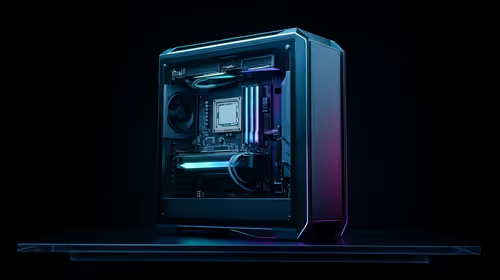
Ultimately, the best PC for video editing is one that matches your specific workflow, footage type, and budget. By focusing on a balanced system with a strong CPU, a capable NVIDIA GPU, and plenty of fast RAM and storage, you'll build a machine that lets you create without limits. ✨
Ready to Build Your Ultimate Editing Rig? Stop waiting and start creating. Whether you need a pre-configured powerhouse or want to spec out every component, we have the perfect PC for your workflow and budget. Design your dream Premiere Pro PC with our Custom Builder and experience seamless editing.