Quick Answer
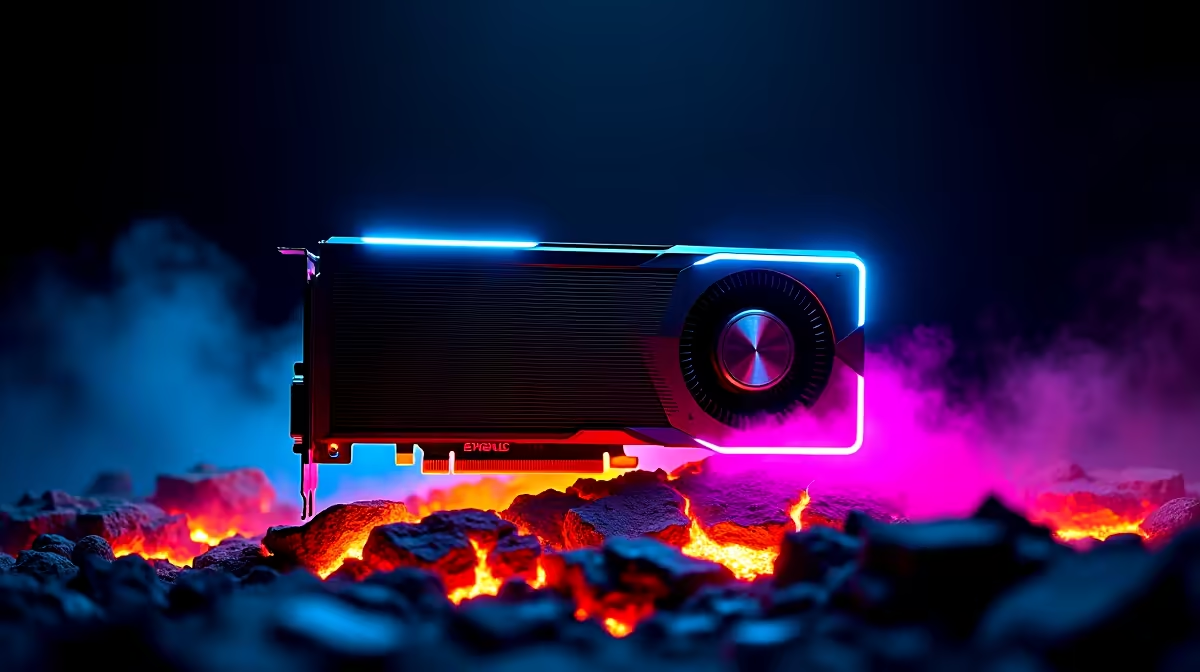
The RTX 3060 can run games at 4K 60Hz but with significant compromises. At native 4K, most demanding titles require medium to low settings to hit 60 FPS consistently. Using DLSS Quality mode at 4K is the recommended approach for a better balance of image quality and performance.
The RTX 3060 is a capable 1080p to 1440p card, and many SA gamers picked one up during the GPU drought years when pricing came down to around R7,000 to R9,000 locally. Running 4K on it is a different story - the 12GB VRAM buffer actually helps at 4K resolution, but the shader core count and memory bandwidth weren't designed for native 4K gaming. Here's what you can realistically expect.
Native 4K Performance Without DLSS
At native 4K with high settings, the RTX 3060 averages between 25 and 45 FPS in most modern AAA titles. In Cyberpunk 2077 with RT off, expect around 28-35 FPS. In Forza Horizon 5, around 40-45 FPS on high. In older or less demanding titles like The Witcher 3 (without RT), you can hit 50-60 FPS at high settings. Competitive games like Valorant or CSGO at 4K hit comfortably above 60 FPS since they're not GPU-bound in the same way. Native 4K without upscaling on the RTX 3060 means you need to accept lower settings to reach 60 FPS in demanding titles.
4K with DLSS Quality Mode
This is where the RTX 3060 becomes a legitimate 4K option. DLSS Quality mode renders internally at around 1440p and upscales to 4K, delivering image quality that's very close to native while recovering significant performance. In supported titles, DLSS Quality at 4K typically boosts frame rates by 40-60%, turning a 35 FPS native experience into a 55-65 FPS DLSS one. For titles with DLSS 3 support, Frame Generation isn't available on the RTX 3060 (that's RTX 40-series only), but DLSS Super Resolution works well. If your game list prioritizes DLSS-supported titles, 4K 60Hz is achievable.
Should You Run a 4K Monitor with an RTX 3060?
For casual gaming and media consumption, yes - the RTX 3060 can drive a 4K display and the desktop experience is perfect. For gaming, pairing a 4K monitor with an RTX 3060 makes most sense if you also game at 1440p or 1080p regularly, or if your game library skews toward less demanding titles and esports games. If your primary goal is maxed-out 4K gaming in AAA titles at 60+ FPS, the RTX 3060 will leave you wanting a 3080 or 4070-class card. But for a budget 4K setup in SA where a 4K monitor is already owned, it's workable with smart settings choices.
Frequently Asked Questions
Q: Does the RTX 3060's 12GB VRAM help at 4K? A: Yes - 12GB is enough VRAM to avoid texture pop-in and stuttering at 4K with high texture settings. Most 4K issues on the RTX 3060 are about shader performance, not VRAM, so the 12GB is a genuine advantage over the 8GB RTX 3060 Ti in VRAM-heavy scenarios.
Q: What settings should I use for 4K 60Hz on RTX 3060? A: In demanding AAA titles, use DLSS Quality mode if available. Without DLSS, target medium-high settings with shadows and reflections reduced first. Anti-aliasing can be dropped to TAA since 4K already reduces aliasing significantly.
Q: Can the RTX 3060 run 4K video and content creation at 4K resolution? A: Absolutely. Video playback, streaming, and even video editing preview at 4K is handled easily by the RTX 3060. The NVENC encoder also supports 4K recording and streaming without impacting gaming performance much.
Ready to Find Your Perfect Match? Check out Evetech's gaming PC deals for NVIDIA-powered builds across every budget.