

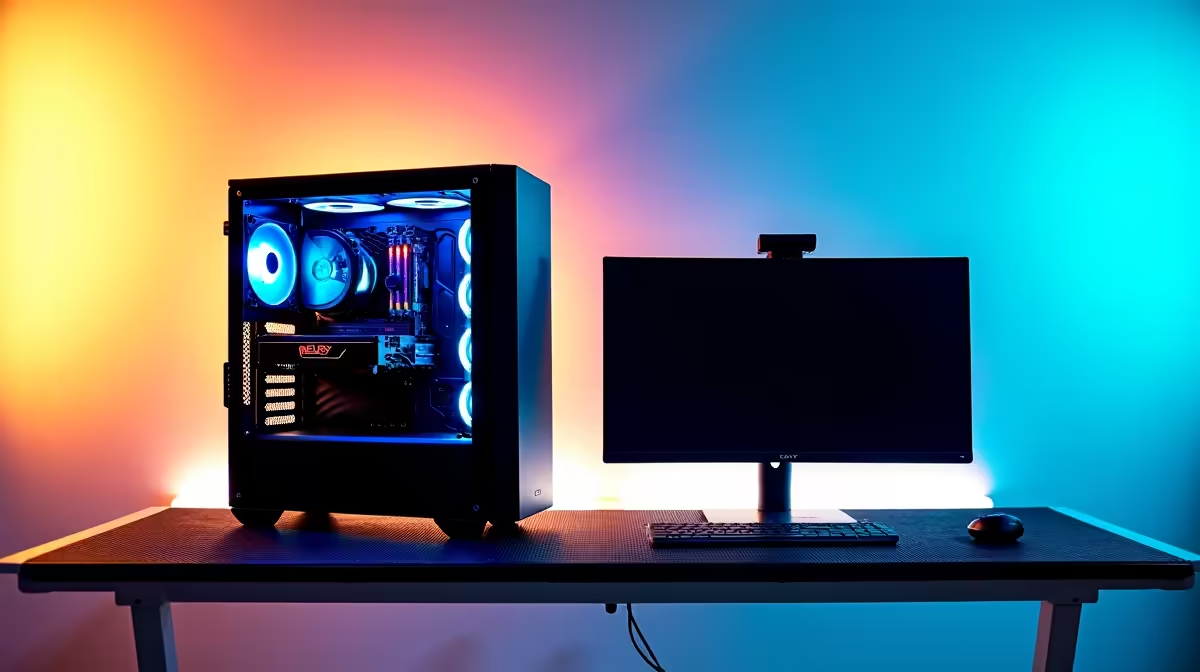
Quick Answer
In South Africa, local gaming on your own hardware consistently outperforms cloud gaming for latency-sensitive titles. SA''s infrastructure and the geographic distance from international cloud gaming server clusters introduces input lag that makes cloud gaming unsuitable for competitive play. For casual single-player titles, cloud gaming is a viable alternative where latency tolerances are higher.
Cloud gaming promises access to high-end game performance without the upfront cost of hardware, and globally it has made real strides. In South Africa, however, the conversation is more complicated. Our geographic position, internet infrastructure, and the location of cloud gaming server infrastructure combine to create an experience that diverges significantly from what international reviews describe. This guide examines the practical realities for SA gamers.
Latency: The Core Challenge for SA Cloud Gamers
Input latency is the fundamental metric that separates enjoyable gaming from frustrating gaming. Local gaming on a desktop or laptop processes inputs within milliseconds - the chain from keyboard or controller to screen involves only your hardware and display. Cloud gaming adds a multi-step round trip: your input travels over your internet connection to a remote server, is processed there, and the resulting video stream travels back to your screen. Each step adds latency, and it accumulates.
For South African users, the nearest major cloud gaming server clusters are typically located in Europe or the Middle East. The baseline round-trip time from South Africa to these regions ranges from 80 ms to 200 ms depending on the service, routing, and ISP. Add video encoding and decoding time - typically 30–70 ms on top of raw ping - and total input-to-screen latency of 150–270 ms is a realistic expectation. For comparison, a local gaming setup on wired ethernet and a 1ms monitor operates at under 10 ms total. That gap is imperceptible in a slow-paced puzzle game but decisive in a first-person shooter or fighting game where frame-accurate inputs matter.
Video Quality and Streaming Consistency
Cloud gaming delivers your game as a compressed video stream. Quality is constrained by your available bandwidth and the compression settings of the service provider. On a stable 50 Mbps fibre connection with consistent packet delivery, modern cloud gaming services can stream at 1080p 60fps with acceptable image quality for single-player titles. On a 25 Mbps or variable-speed connection - common in South African residential fibre deployments - compression artefacts, momentary resolution drops, and stream interruptions occur frequently. Where a local PC renders games at native resolution with no compression, cloud gaming always involves some image quality loss.
Where Cloud Gaming Makes Sense in SA
Despite its limitations, cloud gaming serves specific use cases well in South Africa. Subscribers who want to try a broad library of titles without purchasing hardware can access playable experiences in strategy games, turn-based RPGs, and slow-paced adventure titles where latency tolerances are high. Students in residences who cannot afford gaming desktops, but who have stable fibre internet, can use cloud gaming as a bridge to experiences their devices cannot otherwise run. Cloud gaming also enables gaming on non-gaming hardware - a work laptop or family computer - which has practical value in households where dedicated gaming PCs are not justified by the budget.
Local Hardware vs Cloud: The South African Verdict
For competitive gaming - any title where reaction speed and input precision affect outcomes - local hardware wins unambiguously. The latency difference is too large to overcome with current cloud gaming infrastructure in SA. For casual and single-player gaming, cloud gaming is a credible alternative for users who cannot or do not want to invest in hardware. As dedicated cloud gaming server infrastructure in South Africa develops and fibre penetration increases, the value proposition will improve - but in 2026, local hardware gaming remains the performance-first choice for SA gamers who care about competitive results.
Frequently Asked Questions
Q: Which cloud gaming services are usable in South Africa? A: Several international cloud gaming platforms serve South African users with varying levels of performance. Due to the lack of local server infrastructure for most services, your experience depends heavily on your ISP, line quality, and the routing your traffic takes to international data centres.
Q: What internet speed do I need for cloud gaming in SA? A: Most services recommend a minimum of 15–25 Mbps for 1080p streaming. For consistent quality with minimal artefacts, 50 Mbps or faster with low jitter is more reliable. Wired ethernet is strongly preferred over Wi-Fi.
Q: Is cloud gaming cheaper than buying local hardware over time? A: In the short term, cloud gaming subscription costs are lower. Over a two-to-three year horizon, mid-range gaming PC ownership typically becomes more economical, especially as you build a game library.
Q: Will cloud gaming latency in SA improve significantly in the next few years? A: As investment in African data centre infrastructure grows and fibre penetration increases, latency will improve. Meaningful improvement for competitive gaming likely requires South African or regional server presence from major providers - a medium-term development rather than an immediate reality.
Ready to Find Your Perfect Match? Build your local gaming advantage with hardware from Evetech - zero streaming lag, pure performance on your terms.











