

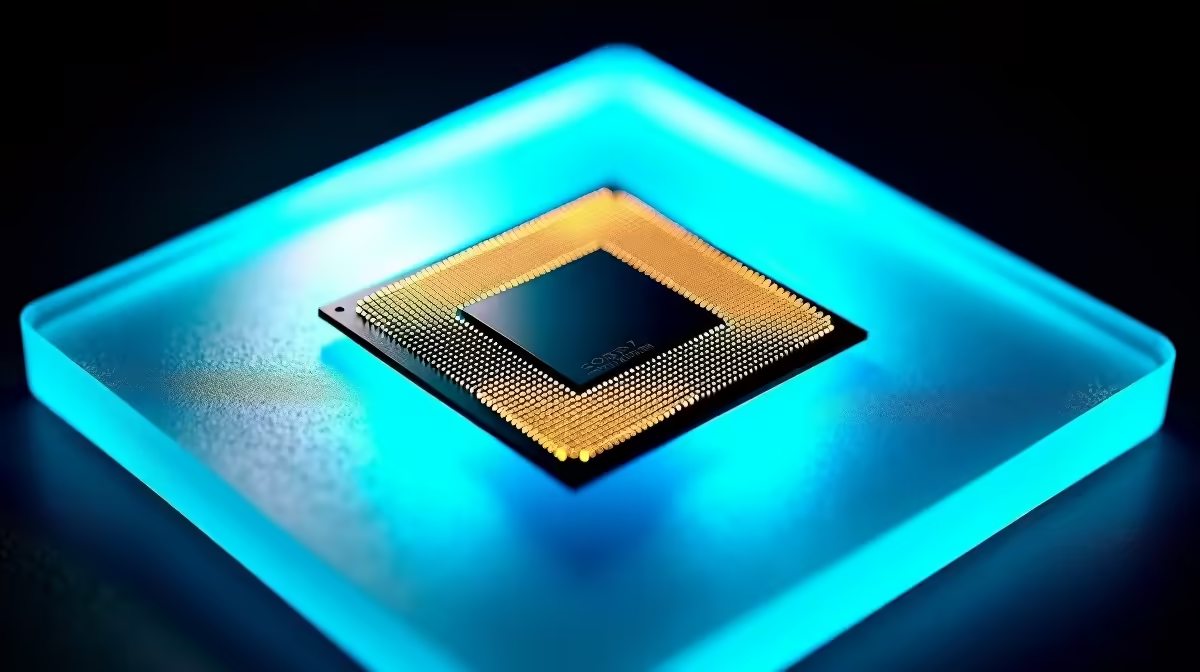
Intel's Core Ultra 200 series has reshaped the mid-to-high-end CPU market in South Africa, and the 265K versus 245K decision is one of the most common upgrade dilemmas SA builders face in 2026. Both chips share the same Lion Cove/Skymont hybrid architecture and LGA1851 socket, but they serve different use cases - and the price gap between them in the SA market makes the choice genuinely consequential.
Quick Answer
The Core Ultra 7 265K is the better CPU for heavy multi-threaded workloads like video rendering, 3D compilation, and streaming. The Core Ultra 5 245K delivers nearly identical gaming frame rates in most titles at a lower price point, making it the better value for pure gaming builds. The right choice depends on whether your workflow extends beyond gaming.
Architecture and Core Configuration 🔧
Both CPUs are built on Intel's 3nm-class process with the same hybrid core design, but they differ in core counts and cache:
Core Ultra 7 265K: 8 Performance cores (P-cores) + 16 Efficient cores (E-cores) = 24 cores / 24 threads. 36MB L3 cache.
Core Ultra 5 245K: 6 P-cores + 8 E-cores = 14 cores / 14 threads. 24MB L3 cache.
The 265K's advantage is substantial in workloads that scale across many threads. Compilation tasks, Blender renders, and multi-stream encoding see meaningful differences. In gaming, however, most titles are limited by the performance of 4–6 P-cores, and the 245K's P-cores are clocked similarly to the 265K's - so gaming performance differences are typically within 3–5% and often within margin of error.
Both CPUs are unlocked multiplier chips requiring Z890 motherboards. Neither includes a stock cooler, so budget for a quality cooler - explore the CPU cooler range at Evetech when planning your build.
Gaming Performance: Frame Rate Reality 💡
In GPU-limited scenarios (playing at 1440p or 4K with a high-end GPU), both CPUs produce nearly identical frame rates. At 1080p on lower graphics settings - where CPU bottlenecks become more visible - the 265K holds a consistent but small lead of 4–8% in titles like CS2, Valorant, and Rainbow Six Siege.
For SA gamers running high-refresh-rate monitors at 1080p or 1440p, that small gap is unlikely to be perceptible during actual play. The 265K's gaming advantage becomes more meaningful in CPU-intensive open-world games like Microsoft Flight Simulator or Cities: Skylines 2, where the additional E-cores handle background simulation tasks and keep the main game thread smoother.
If gaming is your primary use case, pair either CPU with a strong GPU from Evetech's graphics card range - the GPU will be your actual frame rate bottleneck in most gaming scenarios.
Productivity and Content Creation Performance ⚡
This is where the 265K separates itself decisively. Tasks that scale well with core count show substantial differences:
- Blender rendering: 265K renders complex scenes approximately 40–50% faster due to the additional P-cores and larger E-core cluster.
- Video export (DaVinci Resolve, Premiere): 265K completes 4K exports roughly 30–35% faster.
- Code compilation (large C++ projects, Unity builds): 265K build times are 25–40% shorter.
- Unreal Engine 5 shader compilation: The 265K's additional threads cut down the notorious UE5 shader compile wait significantly.
For SA creators, streamers who encode locally, software developers, and students in design or engineering programs, the 265K's productivity advantage justifies the price premium. For a pure gaming PC that occasionally runs Photoshop or light video editing, the 245K is sufficient and leaves money for a better GPU or faster RAM.
Platform and Memory Compatibility 🖥️
Both CPUs require an LGA1851 socket and Z890 chipset motherboard. Z790 compatibility does not extend to Core Ultra 200K series - this is a full platform upgrade from 12th/13th Gen Intel systems. DDR5 is mandatory, with sweet spots at DDR5-6000 for gaming and DDR5-7200+ offering smaller incremental gains for productivity workloads.
The shared platform means motherboard, RAM, and cooler costs are identical between the two CPUs. The only variable is the CPU price itself, making the 245K to 265K upgrade decision purely about what you're paying for - cores and cache.
Pair either CPU with compatible DDR5 RAM from Evetech's RAM range and a quality Z890 motherboard to complete the build.
Frequently Asked Questions ❓
Q: Is the Core Ultra 7 265K worth the price premium over the 245K for a gaming-only PC? A: For gaming only, the 245K delivers 95–97% of the 265K's frame rate performance at a meaningfully lower price. The extra money is better spent on a GPU upgrade, which will have a larger impact on gaming performance.
Q: Do both CPUs support Intel Arc GPU integrated graphics? A: Yes, both the 265K and 245K include Intel Xe integrated graphics, which is useful for display output during initial system setup, though not suitable for gaming workloads without a discrete GPU.
Q: What is the thermal difference between the 265K and 245K? A: The 265K runs hotter under sustained multi-threaded workloads due to more active cores - expect peaks around 90°C–95°C with a quality 240mm AIO. The 245K typically peaks 5°C–10°C lower under the same cooler in gaming scenarios.
Q: Can I overclock both CPUs on a Z890 motherboard? A: Yes, both the 265K and 245K are fully unlocked for manual overclocking on Z890 boards. Intel Application Optimization (APO) is also supported on both, providing automated per-game performance tuning without manual OC.
Evetech carries Intel Core Ultra 5 and Graphics Card Deals — check live stock and pricing before you buy.
Ready to Find Your Perfect Match? Explore relevant Evetech options, compare current South African pricing, and choose hardware that fits your setup. Shop now











