

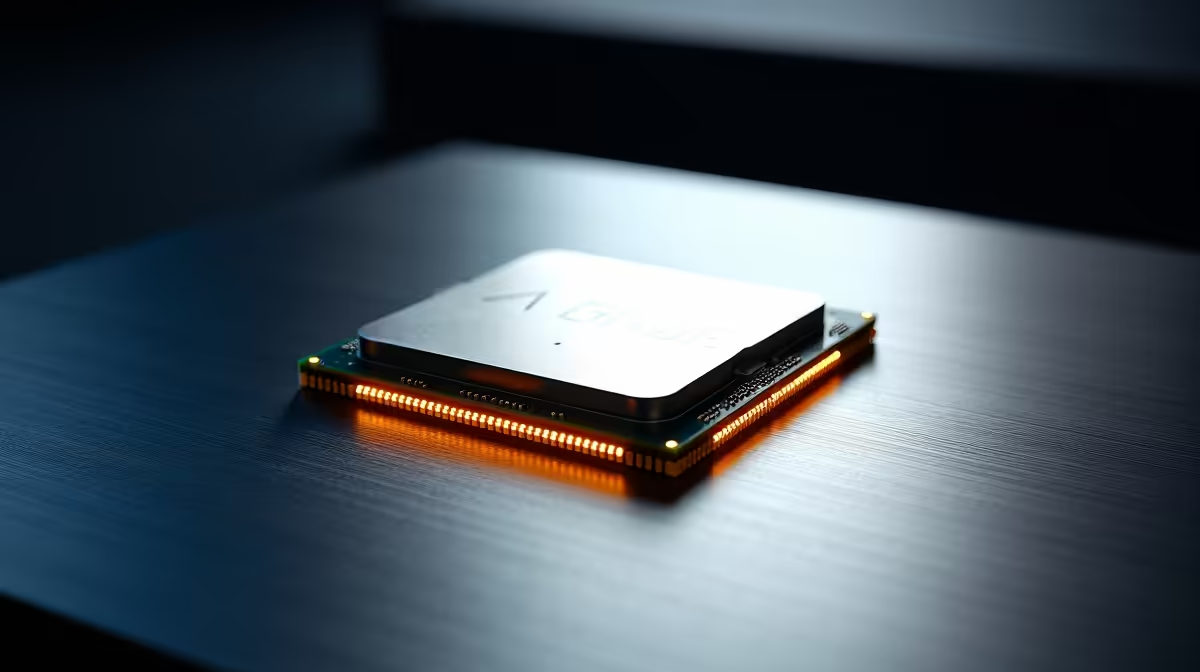
Intel's Core Ultra 9 285K represents the top of Intel's Arrow Lake desktop lineup, bringing a new architecture designed with efficiency and AI acceleration in mind alongside raw performance. For South African content creators working in video editing, 3D rendering, motion graphics, and audio production, the question is not simply whether it is fast - it is whether it is worth the significant price premium over capable alternatives in the R30,000–R50,000 workstation bracket.
Quick Answer
The Core Ultra 9 285K is a capable content creation CPU with strong multi-threaded performance and Intel's NPU for AI-accelerated workflows. However, in South Africa's market, where pricing premiums are amplified by currency factors, AMD's Ryzen 9 7950X or 9950X often delivers comparable or better rendering performance at a lower system cost - making the 285K worth it only if you specifically need Intel's platform or AI NPU features.
🏗️ Architecture and What's Actually New
The Core Ultra 9 285K introduces Intel's Arrow Lake architecture on the LGA1851 socket, abandoning the hybrid P-core/E-core approach of Raptor Lake in favour of a more balanced multi-cluster design. It ships with 24 cores (8 Performance + 16 Efficient), a built-in NPU rated at 13 TOPS, and a revamped memory controller supporting LPDDR5X and DDR5. The removal of Hyper-Threading on P-cores is the most controversial architectural decision - in some multi-threaded rendering benchmarks, the 285K trails the previous-gen Core i9-14900K despite higher core counts.
For content creators, the NPU is the genuinely interesting addition. Adobe Premiere Pro, DaVinci Resolve, and Topaz Labs have begun integrating NPU acceleration for specific AI tasks - background removal, speech enhancement, and upscaling. If your workflow relies heavily on AI-powered tools, the NPU offloads these tasks from the GPU and CPU simultaneously, which is a meaningful real-world benefit during complex timelines.
💰 South African Pricing Reality
In South Africa, the Core Ultra 9 285K lands at roughly R12,000–R15,000 depending on import timing and exchange rate conditions. Pair it with a required Z890 motherboard (R4,000–R8,000), DDR5 RAM (R3,000–R6,000 for 64GB), and a suitable CPU cooler, and the platform cost before GPU, storage, and case exceeds R22,000–R25,000.
By contrast, AMD's Ryzen 9 9950X on an X670E board at similar RAM capacity comes in at a comparable total, but with better multi-threaded rendering performance in Blender and Cinebench R23. The value equation tips toward AMD for creators whose primary workflow is rendering-heavy. The 285K makes more sense for mixed workloads where Intel's NPU and QuickSync video encoding acceleration play a larger role.
🖥️ Real Workload Performance for SA Creators
In video editing scenarios using DaVinci Resolve with GPU acceleration enabled, the 285K performs comparably to the Ryzen 9 9900X in timeline scrubbing and export times. Where the 285K pulls ahead is in Intel QuickSync H.265 and AV1 hardware encoding - if you export to streaming platforms frequently, QuickSync encoding is meaningfully faster than software encoding and offloads the render from the main CPU cores.
For 3D workflows in Cinema 4D, Blender, or Unreal Engine 5, the Ryzen 9 9950X's higher Cinebench scores translate to real-world time savings in CPU path tracing. The 285K is not slow - it is genuinely fast - but the premium it commands in South Africa is harder to justify when alternatives match or exceed it in the workloads most creators use daily. If your workflow is Premiere-heavy with AI features, Intel NPU support makes the 285K more compelling.
🔧 Platform Considerations and Longevity
The LGA1851 socket is Intel's current-generation platform, but Intel's track record on socket longevity has been less predictable than AMD's AM5 platform. AMD has committed to AM5 support through at least 2027, providing a clearer upgrade path for the same motherboard investment. For South African creators planning a 4–5 year system lifecycle, this platform longevity consideration is not trivial given the cost of swapping motherboards locally.
Z890 boards require DDR5, which is now mainstream in pricing - this is no longer a differentiator from AMD's AM5 platform. Ensure your chosen board has sufficient PCIe 5.0 bandwidth for high-speed NVMe storage if you work with large RAW video files. Pair your build with fast SSD storage to eliminate the storage bottleneck that plagues many creator workstations.
❓ FAQ
Q: Is the Core Ultra 9 285K better than the Ryzen 9 9950X for video editing? It depends on the application. In DaVinci Resolve with GPU acceleration, they perform similarly. For Premiere Pro with AI tools and QuickSync encoding, the 285K has an edge. In Blender CPU rendering and multi-threaded exports, the 9950X generally leads. Match the CPU to your primary software.
Q: Does the Core Ultra 9 285K support DDR4 RAM? No. The LGA1851/Z890 platform requires DDR5. DDR4 is not supported on Arrow Lake desktop processors.
Q: What cooler do I need for the Core Ultra 9 285K? The 285K has a 125W base TDP but boosts significantly under multi-threaded loads. A 280mm or 360mm all-in-one liquid cooler, or a high-end air cooler rated above 250W TDP, is recommended for sustained content creation workloads.
Q: Is the 285K good for gaming as well as content creation? The 285K is capable in gaming but is not the top gaming CPU - Raptor Lake Refresh chips like the Core i9-14900K and Ryzen 7 9800X3D outperform it in many gaming titles due to gaming's preference for high single-thread performance and cache. For a dual-purpose gaming and creation workstation, consider your primary use case priority.
Evetech carries Intel Core Ultra 9 and Graphics Card Deals — check live stock and pricing before you buy.











