Staring at a render progress bar is a universal pain for South African creators. Whether you're a Blender artist in Durban or a motion designer in Johannesburg, every minute spent waiting is a minute lost. The big question is… what’s the secret to faster renders? The answer often lies in understanding the CPU vs GPU rendering battle. This guide breaks down the performance differences to help you choose the right hardware for your creative workflow and get back to creating.
Understanding the CPU vs GPU Rendering Showdown
At its core, the difference between CPU and GPU rendering comes down to architecture. Think of your CPU (Central Processing Unit) as a highly skilled project manager. It has a few powerful cores, perfect for juggling complex, sequential instructions one after another. Your GPU (Graphics Processing Unit), on the other hand, is like a massive team of specialised workers. It has thousands of smaller, simpler cores designed to tackle thousands of parallel tasks simultaneously. This fundamental difference dictates which is better for your specific rendering needs. For many creators, the power of a modern graphics card can transform their workflow, which is why exploring the best gaming PC deals is often the first step towards a faster machine.
When Your CPU is the Star of the Show 👑
While GPU rendering gets most of the hype, rendering on a CPU is still the undisputed champion in certain scenarios. CPU-based render engines are often more accurate with complex calculations like light bounces and intricate physics simulations. They can also access your system's full RAM, making them ideal for enormous, memory-hungry scenes that would overwhelm a GPU's dedicated VRAM. If your work demands absolute precision or involves scenes with terabytes of textures, a powerful processor is non-negotiable. This is where high-performance PCs over R20k with top-tier CPUs truly justify their investment.
Why GPU Rendering is Taking Over 🚀
For the vast majority of 3D artists and video editors today, the speed of GPU rendering is a revelation. Software like Blender (Cycles), Octane, Redshift, and V-Ray GPU are optimised to use the massive parallel processing power of NVIDIA and AMD cards. This translates into dramatically faster render times… we're talking hours reduced to minutes. The biggest advantage is the interactive feedback. You can tweak lighting, materials, and camera angles and see a near-instant preview, which massively accelerates the creative process. You don't even need a top-of-the-line card to see the benefits; many powerful builds under R20k offer fantastic GPU rendering performance for the price.
VRAM is Key ⚡
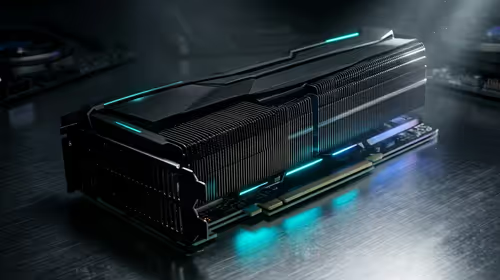
When choosing a GPU for rendering, VRAM (Video RAM) is just as important as core count. Your entire scene, including models, textures, and lighting information, must fit into the GPU's VRAM. If it doesn't, you'll face slow performance or render failures. Aim for at least 8GB of VRAM for general work, and 12GB or more for complex 4K projects.
CPU + GPU Rendering: The Best of Both Worlds?
So, what’s the final verdict in the CPU rendering vs GPU debate? It's not always an either/or choice. Many modern render engines support hybrid rendering, using both the CPU and GPU together to push out frames even faster. However, the performance gains can vary depending on the application and hardware combination. The ultimate decision depends on your primary software and budget.
For most South African creators starting out or looking to upgrade, prioritising a powerful GPU will deliver the most noticeable speed improvement for your rand. The ability to iterate quickly and slash final render times is invaluable. Even many budget gaming PCs pack a GPU that can run circles around CPU-only rendering for supported applications. Ultimately, a balanced system is the goal, and our range of pre-built PC deals is curated to offer the best performance for your budget, whether you lean towards CPU or GPU-heavy workloads.
Ready to Crush Your Render Times?
The CPU vs GPU rendering choice is all about your workflow. For maximum speed and creative freedom in modern applications, a powerful GPU is essential. Explore our massive range of custom-built PCs and find the perfect machine to bring your vision to life.