

Quick Answer
For most PC builders, a custom water cooling loop is not worth the cost or complexity compared to a quality AIO. Custom loops deliver better sustained thermal performance and aesthetics, but they cost significantly more, require hours of planning and assembly, and carry risks that AIOs do not. In South Africa, where hardware is expensive and replacement parts can be hard to source, the risk-reward calculation favours AIOs for all but the most dedicated builders.
What a Custom Loop Actually Involves
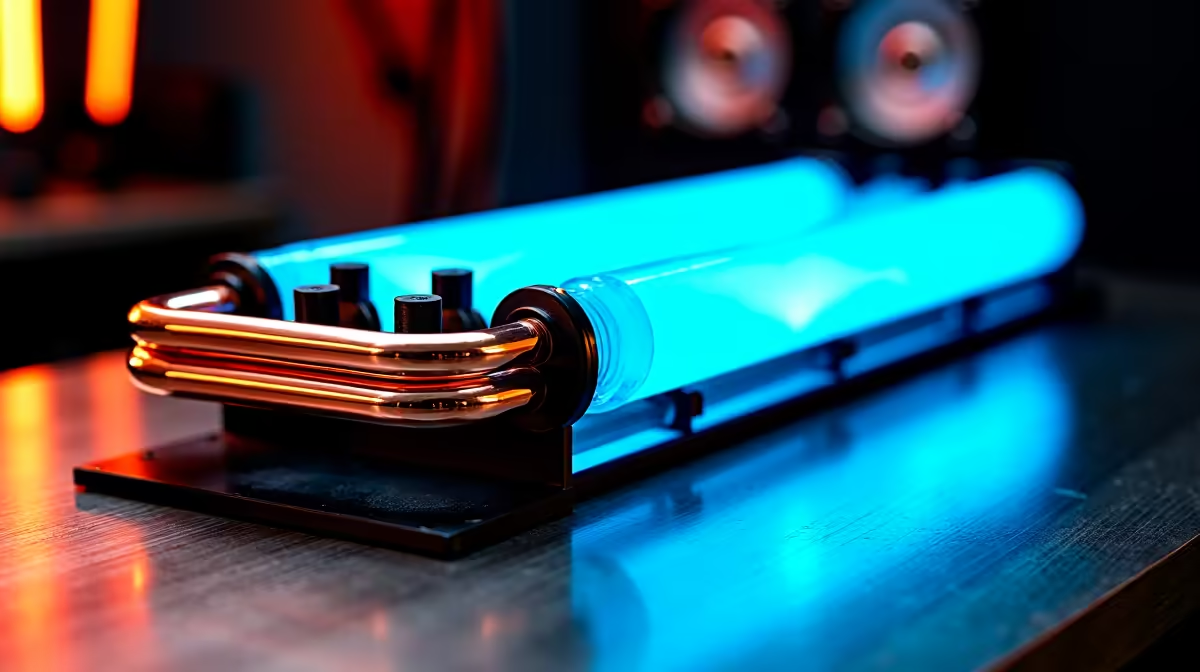
A custom water cooling loop is a closed circuit of components you assemble yourself: a water block that sits on the CPU (and optionally GPU), a pump to move the coolant, a reservoir to hold extra fluid, tubing to connect everything, and one or more radiators to dissipate heat. You choose every component, route the tubing yourself, fill the loop with coolant, bleed the air out, and check for leaks before running the system under load. This process takes anywhere from four to ten hours depending on your case, loop complexity, and experience level. Once running, a custom loop requires periodic maintenance: coolant top-ups, anti-algae additive changes every six to twelve months, and occasional drain-and-refill cycles. If a pump fails or a fitting develops a slow leak, you could face a serious hardware incident. In South Africa, sourcing custom loop components is more limited than in Europe or North America. Pumps, fittings, hard tubing, and high-quality radiators may need to be sourced from a small number of specialist suppliers, and if a component fails, lead times can be long. ## Performance: Where Custom Loops Actually Win
Custom loops genuinely outperform AIOs in specific scenarios. When you add a GPU water block to the loop, you are cooling both CPU and GPU through the same system, which allows very large radiator configurations that no AIO can match. A 480mm radiator or a dual-360mm radiator configuration can handle a heavily overclocked CPU and GPU simultaneously with significantly lower temperatures than any AIO. For extreme overclocking, professional content creation builds running 64-core Threadripper CPUs, or multi-GPU workstation setups, the thermal ceiling of a custom loop is genuinely higher. In these cases, the investment can be justified by measurable performance gains. For a standard gaming build with a Ryzen 7 or Core i7 CPU and a single GPU, the thermal difference between a 360mm AIO and a custom loop is small in practice. A well-matched 360mm AIO keeps modern gaming CPUs in the 70 to 80 degree range under load, which is entirely safe and does not limit performance. ## Cost Comparison in the SA Market
A quality 360mm AIO in South Africa costs between R1,800 and R3,500. A custom loop that matches or exceeds it in performance, including pump, reservoir, CPU block, tubing, fittings, and radiator, costs between R4,000 and R8,000 for a CPU-only loop. Add a GPU block and the cost climbs further. The premium is significant, and in a market where the rand stretches hard against hardware pricing, that extra R3,000 to R5,000 buys meaningful GPU or storage upgrades instead. Loadshedding in SA adds a practical risk factor. Frequent power cycling is harder on pump motors over time. Custom loop pumps are generally robust, but the cumulative effect of thousands of cold starts and power cuts over several years of Stage 2 to Stage 6 loadshedding is a real consideration. AIOs share this risk, but a failed AIO pump is typically covered by warranty and replaced as a single unit. ## Who Should Build a Custom Loop in 2026
Custom loops are worth the investment if you are building a flagship content creation or overclocking rig where thermal performance directly impacts output, you value the aesthetics of a fully custom loop with hard tubing and matching fittings as a centrepiece of your build, or you enjoy the process of building and maintaining a system as a hobby in itself. If any of those three apply, the cost and complexity become part of the experience rather than a downside. For gaming builds, student rigs at Wits or UCT, or any build where reliability and value matter more than maximum thermal headroom, a premium AIO is the better choice. ## Frequently Asked Questions
Can a custom loop leak and damage components? Yes. Improperly fitted fittings, manufacturing defects, or tubing that hardens over time can all cause leaks. Using distilled water with a corrosion inhibitor and proper leak-testing before powering on reduces this risk significantly, but it never reaches zero. How much better is a custom loop than a 360mm AIO on a gaming CPU? For a gaming-class CPU like the Ryzen 7 7700X or Core i7-13700K, a custom CPU-only loop typically runs 5 to 15 degrees cooler than a 360mm AIO under sustained load. The practical gaming benefit is minimal since both keep the CPU within safe thermal limits. Are custom loop components available in South Africa? Yes, but selection is more limited than international markets. Components like Barrow, Bitspower, and EK are available through specialist PC component suppliers in SA. Budget extra time for sourcing and expect a premium over international pricing due to import costs. Is a custom loop suitable for a system that experiences loadshedding? It adds some risk due to pump wear from repeated cold starts. If your system is on a UPS for loadshedding, this concern is largely mitigated since the system does not actually power down during outages.
Ready to Find Your Perfect Match? Explore AIO liquid coolers and cooling solutions for every build type at Evetech, with delivery across South Africa.











