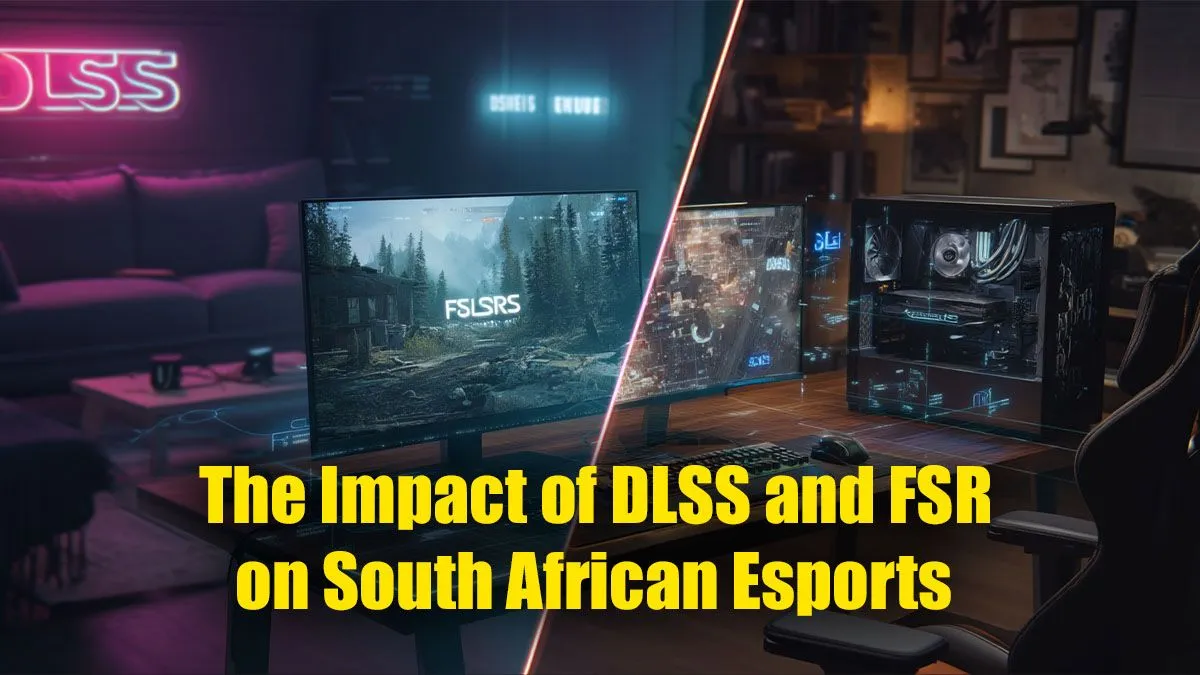
In the high-stakes world of South African esports, every frame is a potential victory. But what if you could boost your FPS by 30% or more without a pricey upgrade? That’s not a cheat code… it's the power of NVIDIA DLSS and AMD FSR. These smart upscaling technologies are your secret weapon for hitting those silky-smooth frame rates, giving you a tangible performance edge when it matters most. Let's dive in. 🚀
Unpacking DLSS & FSR: Your FPS Boost Explained
Before we get into the competitive weeds, what exactly are these technologies? Think of them as incredibly clever performance multipliers for your graphics card.
Both NVIDIA's Deep Learning Super Sampling (DLSS) and AMD's FidelityFX Super Resolution (FSR) work by rendering your game at a lower internal resolution (say, 1080p) and then using sophisticated algorithms to upscale the image to your monitor's native resolution (like 1440p or 4K). The result? A massive frame rate increase with a minimal impact on visual quality. This is the core of the performance edge that DLSS & FSR in South Africa provide to competitive gamers.
NVIDIA DLSS: The AI-Powered Powerhouse
DLSS leverages the dedicated Tensor Cores found on NVIDIA's RTX graphics cards. It uses a deep learning neural network to reconstruct the image, often resulting in visuals that are as sharp—or even sharper—than the native resolution. It's a premium feature for those with the right hardware.
AMD FSR: The Open-Source Challenger
FSR, on the other hand, is an open-source spatial upscaler. The big advantage? It works on a much wider range of hardware, including AMD's own GPUs, older NVIDIA GTX cards, and even Intel's Arc GPUs. While earlier versions traded a little more image quality for this compatibility, the latest FSR iterations have closed the gap significantly.
The Real-World Esports Performance Edge
So, how does this tech translate to a clutch moment in CS2 or a frantic final circle in Warzone? It's simple: higher FPS means smoother gameplay and faster reaction times.
When your game runs at a higher, more stable frame rate, you get more up-to-date information on your screen. This reduces input lag and motion blur, making it easier to track fast-moving targets and land critical shots. For anyone using a 144Hz or 240Hz monitor, leveraging DLSS or FSR is non-negotiable. Pushing enough frames to match your monitor's refresh rate is crucial, and these tools get you there. If you're running Team Green, having a compatible NVIDIA GeForce graphics card is your ticket to unlocking DLSS's AI-enhanced performance. ✨
DLSS vs FSR: Which is Right for Your Rig?
Choosing between DLSS and FSR in South Africa often comes down to the hardware you already own or plan to buy.
If you have an NVIDIA RTX 20-series card or newer, DLSS is almost always the superior choice for its outstanding image quality. The AI reconstruction is simply phenomenal.
However, if you're building a new PC on a tighter budget or want to breathe new life into an older GPU, FSR is a fantastic option. Its wide compatibility makes it a true hero for the people. It means you can still get a competitive edge without needing the latest and greatest silicon. Pairing FSR with a powerful AMD Radeon graphics card delivers incredible performance-per-Rand, a key consideration for any local gamer.
Pro Tip: Finding the Sweet Spot ⚡
In your game settings, you'll see modes like 'Quality', 'Balanced', 'Performance', and 'Ultra Performance' for both DLSS and FSR. For competitive multiplayer, start with 'Performance' mode. It offers the biggest FPS boost. If you find the image quality a bit soft for your liking, dial it back to 'Balanced'. 'Quality' is best for stunning single-player games where visual fidelity is king.
Why This Matters for South African Gamers 🇿🇦
Ultimately, the rise of DLSS & FSR in South Africa is about democratising high-performance gaming. Graphics cards are a significant investment, and these technologies extend the useful lifespan of your hardware. You can buy a mid-range card today and be confident it will handle new titles for years to come by leveraging these smart upscaling features. It's about playing the latest games at smooth frame rates without having to break the bank every year… and gaining that crucial esports performance edge in the process.
Ready to Find Your Perfect Match? Whether you're Team Green or Team Red, DLSS and FSR offer a massive performance boost. Getting the right GPU is the first step. Explore our massive range of graphics card deals and find the perfect engine for your esports domination.