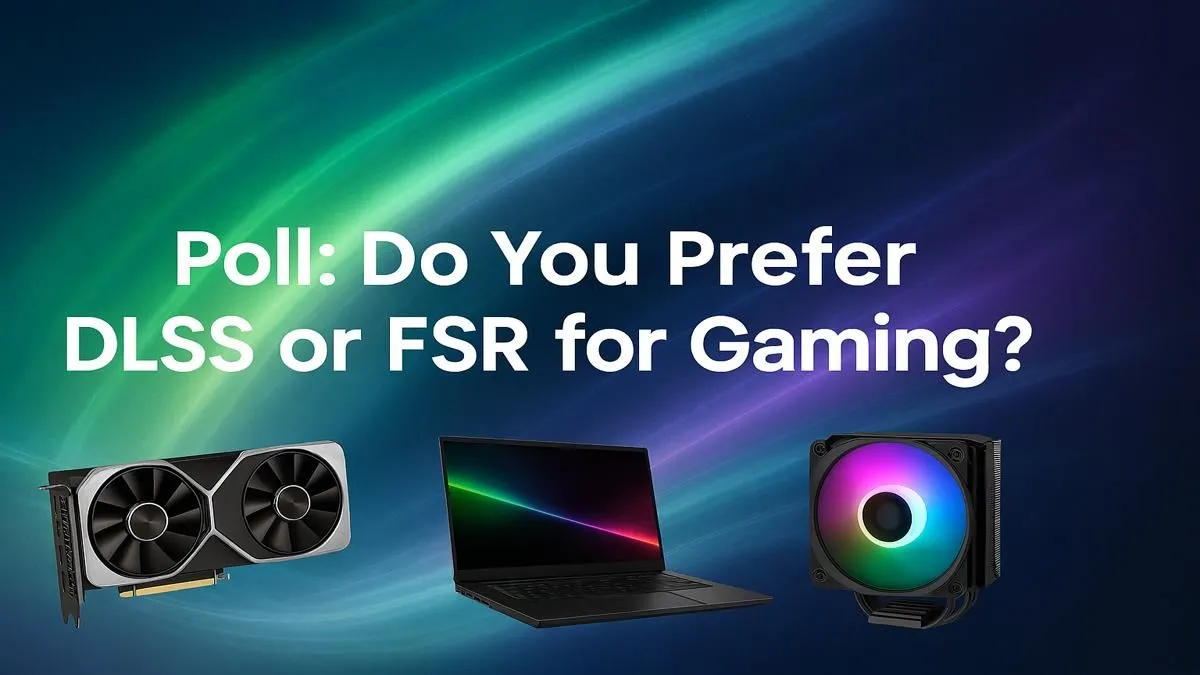
Hitting that sweet spot of high frame rates and stunning visuals can feel like a constant battle in PC gaming. What if you could get a massive FPS boost without spending a single Rand? That's the magic promised by AI upscaling. But with two titans in the ring, the choice of DLSS vs FSR can be confusing. Let's break down which AI upscaling tech is the right choice for your South African gaming rig. 🚀
What is AI Upscaling and Why Should You Care?
At its core, AI upscaling is a clever trick. Your graphics card renders a game at a lower resolution (like 1080p) and then uses sophisticated AI algorithms to intelligently scale it up to your monitor's native resolution (like 1440p or 4K).
The result? You get performance that's much closer to the lower resolution, but with a visual quality that's almost indistinguishable from the higher one. It's the key to unlocking smooth, high-refresh-rate gaming on demanding titles without needing a top-of-the-line GPU.
The Green Team's Champion: NVIDIA DLSS
For gamers running Team Green hardware, NVIDIA’s Deep Learning Super Sampling (DLSS) is often the first port of call. This clever tech uses dedicated AI processors, called Tensor Cores, found on the latest NVIDIA GeForce RTX graphics cards to reconstruct images with incredible detail.
Because it uses machine learning trained on super-high-quality offline renders, DLSS has a reputation for producing a sharp, stable image that sometimes looks even better than native resolution. The main catch is its exclusivity—you need an RTX card to join the club.
The Red Team's Challenger: AMD FSR
On the other side of the DLSS vs FSR debate is AMD's FidelityFX Super Resolution (FSR). FSR’s superpower is its accessibility. Because it's an open-source technology, it doesn't require specialised hardware. This means it works on a huge variety of GPUs, including all the powerful AMD Radeon graphics cards and even older NVIDIA models.
While early versions of FSR weren't quite as crisp as DLSS, the latest iterations (FSR 2 and 3) have closed the gap significantly, offering fantastic performance gains for everyone.
The Big Showdown: DLSS vs FSR Head-to-Head
So, how do the two leading AI upscaling technologies stack up against each other? The answer usually depends on what you prioritise.
Image Quality ✨
Generally, the consensus is that NVIDIA DLSS holds a slight edge in pure image fidelity. Its AI-based reconstruction often does a better job of preserving fine details and minimising visual artefacts like "ghosting" on moving objects. However, AMD's FSR has made huge strides, and in many games, you'd be hard-pressed to tell the difference without pausing and zooming in.
Performance Boost
Both technologies provide a massive FPS uplift, often turning unplayable frame rates into a smooth 60+ FPS experience. The exact gains vary by game, your hardware, and the quality setting you choose, but neither will leave you disappointed in the performance department.
Pro Gamer Tip ⚡
Always start with the "Quality" mode in either DLSS or FSR. The performance boost is still significant, and it preserves the most image detail. Only drop to "Balanced" or "Performance" if you're really struggling to hit your target frame rate, like 60 FPS in a demanding single-player game or 144+ FPS in a competitive shooter.
Hardware Compatibility
This one is an easy win for Team Red. FSR's open-source nature means it runs on almost any modern graphics card from any brand. DLSS is a fantastic piece of tech, but it's locked into NVIDIA's RTX ecosystem.
The Verdict: Which AI Upscaling Tech is for You?
When choosing between DLSS or FSR, the decision is actually quite simple and comes down to the card in your PC.
- If you own an NVIDIA RTX 20, 30, or 40-series card: Use DLSS. You have the dedicated hardware for it, and it will almost always provide the best possible balance of image quality and performance.
- If you own an AMD graphics card or an older non-RTX NVIDIA card: Use FSR. It’s an incredible technology that brings modern performance features to a massive range of hardware, ensuring you're not left out of the high-FPS party.
Ultimately, both DLSS and FSR are fantastic technologies that make PC gaming more accessible and enjoyable. They let you crank up the eye candy or push for higher refresh rates, giving you the power to optimise your experience just the way you like it.
Ready to Boost Your FPS?
Whether you're Team Green or Team Red, the right graphics card is your ticket to silky-smooth frame rates. The DLSS vs FSR debate shows that modern GPUs offer incredible performance. Explore our incredible graphics card deals and find the perfect upgrade for your rig today.