

Quick Answer
For most SA gamers, a curved monitor delivers a more immersive experience and reduces eye strain during long sessions, while flat monitors remain the preferred choice for competitive esports play and multi-monitor desk setups. The right choice depends on your gaming style, budget, and desk space.
Choosing between a flat and curved monitor is one of the most debated decisions in the SA gaming community. Both panel types have matured significantly in recent years, and each has a genuine place depending on how you play and what you value most in front of a screen. This guide unpacks the real-world differences so you can make a confident decision before spending your Rands.
Understanding the Curvature Difference
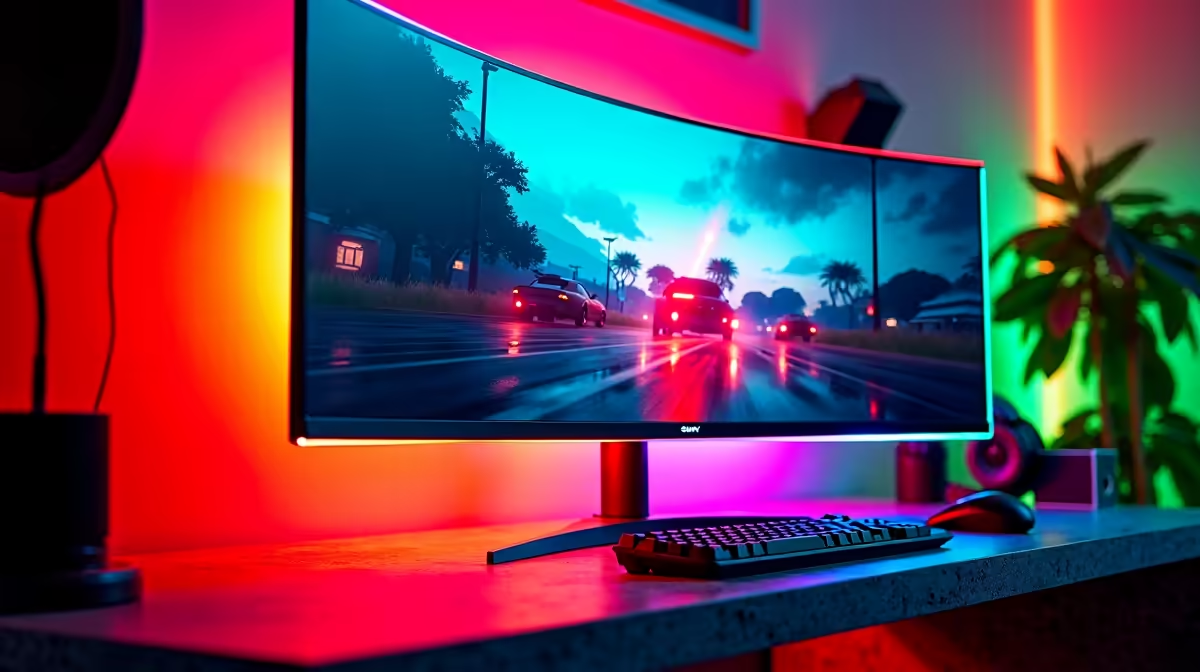
Curvature is measured in a radius figure - the most common being 1800R, 1500R, and 1000R, where a smaller number means a tighter, more aggressive curve. A 1800R curved monitor means the screen forms an arc matching a circle with an 1,800mm radius. For gaming, tighter curvatures (1500R and below) create a more pronounced wrap-around effect that can feel more natural to the eye''s own curved field of vision. Flat monitors have no curvature at all and present a perfectly planar image surface. For standard 24-inch to 27-inch monitors, curvature is subtle and the practical difference between flat and curved is relatively small. The real immersive payoff of curvature becomes more apparent on ultrawide and 32-inch-plus panels.
Immersion and Eye Comfort
Curved monitors are widely regarded as more comfortable for extended gaming sessions. The curvature reduces the degree to which your eyes need to scan across the screen, keeping more of the display within your optimal focal plane. This is particularly noticeable on wider panels where the edges of a flat screen can be harder to focus on from a typical seating distance. South African gamers who spend long evenings on RPGs, open-world titles, or strategy games often report that a curved panel feels less fatiguing over hours of play. Flat monitors are perfectly comfortable for most people and remain the standard in competitive esports environments where edge distortion or minor curvature inconsistencies could theoretically affect pixel-precise aim.
Competitive Gaming and Professional Use
The competitive gaming and esports scene in SA - as globally - predominantly uses flat monitors. There are practical reasons for this: flat panels have no edge distortion, they are easier to colour-calibrate uniformly, and they work better in multi-monitor setups where bezels need to align. If your priority is ranked play in shooters like CS2 or Valorant, a flat 24-inch or 27-inch monitor at 1080p or 1440p with a fast refresh rate is the conventional choice. Many professional and semi-professional SA players stick to flat panels simply because that is what tournament infrastructure uses, keeping their practice environment consistent with competition conditions.
Price Reality in South Africa
In the South African market, curved monitors carry a premium over comparable flat panels at the same resolution and refresh rate. That said, the price gap has narrowed considerably. Entry-level curved 27-inch 1080p panels are now accessible at prices that many SA gamers can justify, while flat panels at the same spec remain slightly more affordable. When budgeting, factor in that a curved ultrawide (21:9 or 32:9) will cost meaningfully more than a standard flat widescreen, and these wide curved panels often demand a more powerful GPU to run at native resolution - an additional spend consideration for SA buyers working with a fixed rig budget.
Frequently Asked Questions
Q: Is a curved monitor better for single-player games? A: Yes, curved monitors genuinely enhance immersion in single-player, open-world, and cinematic games. The wrap-around effect draws you into the scene more effectively than a flat panel, especially on 27-inch and larger screens.
Q: Do curved monitors affect aim in FPS games? A: Most players report no negative impact on aim. Some competitive players prefer flat panels for their perfectly uniform geometry, but for casual to mid-level play, curvature has no meaningful effect on aiming performance.
Q: Are curved monitors worth the extra cost in SA? A: If you game for extended sessions and value immersion, the extra spend is often justified. If your priority is budget or competitive esports, a quality flat panel at the same price point may deliver better value.
Q: Can I use a curved monitor for work and content creation? A: Yes, though colour-critical professional work benefits from flat IPS panels which are easier to calibrate uniformly. For general office work and content consumption, a curved monitor is perfectly suitable.
Ready to Find Your Perfect Match? Find your ideal gaming monitor - flat or curved - at Evetech.











