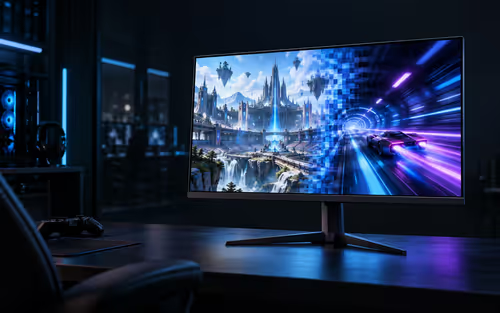
You’re in the final circle in Warzone. It’s a 1v1. You peek around a rock, line up the perfect headshot… and your screen splits in half with a jarring horizontal tear. Your aim falters, and you’re sent back to the lobby. Sound familiar? This is screen tearing, and it’s a massive pain for South African gamers. The battle of FreeSync vs G-Sync in South Africa is all about eliminating this problem for good. Let's dive in.
What is Screen Tearing Anyway?
Before we can solve the problem, let's quickly diagnose it. Screen tearing happens when your graphics card (GPU) sends out frames at a different rate than your monitor can display them.
Imagine your monitor has a fixed refresh rate of 60Hz. It draws a new image 60 times per second, top to bottom. But your powerful GPU might be pumping out 85 frames per second (fps). When the monitor is halfway through drawing one frame, the GPU sends a new one. The monitor then starts drawing the new frame from that halfway point, creating a "tear" where two different frames are displayed at once. It's distracting at best and can cost you the match at worst. ✨
The Solution: How Adaptive Sync Works
This is where adaptive sync technology comes in. Instead of a fixed refresh rate, it allows your monitor to dynamically adjust its refresh rate to match the frame rate of your GPU in real-time. If your GPU outputs 73fps, your monitor refreshes at 73Hz. If it drops to 54fps, the monitor follows suit.
The result? Perfectly smooth, tear-free gameplay. The two main players in this space are AMD's FreeSync and NVIDIA's G-Sync, and you'll find both across our entire range of PC monitors.
AMD FreeSync: The People's Champion 🏆
FreeSync is AMD's answer to screen tearing. Its biggest advantage is that it's an open, royalty-free standard built into the DisplayPort connection. This means monitor manufacturers don't have to pay a licensing fee to include it.
For you, the gamer in South Africa, this translates to more choice and more affordable prices. You can often find fantastic FreeSync-enabled screens in our list of great monitor deals, making smooth gameplay more accessible than ever.
There are three tiers:
- FreeSync: The basic, tear-eliminating standard.
- FreeSync Premium: Adds mandatory low framerate compensation (LFC) and at least a 120Hz refresh rate at 1080p.
- FreeSync Premium Pro: Includes everything from Premium, plus optimised support for HDR (High Dynamic Range) content.
NVIDIA G-Sync: The Premium Experience
G-Sync is NVIDIA's proprietary solution, and it historically took a different approach. The highest tiers (G-Sync and G-Sync Ultimate) use a dedicated hardware module inside the monitor. This chip communicates directly with your NVIDIA GeForce GPU, ensuring a flawlessly smooth experience that passes over 300 rigorous tests for image quality and performance.
This hardware-based approach generally means G-Sync monitors come with a higher price tag in ZAR. However, the quality and consistency are undeniable. To compete with FreeSync's popularity, NVIDIA also introduced "G-Sync Compatible." These are essentially top-tier FreeSync monitors that NVIDIA has tested and certified to provide a great variable refresh rate experience with their GPUs. You can browse through all our gaming monitors to see the wide variety available.
Pro Tip: G-Sync on a FreeSync Monitor? 🔧
Many FreeSync monitors work with NVIDIA's G-Sync Compatible mode, even if they aren't officially certified! If you have an NVIDIA 10-series GPU or newer, dive into the NVIDIA Control Panel. Under "Set up G-SYNC," you can enable it for your display. It might take some tweaking, but you can often get tear-free gaming without paying the 'G-Sync tax'.
FreeSync vs G-Sync South Africa: The Final Showdown
So, when it comes to the FreeSync vs G-Sync South Africa debate, which one is right for your rig? Let's break down the key differences.
### Cost and Accessibility
This is the biggest differentiator. FreeSync monitors are almost always more affordable than their G-Sync counterparts with the dedicated hardware module. If you're building a PC on a tight budget, FreeSync is the clear winner, offering incredible value.
### Hardware Requirements
This is simple:
- FreeSync: Requires an AMD Radeon GPU (or a modern NVIDIA GPU for G-Sync Compatible mode).
- G-Sync: Requires an NVIDIA GeForce GPU.
Your choice of graphics card will heavily influence your monitor decision, and vice-versa.
### Performance and Features
While G-Sync's dedicated module once gave it a clear performance edge, the gap has narrowed significantly. A FreeSync Premium Pro monitor can go toe-to-toe with a G-Sync display, especially for the average gamer. Where G-Sync Ultimate still shines is at the absolute high end, with superior HDR implementation and variable overdrive on premium high-resolution 4K monitors.
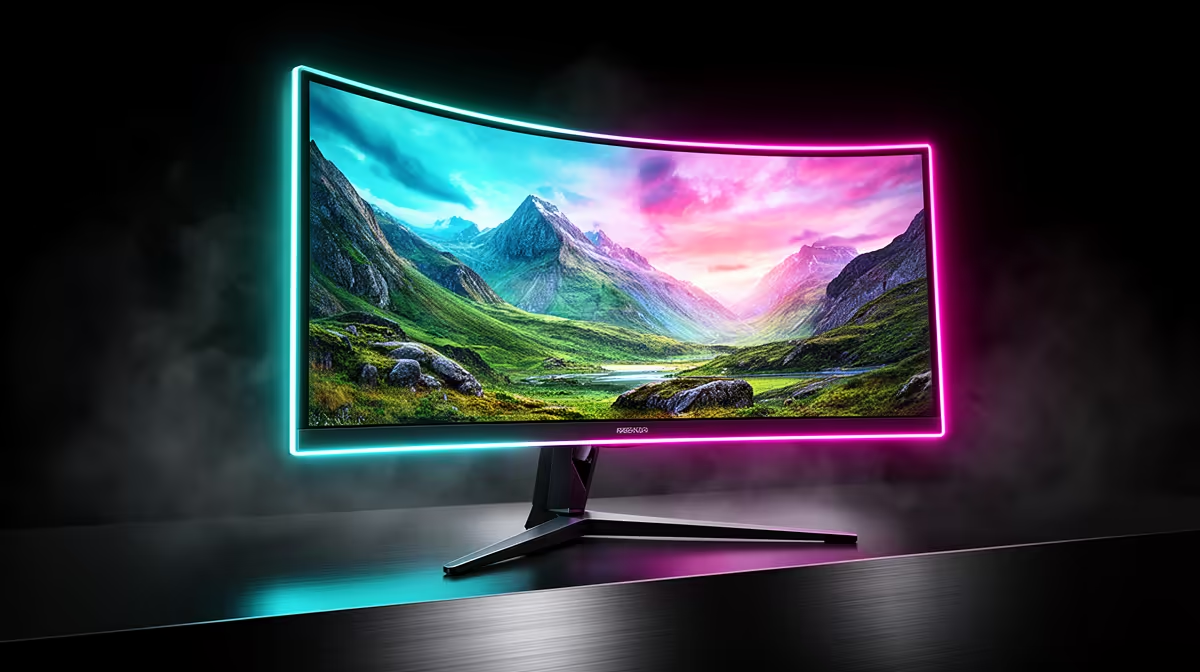
Ultimately, the technology is now available across a huge variety of displays, from huge immersive curved monitors to niche products like even portable monitors.
The Verdict: Which Should You Buy? 🚀
Choosing between FreeSync and G-Sync in South Africa in 2024 is less about which is "better" and more about which is "better for you."
- Go for FreeSync if: You have an AMD GPU, you're budget-conscious, or you want the widest possible selection of monitors.
- Go for G-Sync if: You have an NVIDIA GPU and want the guaranteed, out-of-the-box premium experience with no compromises, especially for high-end competitive gaming.
- The Sweet Spot: For most NVIDIA users, a "G-Sync Compatible" monitor (which is a FreeSync monitor) offers the best of both worlds—smooth gameplay and great value.
Once you've picked your panel, don't forget to grab the right monitor accessories like a quality VESA mount or DisplayPort cable to complete your setup.
Ready to Banish Screen Tearing for Good? The FreeSync vs G-Sync debate comes down to your budget and GPU, but the perfect tear-free experience is out there. Explore our huge range of gaming monitors and find the display that will take your gameplay to the next level.