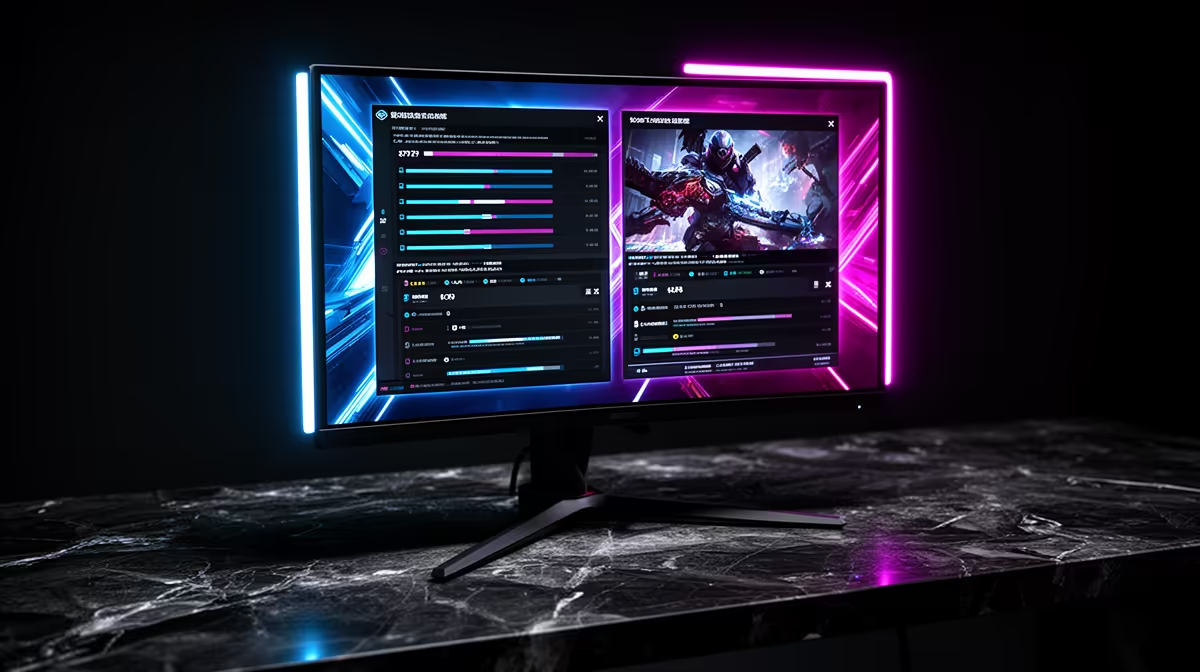
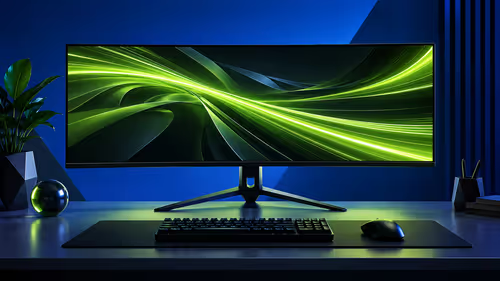
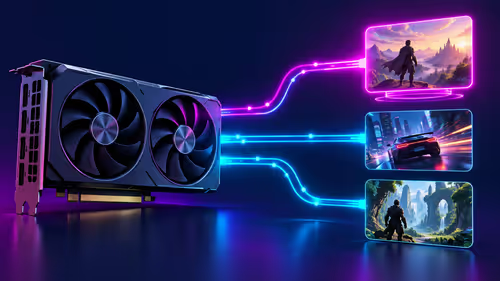
Here in South Africa, every watt counts. Between outage schedules and rising electricity costs, we're all looking for ways to trim the fat from our power bills. But have you ever considered your gaming monitor? That glorious screen is a key part of your rig, but could its adaptive sync technology be a secret power vampire? We put the two titans, AMD FreeSync and NVIDIA G-Sync, head-to-head to settle the score on their power consumption.
The Sync Showdown: A Quick Refresher
Before we dive into the numbers, let's quickly recap what these technologies do. Both FreeSync and G-Sync are forms of Variable Refresh Rate (VRR) or adaptive sync. Their job is to synchronise your monitor's refresh rate with the frames-per-second (FPS) your graphics card is producing. This eliminates ugly screen tearing and stuttering, giving you a buttery-smooth visual experience.
The main difference lies in the hardware. G-Sync traditionally requires a proprietary NVIDIA hardware module inside the monitor, while FreeSync is an open standard built into the DisplayPort specification. This fundamental design choice is the key to understanding the FreeSync vs G-Sync power consumption debate.
FreeSync vs G-Sync Power Consumption: The Evetech Lab Test
So, which one sips power and which one gulps it down? To get a clear answer for our fellow South African gamers, we ran some tests.
Our Testing Methodology
We took two comparable 27-inch, 1440p, 165Hz gaming monitors. One was G-Sync certified with a dedicated hardware module, and the other was a FreeSync Premium model. We measured the total system power draw from the wall using a Kill A Watt meter while running a demanding benchmark in Cyberpunk 2077 for 30 minutes, with VRR enabled on both setups.
The South African Test Results Revealed ⚡
The results were consistent and clear. The monitor with the dedicated G-Sync module caused the system to draw, on average, 10-15 watts more than the FreeSync system under identical gaming loads.
While idling on the desktop, the G-Sync monitor also had a slightly higher power draw, typically around 5-8 watts more. This might not sound like a mountain of difference, but over thousands of gaming hours, those watts add up. It's a factor worth considering when browsing the latest PC monitor deals.
Why the Difference in Power Draw?
The power consumption gap between G-Sync and FreeSync comes down to that dedicated hardware module. The NVIDIA G-Sync scalar module is an extra piece of processing hardware inside the monitor that is always active, managing the sync process. This chip requires constant power to operate, hence the higher idle and load consumption.
FreeSync, on the other hand, leverages the existing DisplayPort Adaptive-Sync standard. It doesn't need an extra, power-hungry chip. The logic is handled by the GPU and the monitor's standard scaler, making it a more energy-efficient solution. This efficiency is especially noticeable on versatile portable monitors where battery life is paramount.
Optimise Your Monitor's Power Settings 🔧
modern monitors have an 'Eco Mode' or power-saving setting. While not ideal for competitive gaming, it's perfect for browsing or work. Also, ensure 'Sleep Mode' is enabled in your OS. This simple step can save a surprising amount of power, especially if you often step away from your PC. Don't forget to grab the right [monitor accessories](https: www.evetech.co.za buy-monitor-accessories-368.aspx) like a good quality DisplayPort cable to ensure all features work correctly.
Does It Really Matter for Your Eskom Bill?
Let's be realistic. An extra 15 watts is not going to suddenly plunge you into the next prolonged outage periods. It's roughly the equivalent of leaving a modern LED light bulb on. However, for the eco-conscious gamer or someone building a highly optimised, low-power rig, it's a tangible data point.
The choice often comes down to your priorities. Are you chasing the absolute pinnacle of performance, where the rigorous testing of a G-Sync Ultimate certification on high-end 5K & 4K monitors gives you peace of mind? Or do you prefer the value, efficiency, and wider selection offered by the vast world of FreeSync gaming monitors?
Ultimately, both technologies deliver a fantastic, tear-free gaming experience. The slight edge in power efficiency for FreeSync is just one more factor to consider when you're choosing from the wide array of excellent PC monitors available today. For many, the immersion from stunning curved monitors will far outweigh the minor power difference.
Ready for a Tear-Free, Power-Smart Upgrade?
The FreeSync vs G-Sync power consumption debate shows how deep the tech goes. But the best monitor is the one that fits your rig, your style, and your budget. Explore our massive range of gaming monitors and find the perfect screen to dominate your game.