So, you've just unboxed your shiny new rig, or maybe your trusty old machine is starting to feel a bit... sluggish. You fire up a game, and the framerate stutters just as you're about to clutch the round. Sound familiar? The big question is: how powerful is your PC, really? A proper gaming PC benchmark is the only way to get the cold, hard data and see exactly what your hardware is capable of. 🚀
What Exactly is a Gaming PC Benchmark?
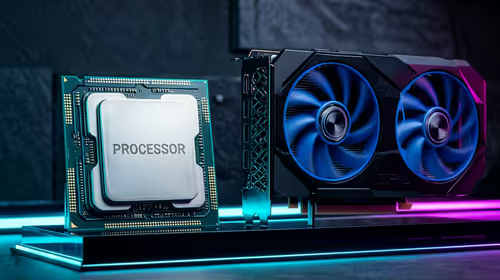
Think of a gaming PC benchmark as a stress test or an exam for your computer. It's a standardised process that pushes your components—primarily your graphics card (GPU) and processor (CPU)—to their limits to measure their performance. The results give you concrete numbers, like frames per second (FPS), scores, and temperature readings, which you can use to compare your rig to others or track its performance over time.
This isn't just for bragging rights. A good PC performance test helps you:
- Identify Bottlenecks: Is your CPU holding back your new GPU?
- Troubleshoot Issues: Are high temperatures causing performance drops?
- Plan Upgrades: Know exactly which component will give you the biggest boost.
- Optimise Settings: Find the perfect balance of visual quality and smooth gameplay.
The Best Tools for Testing Your Rig's Performance
You don't need a degree in computer science to benchmark your gaming PC. There are plenty of user-friendly tools available, both free and paid. They generally fall into two categories:
Synthetic Benchmarks
These are specialised programs designed to run a series of intense, pre-defined graphical tests. They produce a score that makes it easy to compare your system against a global database.
- 3DMark: The industry standard. Its Time Spy and Fire Strike tests are fantastic for modern DirectX gaming PCs.
- Cinebench: This one focuses purely on your CPU's performance, which is crucial for tasks beyond gaming, like streaming or video editing.
In-Game Benchmarks
Many modern games come with their own built-in benchmark tools. These are excellent for getting a real-world idea of how your PC will handle that specific title. Running the built-in test for a demanding simulation like Microsoft Flight Simulator will give you a much clearer picture than a synthetic score alone. If a game doesn't have a built-in tool, you can use software like MSI Afterburner to display your FPS during normal gameplay.
Get Clean Results ⚡
Before running any gaming PC benchmark, make sure to create a 'clean' environment. Close all background applications... yes, even your browser with 50 tabs open! Update your graphics drivers to the latest version and restart your PC. This ensures the benchmark is measuring your hardware's true potential, not its ability to multitask.
How to Interpret Your Benchmark Scores
Okay, so you've run the tests and you have a bunch of numbers. What do they mean? It all depends on your goal. A score that’s perfect for the slick, competitive gameplay of Overwatch 2 might not be enough for cinematic, graphically intense experiences.
- For Competitive Gamers (144+ FPS): If you're playing high-refresh-rate titles like Counter-Strike 2 or dropping into fast-paced action in Call of Duty: Warzone, your primary focus is maximum FPS. You want your average framerate to be at or above your monitor's refresh rate (e.g., 144Hz, 240Hz) at your desired resolution (usually 1080p) to ensure the smoothest possible experience. A stable frame time is key here.
- For AAA Enthusiasts (60+ FPS at High/Ultra): For those who want to soak in the stunning ray-traced visuals in Cyberpunk 2077 or explore the sprawling city of Los Santos on a capable GTA V machine, the goal is a consistent 60 FPS or higher at 1440p or 4K with the graphics settings cranked up. Here, the GPU score from a benchmark like 3DMark Time Spy is a great indicator of performance.
- For All-Rounders & Casual Gamers: If you jump between different genres, from the vibrant battlegrounds of Fortnite to dropping into Erangel on a PUBG-ready PC, a solid 60-100 FPS at 1080p or 1440p is a fantastic target. Even a heavily modded Minecraft world can benefit from a rig that has been properly tested and optimised. 🔧
Ultimately, a gaming PC benchmark is your personal report card. It tells you where you stand and empowers you with the knowledge to get the best possible performance from your hardware. So go on, run some tests... the numbers don't lie.
Not Hitting the Numbers You Want?
A gaming PC benchmark is your best tool for knowing when it's time to level up. If your scores are looking a bit tired, don't just dream about higher frames... make it a reality. Explore our legendary range of gaming PCs and find the perfect rig to dominate the leaderboards.