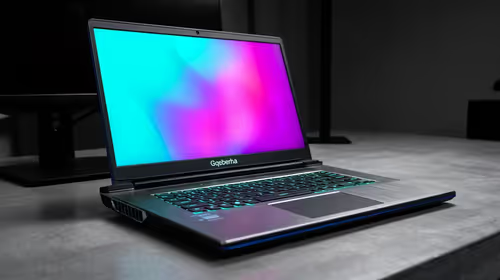
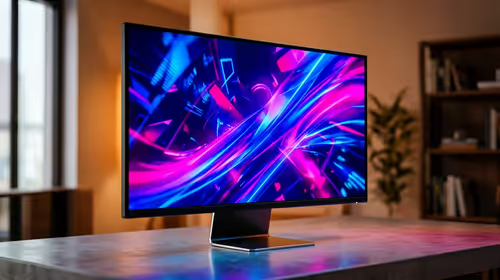
Picture this: you're in the final circle in Warzone, lining up the perfect shot... and your screen tears in half. That jarring visual glitch is screen tearing, the enemy of smooth gameplay. Luckily, there's a fix: gaming sync technology. But with NVIDIA's G-Sync and AMD's FreeSync battling it out, which one is right for your rig?
This quick quiz will help you find your perfect match in South Africa and get you back to winning. 🚀
What is Gaming Sync Technology and Why Should You Care?
Ever noticed how your game stutters or shows a weird horizontal line during fast action? That's your graphics card (GPU) and monitor falling out of sync. Your GPU is rendering frames faster or slower than your monitor can display them, causing visual chaos.
Gaming sync technology, also known as adaptive sync, solves this. It forces your monitor to match its refresh rate to the exact frame rate your GPU is putting out, in real-time. The result? Buttery-smooth visuals, no tearing, and less input lag. It’s a must-have for any serious gamer, and you can find it across a huge selection of PC monitors available today.
G-Sync vs. FreeSync: The Main Event
At the heart of the gaming sync technology debate are two main players:
- NVIDIA G-Sync: This is NVIDIA's proprietary tech. Traditionally, it required a special hardware module inside the monitor, which often meant a higher price tag. It's known for its rigorous testing and premium performance.
- AMD FreeSync: This is AMD's open-standard alternative. Because it doesn't require a specific hardware chip, FreeSync monitors are generally more affordable and widely available.
The lines have blurred recently with "G-Sync Compatible" displays, which are essentially FreeSync monitors that NVIDIA has tested and certified to work well with their GPUs. This gives gamers more choice than ever. To see how this affects pricing, you can always check out the latest PC monitor deals in ZAR.
Take the Quiz: Find Your Perfect Gaming Sync Match
Ready to find your ideal setup? Just answer these simple questions to pinpoint the right gaming sync technology for you.
### 1. Which Graphics Card is Powering Your Rig?
This is the most important question. Your choice of GPU locks you into one ecosystem.
- "I have an NVIDIA GeForce (RTX or GTX) card."
You're in Team Green's camp. Your best options are a premium G-Sync or G-Sync Ultimate monitor for guaranteed top-tier performance. For more flexibility and value, a G-Sync Compatible monitor is an excellent choice.
- "I'm running an AMD Radeon (RX) card."
You're with Team Red. FreeSync is your native choice. With three tiers (FreeSync, FreeSync Premium, and FreeSync Premium Pro), you can pick a monitor that matches your performance needs, from basic tear-elimination to HDR-ready gaming.
### 2. What's Your Gaming Style and Priority?
How you play determines what kind of display will feel best.
- "I'm a competitive legend in Valorant & CS2."
You need speed and responsiveness above all. A high-refresh-rate (240Hz+) monitor with the lowest possible input lag is key. The specific sync tech is less critical than raw speed, but having it ensures a smooth experience. You'll find your fit when you browse all our gaming monitors.
- "I get lost in cinematic worlds like Cyberpunk 2077 & Starfield."
Immersion is your goal. You'll want a display with amazing colour, deep blacks, and a grand scale. This is where our stunning curved monitors truly shine, wrapping the game world around you. Pairing this with FreeSync Premium Pro or G-Sync Ultimate will make those worlds pop with HDR.
- "I need a flexible setup for work, play, and travel."
Your needs are diverse. While your main monitor will be your gaming hub, don't forget that a second screen can boost productivity. There are even versatile portable monitors for gamers on the go.
### 3. Are You Chasing Pixels or Performance?
Resolution plays a massive role in your experience and GPU demand.
- "Give me every single detail! 4K or bust."
If visual fidelity is everything, one of the jaw-dropping 4K and 5K monitors is for you. Be warned: you'll need a powerful GPU (like an RTX 4080 or RX 7900 XTX) to run modern games smoothly at this resolution. Here, a top-tier sync technology is essential to smooth out any frame drops.
- "I prefer high frame rates at 1080p or 1440p."
This is the sweet spot for most South African gamers. 1440p (QHD) offers a sharp image without demanding a monster GPU, allowing you to push for higher refresh rates. 1080p (FHD) remains the king for competitive esports where every frame counts.
Activation is Key! 🔧
Just buying a G-Sync or FreeSync monitor isn't enough! Remember to enable the feature in your NVIDIA Control Panel or AMD Radeon Software. It's usually a simple checkbox, but it's the final step to unlocking that buttery-smooth, tear-free gaming experience. Check your monitor's settings too, as you may need to enable it there first.
Beyond Sync: Don't Forget the Essentials
While gaming sync technology is crucial, it's part of a bigger picture. When choosing your monitor, also consider:
- Refresh Rate (Hz): How many times your screen updates per second. 144Hz is the modern standard for gaming, with 240Hz+ for the competitive elite.
- Response Time (ms): How quickly pixels can change colour. 1ms is the goal for eliminating motion blur or "ghosting."
- Panel Type: IPS for best colours, VA for best contrast, and TN for the absolute fastest response times.
Once you've picked your screen, you can complete your setup with essential monitor accessories like mounts and cleaning kits to keep it in prime condition. ✨
Ready to Find Your Perfect Match?
Choosing the right gaming sync technology transforms your experience from frustrating to flawless. Armed with this knowledge, you're ready to pick a winner. Explore our massive range of gaming monitors and find the perfect screen to conquer your world.