

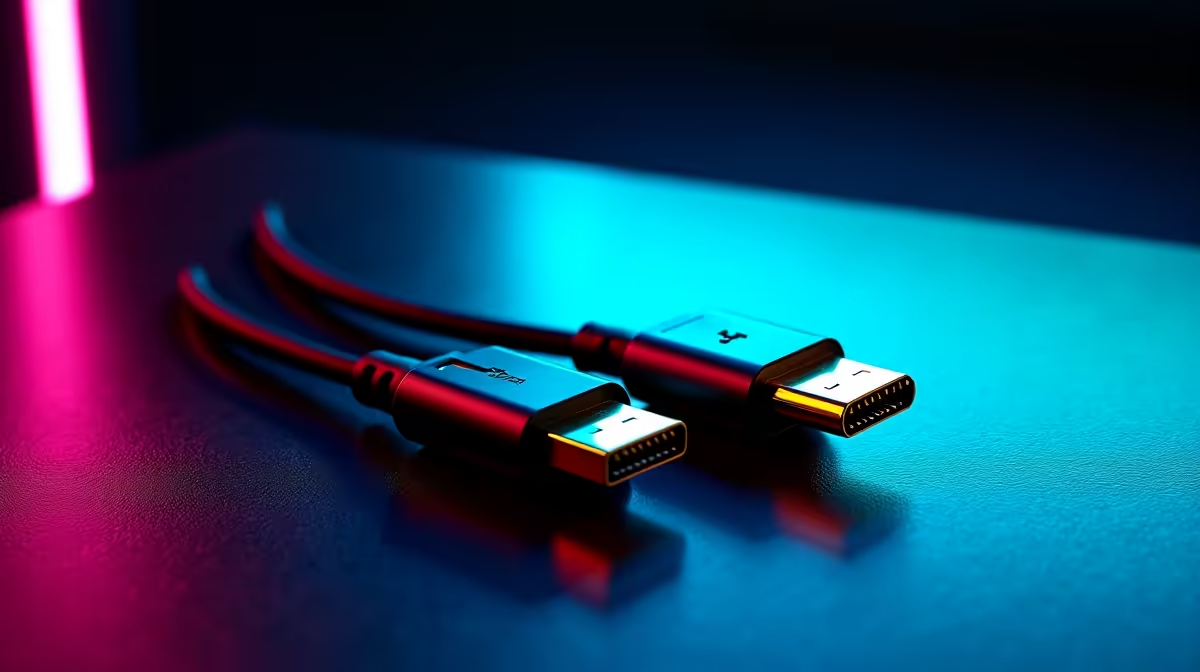
Quick Answer
For TV gaming in South Africa, HDMI 2.1 is the better choice because all modern gaming TVs use HDMI as their primary input standard, supporting 4K 120Hz and VRR without adapters. DisplayPort 2.1 is faster in raw bandwidth but is absent on virtually all consumer TVs, making it irrelevant for TV-based gaming setups.
The HDMI 2.1 versus DisplayPort 2.1 debate looks different when a TV is the display rather than a monitor. South African gamers who build living room setups around large 4K TVs are working in a world where HDMI dominates and DisplayPort is all but absent. Understanding why - and knowing where DisplayPort still wins - helps you make the right connection choice for your specific setup and hardware.
HDMI 2.1: Built for TVs and Console Gaming
HDMI 2.1 was designed with both TV broadcasting and gaming in mind. It supports 4K at 120Hz, 8K at 60Hz, and includes features like VRR (Variable Refresh Rate), ALLM (Auto Low Latency Mode), and eARC (Enhanced Audio Return Channel) that are all relevant to TV gaming. Every current-generation gaming TV - including OLED, QLED, and Mini-LED panels available in South Africa from major brands - has HDMI 2.1 ports. If you are connecting a PlayStation 5, Xbox Series X, or a gaming PC to your TV, HDMI 2.1 is the only cable you need for a full-featured experience. The 48Gbps bandwidth of HDMI 2.1 is sufficient for 4K 120Hz with HDR10 without compression, and with DSC it handles higher resolutions and refresh rates.
DisplayPort 2.1: Superior Specs, Wrong Ecosystem for TVs
DisplayPort 2.1 offers up to 80Gbps of raw bandwidth, significantly more than HDMI 2.1. It handles native 4K 240Hz, 8K 165Hz, and dual 4K 144Hz streams simultaneously without compression. For a high-end gaming monitor setup, DisplayPort 2.1 is genuinely superior. The problem for TV gaming is simple: consumer TVs do not have DisplayPort inputs. None of the TVs sold in South Africa's major electronics retail channels include a DisplayPort port. This makes DisplayPort 2.1 technically irrelevant for TV gaming regardless of its specifications. An HDMI to DisplayPort active adapter is not a reliable solution for gaming because most adapters do not support VRR and ALLM passthrough.
VRR, ALLM and Why TV Gaming Features Require HDMI
Variable Refresh Rate reduces screen tearing and judder on TV displays, which is particularly noticeable in fast-paced games played from a couch at 3 to 4 metres viewing distance. ALLM automatically switches your TV into its lowest input latency mode when a gaming source is detected. Both of these features are HDMI-specific in the TV context - they are part of the HDMI 2.1 feature set and are negotiated between the source and display over HDMI. DisplayPort has its own VRR standard (Adaptive Sync) but TVs are not equipped to receive it. If you want a gaming TV that responds to fast PC frame rate changes smoothly, HDMI 2.1 with G-Sync Compatible or FreeSync Premium support on the TV side is your only practical option.
When DisplayPort 2.1 Is the Right Answer
DisplayPort 2.1 wins clearly when you are connecting to a gaming monitor rather than a TV. Any monitor running above 4K 60Hz or at 1440p 360Hz genuinely benefits from DisplayPort 2.1's bandwidth advantage. It also wins for multi-monitor chaining via DisplayPort daisy-chain topologies, which HDMI does not support. If your South African gaming setup includes both a TV for console gaming in the lounge and a monitor at your desk, the correct answer is HDMI 2.1 for the TV and DisplayPort 1.4 or 2.1 for the monitor.
Frequently Asked Questions
Q: Can I use DisplayPort 2.1 to connect my gaming PC to a TV in South Africa? A: Not directly. No consumer TV on the SA market includes a DisplayPort input. You would need an active adapter, which typically loses VRR and ALLM support. HDMI 2.1 is the practical connection standard for TV gaming.
Q: Does HDMI 2.1 support 4K 120Hz without compression? A: Yes. HDMI 2.1's 48Gbps bandwidth supports native uncompressed 4K at 120Hz with HDR10 colour, which is all current gaming hardware can deliver to a TV anyway.
Q: Do South African TVs support G-Sync over HDMI 2.1? A: Several gaming TVs sold in SA are G-Sync Compatible certified, meaning NVIDIA GPUs can use VRR over HDMI 2.1 on these displays. Check the specific TV's spec sheet for G-Sync Compatible or FreeSync support. Not all TVs in SA include this feature.
Q: Is HDMI 2.0 enough for gaming in 2026? A: For 1080p and 1440p gaming it works fine. For 4K 120Hz gaming, HDMI 2.0's 18Gbps bandwidth is insufficient without heavy compression, and it does not support VRR on TVs. Upgrading to a TV with HDMI 2.1 is worthwhile if 4K gaming performance matters to you.
Ready to Find Your Perfect Match? Shop gaming PCs and accessories built for 4K TV gaming at Evetech.











