Quick Answer
The Intel Arc B580 delivers strong Minecraft Java Edition performance, achieving 200 to 400+ FPS at 1080p with vanilla settings and sustaining smooth framerates even with popular shader packs when configured correctly.
Intel Arc B580 Overview and Why It Matters for Minecraft
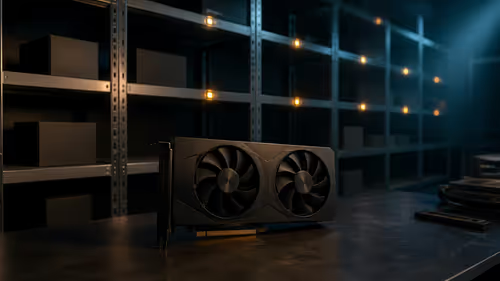
The Intel Arc B580 represents a turning point for Intel's GPU ambitions. Built on the Battlemage architecture with 20 Xe2 cores and 12GB of GDDR6 VRAM, it targets the mid-range gaming segment that represents the bulk of South African GPU buyers. At its South African retail price sitting in the R8,000 to R10,000 range in 2026, it competes directly with other mid-range options while bringing a notably large VRAM buffer to the table.
For Minecraft specifically, the B580 has a few characteristics that make it particularly interesting. Minecraft Java Edition is a game that demands strong single-threaded CPU performance and benefits from fast memory more than raw shader throughput, which suits the B580's architecture. The 12GB VRAM buffer means even with high-resolution texture packs at 512x or higher, the card never has to manage VRAM overflow - a real limitation on 8GB competitors when running heavily modded instances.
Intel's driver maturity has also improved substantially since the A-series launch. The Battlemage driver stack optimises Minecraft Java Edition noticeably better than the original Arc Alchemist cards did, and XeSS (Intel's AI-based upscaling) is available in some Minecraft modpacks and launchers that have implemented it. For SA gamers building a PC around Minecraft and light gaming without exceeding a tight budget, the B580 sits in a genuinely compelling spot.
Benchmark Results: Vanilla, Optifine, and Shaders
In vanilla Minecraft Java Edition 1.21+ with default render distance of 12 chunks, the Arc B580 consistently produces framerates well above 200 FPS at 1080p on modern hardware - often sitting between 280 and 450 FPS depending on the biome and entity count. These are CPU-limited scenarios in most cases, meaning the B580 is waiting on the processor more than working hard itself. Paired with a Ryzen 5 7600 or Core i5-14600K, vanilla performance is essentially uncapped for practical purposes.
With Sodium (the most popular performance mod for Fabric), framerates climb further. Sodium's optimised rendering path plays particularly well with modern GPU architectures including Battlemage, and it is not uncommon to see 600+ FPS in low-complexity areas on optimised settings. South African players running servers hosted locally or in Johannesburg benefit from these high framerates because lower frametimes translate to smoother input response even when server-side tick rates impose their own ceiling.
Shader performance is where the B580 earns its reputation for value. With BSL Shaders at medium settings and 1080p, expect 60 to 90 FPS - playable and visually impressive. Complementary Shaders Unbound at medium quality produces similar results. Moving to a heavier shader pack like Kappa PT (a path tracing shader) drops performance to the 20 to 35 FPS range, which is below comfortable thresholds. For shader gaming on the B580, medium-tier packs are the sweet spot, and the 12GB VRAM means no compromises on texture resolution within those settings.
Best Settings for the Intel Arc B580 in Minecraft
For maximum performance in vanilla or lightly modded play, install Sodium plus Lithium (server-side tick optimisation) and ImmediatelyFast (UI rendering). Set render distance to 10 to 14 chunks depending on your CPU, enable VSync only if you need it (most competitive players disable it), and set entity shadows to minimal. With these settings the B580 runs Minecraft at framerates that make 144Hz and 165Hz monitors feel properly utilised.
For shader play, the Intel Arc B580 benefits from setting Minecraft's video settings render distance to 8 chunks before enabling shaders - this reduces the world geometry the shader needs to process. In the Intel Arc Control software, ensure Resizable BAR is enabled (it dramatically improves performance on Arc GPUs), and set the GPU performance preset to Maximum. These two driver-level settings alone can add 10 to 20% to shader framerates on the B580.
Texture packs are handled excellently by the 12GB VRAM buffer. Even at 512x resolution with PBR (physically-based rendering) textures designed for shader use, the B580 rarely exceeds 8GB VRAM usage in tested configurations. This gives headroom for mods, background applications, and the occasional streaming session. South African players who stream their gameplay to friends or platforms should note that the B580 includes Intel's ARC encoder (AV1 hardware encode), which delivers good stream quality with minimal performance hit compared to software encoding.
Minecraft Modpack Performance on the B580
Heavy modpacks that combine hundreds of mods - automation, magic, exploration, and dimension packs - load the system very differently from vanilla play. The Arc B580 handles these well from a VRAM standpoint but the performance ceiling becomes CPU-bound even faster than in vanilla. With a modpack like All the Mods 9 or Prominence II, expect 60 to 120 FPS at 1080p with standard settings depending on the dimension you are in, entity counts, and chunk generation activity.
The B580's shader compatibility has improved with recent driver updates, with most GLSL shader packs now functioning correctly where earlier Intel Arc drivers had rendering artefacts. If you are running an older Fabric or Forge modpack, check that you are on the latest Intel Arc driver release before diagnosing any visual issues as shader incompatibility.
For South African players who play on community servers running large modpacks, the B580 represents a meaningful upgrade from integrated graphics or entry-level discrete GPUs. The jump in texture streaming performance alone, enabled by 12GB of fast GDDR6, makes modded multiplayer in dense player areas significantly smoother than on 4GB or 6GB alternatives.
Frequently Asked Questions
Q: Does the Intel Arc B580 support ray tracing in Minecraft Bedrock Edition?
A: Yes. Minecraft Bedrock Edition's ray tracing (DXR) feature is supported by the Intel Arc B580. Performance in ray-traced Bedrock at 1080p is typically 30 to 60 FPS depending on the ray tracing world and settings, which is usable for casual exploration. Competitive or fast-paced play benefits from disabling ray tracing for higher framerates.
Q: Is the B580 better than older mid-range GPUs for Minecraft in South Africa?
A: The B580's primary advantage for Minecraft is its 12GB VRAM. Older mid-range GPUs with 6GB or 8GB VRAM can run into memory pressure with high-resolution texture packs and heavy shader packs simultaneously. If you are running heavily modded Minecraft with shaders, the B580's VRAM buffer is a genuine differentiator at its price point.
Q: Does Resizable BAR really matter for Minecraft on the B580?
A: Yes, more than on most other GPUs. Intel Arc architecture relies heavily on Resizable BAR (ReBAR) to perform at its rated level. Benchmarks consistently show 10 to 25% performance differences with ReBAR disabled versus enabled on Arc GPUs. Ensure your motherboard BIOS has Resizable BAR (also called Smart Access Memory on AMD platforms) enabled before benchmarking or comparing performance.
Q: What CPU pairs best with the Arc B580 for Minecraft in 2026?
A: Minecraft Java Edition is heavily single-threaded, so high clock speed matters more than core count. A Ryzen 5 7600X, Ryzen 7 7700X, or Intel Core i5-14600K are excellent pairing choices. These processors deliver the strong single-core performance that prevents CPU bottlenecking in Minecraft's tick and render pipeline, letting the B580 operate closer to its GPU-bound ceiling with shader packs active.
Also at Evetech: Intel Arc B580 Gaming PCs | All Graphics Cards
Ready to Find Your Perfect Match? Shop at Evetech