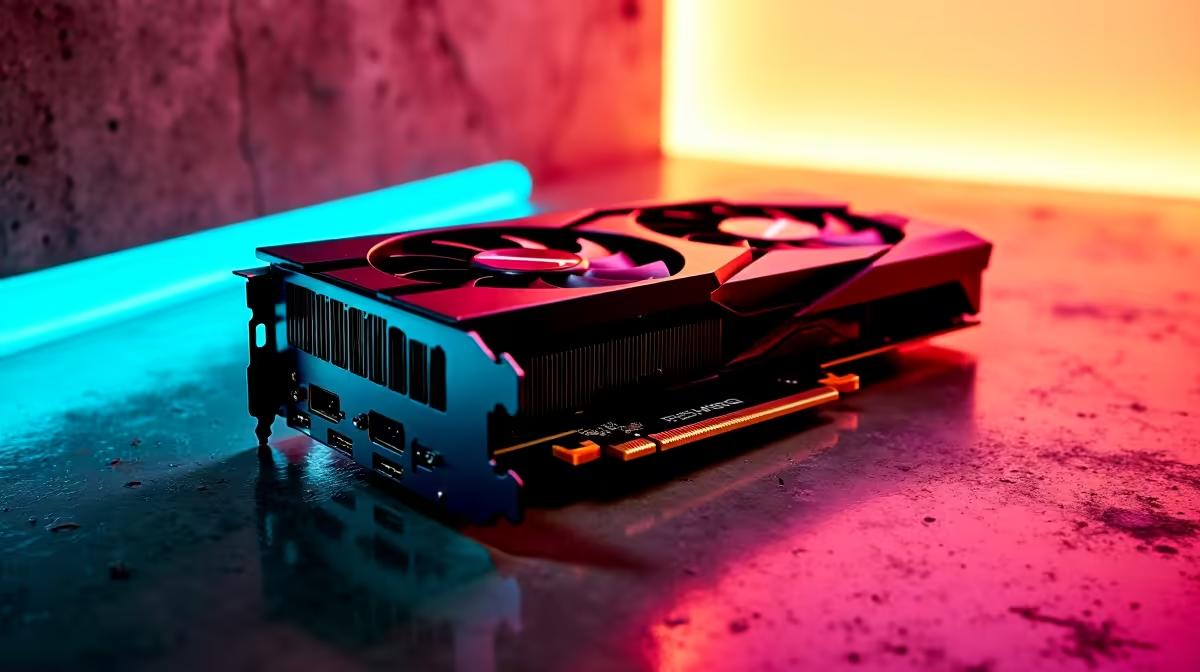
Intel's Arc B580 marked a significant turning point for Intel's GPU division - it is a genuinely competitive mid-range card that challenges established players on rasterisation performance, and it ships with hardware ray tracing support. But ray tracing performance has historically been a weak point for Intel Arc, and SA gamers considering the B580 deserve a clear-eyed answer to the question: is ray tracing worth enabling, and at what cost? This guide tests the B580's ray tracing performance across multiple scenarios and gives you a concrete recommendation for each resolution.
Quick Answer
The Intel Arc B580 supports hardware ray tracing but takes a significant performance hit - typically 35–50% frame rate reduction compared to rasterisation at equivalent quality settings. At 1080p, ray tracing at Low to Medium is manageable with XeSS upscaling. At 1440p, ray tracing is generally not recommended without XeSS, and even with upscaling, the quality trade-offs make it a niche choice for this card.
Rasterisation Baseline Performance 🔧
Before examining ray tracing impact, it is important to understand how the B580 performs without it. In rasterisation mode:
- 1080p High: 80–100 FPS in demanding titles, 100–130+ FPS in well-optimised games
- 1440p High: 55–75 FPS in demanding titles, 75–95 FPS in optimised games
- 4K Medium: 30–45 FPS (borderline playable, benefits significantly from XeSS)
These are respectable numbers for the B580's price point, and they represent the performance ceiling that ray tracing will be pulling down from. The B580 has 12 GB of GDDR6 VRAM - a genuine advantage over many competitors at this price - which helps with texture memory even if ray tracing compute performance is the limiting factor.
Ray Tracing Performance Impact by Title 💡
Cyberpunk 2077 (RT Medium Preset vs No RT, 1080p): Without ray tracing: ~72 FPS average. With RT Medium: ~42 FPS average. That is a 42% performance reduction. Enabling XeSS Quality mode with RT Medium recovers to approximately 58 FPS, which is playable but still represents a significant visual trade-off if you prefer native rendering.
Alan Wake 2 (RT On vs Off, 1080p): This is one of the most demanding ray-traced titles. Without RT: ~65 FPS at High preset. With RT Reflections and Global Illumination on: ~35 FPS. The performance hit here is severe enough that RT is not recommended at 1080p without XeSS, and even with XeSS the image quality at 1080p upscaling is noticeably softer.
Metro Exodus Enhanced Edition (Full Path Tracing, 1080p): Full path tracing (not just partial RT) is the most demanding scenario. The B580 averages 22–28 FPS at 1080p High with full path tracing - unplayable without XeSS. With XeSS Performance mode, averages reach 38–45 FPS, which is marginal. This title specifically exposes the B580's ray tracing compute limitations most clearly.
Shadow of the Tomb Raider (RT Shadows, 1080p High): This is a more moderate implementation. Without RT: 88 FPS. With RT Shadows only: 72 FPS - a 18% hit that is well within acceptable range. Selective RT implementations (shadows only, or reflections only) are far more manageable than full RT presets.
1440p Ray Tracing - The Honest Assessment ⚡
At 1440p, the B580's ray tracing performance becomes more challenging. The additional pixels compound the already-expensive ray tracing workload:
- Demanding titles with full RT preset at 1440p average 25–38 FPS - too low for comfortable gameplay
- Enabling XeSS Quality at 1440p with RT Medium recovers to 45–58 FPS in most titles
- Selective ray tracing (RT Shadows or RT Reflections only, not combined) at 1440p Medium delivers 55–70 FPS in many games
The practical recommendation at 1440p is: use XeSS as your baseline upscaling mode, then selectively enable ray tracing shadows (the most visually impactful effect) while disabling global illumination and reflections. This delivers a noticeable visual improvement over pure rasterisation at an acceptable performance cost.
Intel XeSS - The Essential Companion
XeSS (Intel Xe Super Sampling) is essential for managing the B580's ray tracing performance costs. Intel's upscaler has improved significantly and delivers competitive image quality at Quality and Balanced modes. Think of XeSS as the B580's performance recovery tool - budget ray tracing headroom into your upscaling strategy rather than expecting native resolution RT performance comparable to higher-tier cards.
In titles with XeSS support (the list grows regularly), the workflow is: enable XeSS Quality → then incrementally add RT effects until your frame rate target is met. Enabling everything at once and then scaling back gives you an incomplete picture of the trade-offs. Pair the B580 with a fast CPU to avoid CPU bottlenecks in RT-heavy scenes, where draw call overhead is higher.
Frequently Asked Questions ❓
Q: Is the Intel Arc B580 good for ray tracing? A: It supports hardware ray tracing and handles it adequately in games with selective RT implementations (shadows or reflections only). For full ray tracing presets or path tracing, the performance cost is steep and XeSS upscaling becomes necessary. It is not competitive with NVIDIA RTX 40 and 50 series cards in pure ray tracing throughput.
Q: Does Arc B580 support path tracing in Cyberpunk 2077? A: Yes, the B580 supports path tracing, but performance is very low at native 1080p or higher - typically 18–25 FPS without upscaling. With XeSS Performance mode, it reaches approximately 35–45 FPS, which is marginal for smooth gameplay. Path tracing on the B580 is more of a technical demonstration than a recommended daily driver setting.
Q: What is the best ray tracing setting for the Arc B580 at 1080p? A: Enable RT Shadows only or a Low/Medium RT preset, pair it with XeSS Quality mode, and target games where RT is a secondary effect rather than a defining feature. This gives you genuine visual improvement from RT while keeping frame rates above 60 FPS in most titles.
Q: How does Arc B580 ray tracing compare to RX 7600? A: The B580 and RX 7600 are close competitors in ray tracing performance. The B580 has a slight edge in some titles due to its dedicated hardware RT units, while the RX 7600's FSR 3 compatibility gives it an upscaling advantage in games without XeSS support. Neither card is a strong ray tracing performer compared to NVIDIA RTX 40 and 50 series mid-range options. See the current GPU range at Evetech to compare available options.
Evetech stocks Intel Arc B580 Gaming PCs and All Graphics Cards — browse current SA pricing and availability online.
Ready to Find Your Perfect Match? Explore relevant Evetech options, compare current South African pricing, and choose hardware that fits your setup. Shop now