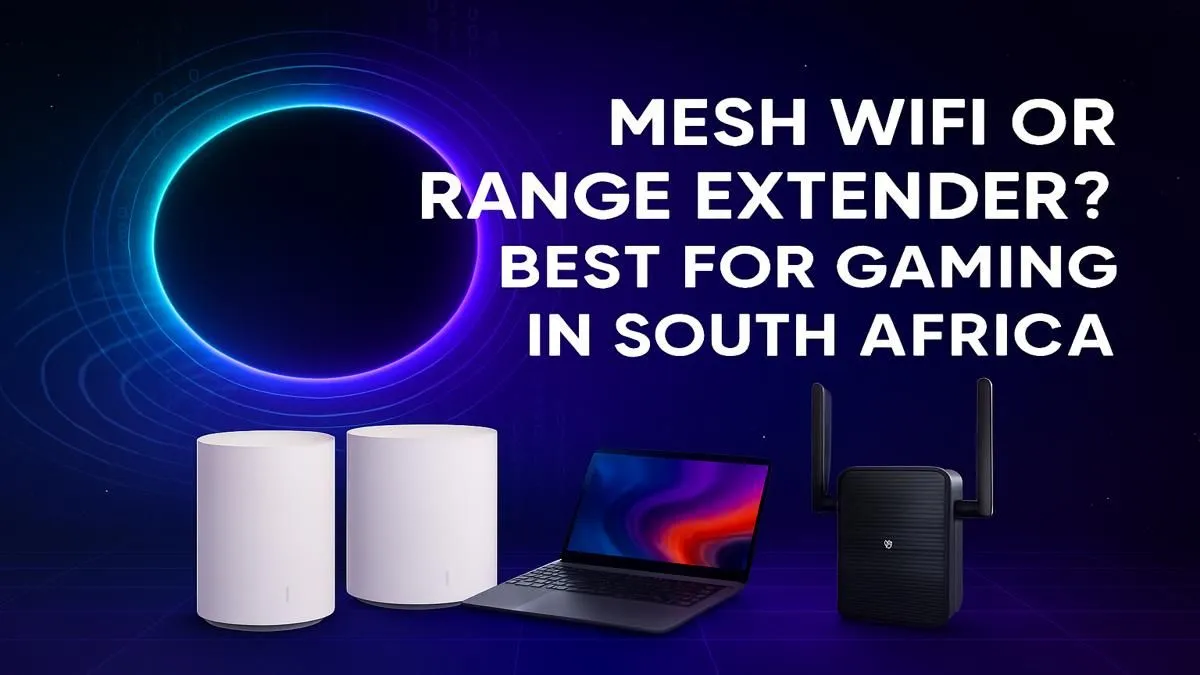
You’ve got fast fibre and a beastly gaming rig, but your Wi-Fi signal dies halfway to the kitchen. That dreaded lag spike hits mid-match, and suddenly you’re staring at the respawn screen. Sound familiar? For many South African gamers, battling Wi-Fi dead spots is as tough as any final boss. The big question is: what’s the best way to fix it? It’s time to settle the score in the ultimate showdown: mesh vs extender for gaming in South Africa.
What's a Wi-Fi Extender, Really?
Think of a Wi-Fi extender as a simple signal booster. You place it halfway between your router and the dead zone, and it grabs the existing Wi-Fi signal, then rebroadcasts it. It’s a straightforward and often cheap solution to get a signal where there was none before.
But for gaming, there’s a massive catch. Most extenders create a new network (like “MyWi-Fi_EXT”) and effectively cut your available bandwidth in half. Why? Because the extender has to use the same radio to both receive the signal and send it out again. This process adds a delay, or latency, which is poison for online gaming. While they can be useful for casual browsing, most basic Wi-Fi range extenders simply aren't built for the high-performance demands of a competitive gamer.
How Does a Mesh Wi-Fi System Work? ✨
A mesh Wi-Fi system is a far more intelligent solution. Instead of one device trying to shout louder, a mesh system uses a team of "nodes" that work together to blanket your entire home in a single, seamless Wi-Fi network. You have a main node connected to your fibre box, and you place other nodes around your house.
These nodes are smart. They talk to each other to figure out the fastest, most efficient path to send data back to the main router. This creates a stable, powerful, and unified network. You can walk from one end of the house to the other on a video call, and your device will seamlessly switch between nodes without ever dropping the connection. This technology is the foundation of many modern wireless routers designed for larger homes.
Placement Pro Tip 📡
Your Wi-Fi signal is a bit like sound. It hates thick brick walls and metal objects. For best results, place your main router and any mesh nodes in open areas, preferably elevated, and not tucked away in a cupboard or behind the TV. A little bit of strategic placement can make a massive difference to your signal strength and gaming performance.
The Verdict: Mesh vs Extender for Gaming Performance
When it comes to serious gaming in South Africa, the choice between a mesh system and a Wi-Fi extender becomes crystal clear. Let's break it down.
Latency (Ping)
Ping is everything in online gaming. A Wi-Fi extender adds an extra "hop" for your data, which directly increases your ping. A mesh system, especially one with a dedicated backhaul channel, is designed to keep latency incredibly low by always routing your traffic along the most efficient path.
- Winner: Mesh, by a long shot.
Speed & Bandwidth
An extender slashes your bandwidth in half by design. A mesh system is built to maintain high speeds across your entire coverage area. This means faster downloads and a more stable connection, even when others in the house are streaming 4K content. For a gaming PC to perform at its peak, it needs a stable connection, which is why pairing great Wi-Fi with a top-tier wireless adapter is crucial.
Coverage & Consistency
Extenders create a second network, forcing you to manually switch between them. They can also create interference. A mesh system provides one single, reliable network name for your whole home, delivering consistent performance without frustrating drop-offs. No more signal dead zones. 🚀
Is an Extender Ever a Good Idea?
So, are we saying extenders are useless? Not at all. If you just need to get a basic signal to a smart TV for streaming, or you want to check emails on the patio, an extender is a perfectly fine, budget-friendly choice.
But for the specific task of gaming… where every millisecond counts… the performance trade-offs are just too great. Investing in your home's wireless networking setup is as important as choosing the right graphics card. For South African gamers battling with lag, a mesh Wi-Fi system is the definitive upgrade.
Ready to Banish Lag for Good?
The mesh vs extender debate is complex, but for serious gaming in South Africa, a mesh system is the undisputed champion for speed and stability. Explore our powerful range of Mesh Wi-Fi Systems and build the lag-free network you deserve.