

Quick Answer
Most popular PC case myths - from airflow colour myths to tempered glass cooling penalties - are not supported by evidence, and understanding the facts helps SA builders make smarter purchases without paying for features they don't need or avoiding perfectly good options based on misconceptions.
Myth 1: More Case Fans Always Means Better Cooling
This is the most persistent myth in PC building communities, and it leads to two bad outcomes: overspending on fan-dense cases that aren't set up correctly, and underestimating simpler cases with well-designed airflow paths. The number of fans in a case matters far less than their placement, the quality of the airflow path, and whether positive or negative pressure is maintained consistently.
A case with three high-quality fans in a proper intake-exhaust configuration will cool better than a case with eight fans fighting each other in conflicting directions. The key principles are: fresh air enters from the front and bottom, exits from the rear and top, and the path between intake and exhaust passes over your major heat-generating components - the GPU and CPU - without obstruction from poor cable management or drive cages.
For SA builders dealing with warm ambient temperatures and occasional load shedding-related heat buildup when passive cooling from open windows is all that's available, getting the airflow path right matters more than maximising fan count. Two or three well-positioned fans in a mesh-front case will consistently outperform a glass-panel case stuffed with fans that has restricted intake vents.
Myth 2: Tempered Glass Side Panels Ruin Cooling
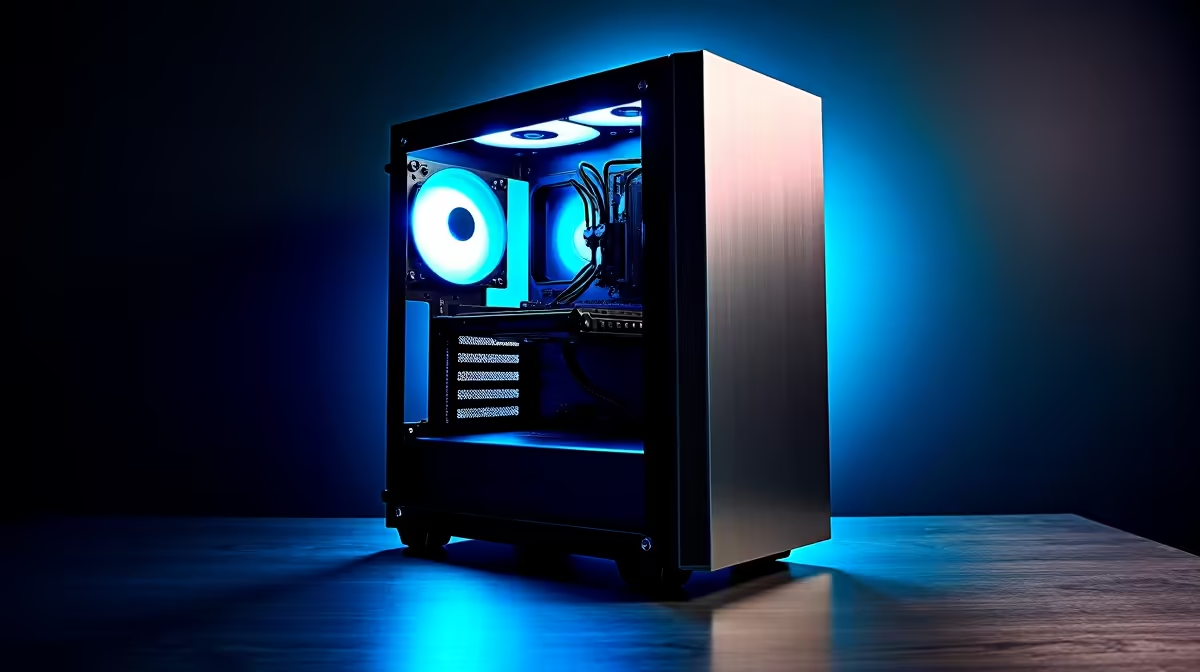
Tempered glass panels became the dominant aesthetic choice in gaming cases over the past five years, and with that came the claim that glass blocks airflow and significantly raises internal temperatures. In practice, this is only partially true and only in specific circumstances.
Modern cases designed with glass panels account for this by placing their primary intake vents on the front panel and the mesh top panel rather than relying on the side for airflow. A glass-sided case with a mesh front and a properly designed internal layout performs comparably to a full-mesh case in most real-world measurements - typically within two to four degrees Celsius difference, which has no meaningful impact on component lifespan or performance.
Where glass panels do create a genuine problem is in cases that use them on both side panels and also have a glass front panel, effectively sealing the interior. These designs - sometimes called fish tank cases - genuinely restrict airflow and should be avoided for high-performance builds. The key is looking at where the case's intake vents are, not whether a glass panel is present on the side.
Myth 3: Expensive Cases Offer Better Cooling Than Budget Options
Price and cooling performance have a weaker correlation in cases than in almost any other PC component category. A R500 mesh-front mid-tower with sensible fan mounting positions can cool components as effectively as a R3,000 premium enclosure with elaborate ventilation engineering, assuming both are used with equivalent fans.
What premium cases legitimately offer that budget cases don't is build quality, cable management routing, noise dampening, drive mounting flexibility, and easier assembly. These are real benefits that affect the building experience and the long-term organisation of your system. But if your primary concern is thermals, a mid-range mesh case at R700 to R1,200 is almost always competitive with far more expensive alternatives from a pure temperature standpoint.
For South African builders managing tighter budgets due to rand-priced components, this is good news. Redirecting money from an expensive case to a better CPU cooler, an additional quality fan, or a higher-tier GPU will almost always produce better real-world gaming performance than the case upgrade would have.
Myth 4: RGB Fans Perform Worse Than Non-RGB Fans
The assumption that RGB fans sacrifice airflow or static pressure performance to accommodate lighting components is understandable but generally inaccurate for fans from established manufacturers. The LED elements in RGB fans are positioned around the frame rather than in the blade path, and the electrical load they add is minimal enough that it doesn't affect motor performance at normal operating voltages.
That said, at the budget end of the RGB fan market - particularly no-brand imports that SA builders sometimes source for their low cost - fan blade geometry and motor quality are often compromised regardless of the RGB feature. The RGB is not the cause of poor performance, but budget RGB fans tend to be poorly engineered overall. From reputable brands, RGB fans measure within one to three percent of equivalent non-RGB models in static pressure and airflow benchmarks - a difference you will never notice in practice.
The practical consideration for SA builders is value. A three-pack of quality RGB fans typically costs more than a three-pack of equivalent non-RGB fans. If your case is against a wall where the lighting won't be visible, the RGB premium is straightforwardly unnecessary. If the aesthetic matters to you, the performance cost of choosing RGB from a reputable brand is negligible.
Frequently Asked Questions
Q: Does the colour of a case affect its internal temperature?
A: No. Case colour has no measurable effect on internal temperatures in typical indoor environments. The heat generated by PC components is orders of magnitude more significant than any radiated heat absorption difference between a white and black exterior. Choose your case colour based on preference and visibility of dust, not thermal properties.
Q: Do I need to buy the fans that come with a case, or should I replace them immediately?
A: It depends on the brand. Cases from reputable manufacturers often ship with decent bundled fans that are worth keeping, especially at mid-range price points. No-name case bundles frequently include fans that underperform their rated specs. Check reviews of the specific case before deciding whether to supplement or replace the bundled fans.
Q: Is a full-tower case better than a mid-tower for cooling?
A: Full towers provide more internal space, which can help with high-end multi-GPU or heavily waterlooped builds. For single-GPU gaming PCs - which describes the vast majority of SA gaming builds - a well-designed mid-tower provides equivalent cooling. Full towers are harder to fit on most South African desks and offer no thermal benefit for standard gaming configurations.
Q: How much should I spend on a case for an R8,000 to R15,000 SA gaming build?
A: A reasonable case budget for a mid-range SA gaming build is R600 to R1,500. Below R600, build quality and cable management options suffer noticeably. Above R1,500, you're paying primarily for aesthetics and premium manufacturing - not meaningful cooling gains. Allocate those rands to your GPU or CPU instead.
Also at Evetech: All PC Cases | Graphics Card Deals
Ready to Find Your Perfect Match? Shop at Evetech











