Is your gaming rig feeling a bit sluggish? Before you start pricing new GPUs, what if you could unlock free performance hidden inside your machine? It won’t cost you a Rand. The secret is learning how to optimize your BIOS for gaming. This simple process can boost frame rates and smooth out gameplay, especially on a budget PC. Let’s dive in and unleash your PC’s true potential… without opening your wallet.
What is the BIOS and Why Should You Care?
Think of the BIOS (Basic Input/Output System) or its modern successor, UEFI, as the control room for your computer's hardware. It’s the first thing that loads when you press the power button, telling your CPU, RAM, and storage how to work together. For gamers, this is crucial. Many budget gaming PCs are shipped with default, ultra-safe settings. A proper BIOS optimization for gaming ensures you're getting every bit of performance you paid for.
Your First Step: Entering the BIOS
Getting into the BIOS is easy. You just need to restart your computer and press a specific key repeatedly as it boots up. This key is usually Delete, F2, F10, or F12. It flashes on the screen for just a moment, so you need to be quick!
What's My BIOS Key? 🔑
't find the right key? Here's a quick cheat sheet for major motherboard brands: ASUS: F2 or Del. MSI: Del. Gigabyte AORUS: Del. ASRock: F2 or Del. If you miss the window, just let Windows load and try again on the next restart.
Once you're in, you might see an "Easy Mode" and an "Advanced Mode". We'll need Advanced Mode to access the settings we want to tweak. Don't be intimidated by all the options; we're only going to change a few key things.
Key BIOS Settings to Optimize for Gaming Performance
Ready to find that free performance? Here are the most impactful settings to look for. The names might vary slightly between motherboard brands, but the concepts are the same.
1. Unleash Your RAM with XMP or DOCP 🚀
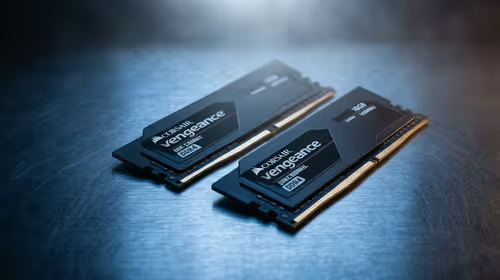
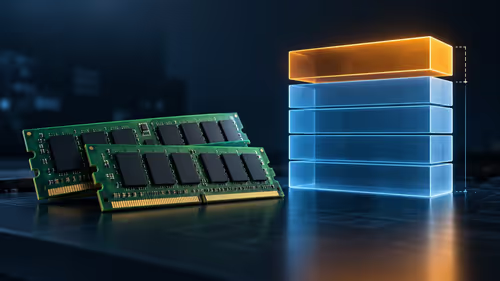
This is the single biggest win you'll get. Your RAM might be advertised as 3200MHz, but it's likely running at a much slower default speed (like 2133MHz) out of the box. Enabling its built-in performance profile is the key.
- For Intel systems, look for "XMP" (Extreme Memory Profile).
- For AMD systems, look for "DOCP" (Direct Overclock Profile) or "A-XMP".
Find this setting, which is usually on the main or "Tweaker" page, and enable it. You'll likely see "Profile 1" as an option—select that, save, and exit. This simple change can provide a noticeable FPS boost in many games, a fantastic result for anyone with PCs under the R20k mark.
2. Check Your CPU Performance Boost Settings ⚡
Modern CPUs from both Intel (Turbo Boost) and AMD (Precision Boost Overdrive) can automatically increase their clock speeds when under load. This setting is almost always enabled by default, but it’s worth double-checking. Look for "Core Performance Boost" or similar CPU features and ensure they are set to "Auto" or "Enabled". This is a core part of any guide to optimize your BIOS for gaming.
We recommend leaving manual CPU overclocking to the experts, as incorrect settings can cause instability. Simply ensuring the automatic boost is on is a safe and effective step.
3. Tweak Your Fan Curves for Better Cooling 🔧
A cooler PC is a faster PC. When components get too hot, they "throttle" or slow down to protect themselves. You can help prevent this by setting a more aggressive fan curve.
Look for a section called "Hardware Monitor," "Q-Fan Control," or "Smart Fan." Here, you can change how fast your case and CPU fans spin at different temperatures. Setting them to spin up a bit earlier and faster can keep your temperatures lower during intense gaming sessions, leading to more consistent performance. Of course, high-end PCs over R20,000 often feature advanced liquid cooling where this is less of a concern.
The Limits of BIOS Optimisation
It's important to be realistic. These BIOS tweaks are brilliant for extracting hidden power from your existing hardware. They can smooth out stutters and add a few valuable frames per second. However, they won't magically turn an entry-level system into a high-end beast.
When you've done all the software and firmware optimisation you can, the next step is a hardware upgrade. Sometimes, the best performance boost comes from a new component or a completely new build. If you feel you've hit the ceiling with your current rig, it might be time to check out our current pre-built PC deals. You can often find some of the best gaming PC deals in South Africa that offer a massive leap in power for your money.
Ready for a Real Performance Leap?
BIOS tweaks are fantastic, but when you're ready to stop tweaking and start dominating, a new machine is the ultimate upgrade. Explore our massive range of gaming PCs and find the perfect rig to conquer your world.