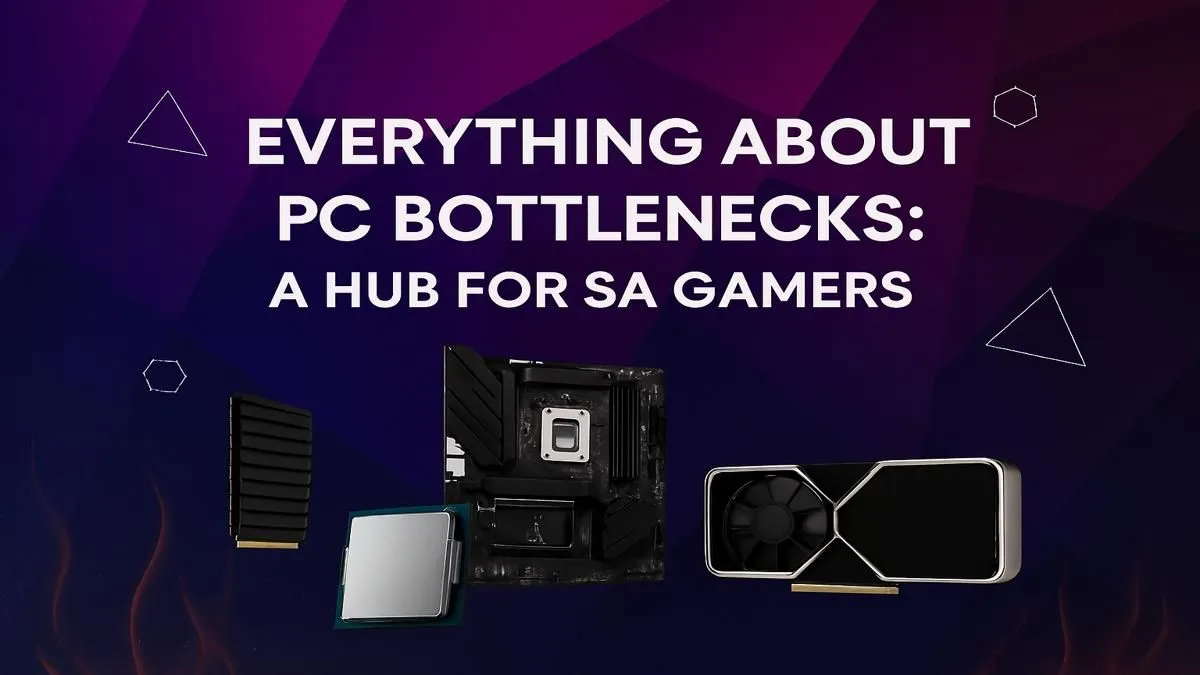
Ever splurged on a beastly new graphics card, only to find your frames in Apex Legends are still… meh? You're not alone. That frustrating feeling is likely a PC bottleneck, the silent performance thief holding your rig back. It’s when one component can't keep up with the rest, creating a digital traffic jam. But don't stress. This guide will help you diagnose and crush the most common performance issues for South African gamers.
What Exactly is a PC Bottleneck?
Think of your PC as a high-performance assembly line. The CPU, GPU, RAM, and storage all work together to build your gaming experience, frame by frame. A PC bottleneck happens when one worker on that line is significantly slower than the others, forcing everyone else to slow down and wait. 🔧
No matter how fast your new RTX 40-series GPU is, it can't render frames any faster than the CPU can prepare them. This imbalance is the core of the problem, and it can seriously cap your PC's potential. Understanding this is the first step to unlocking smoother gameplay.
Identifying the Common Culprits in Your Rig
While any component can technically cause a PC bottleneck, the most common conflict happens between your processor and your graphics card. It’s the classic digital tug-of-war.
The CPU vs. GPU Showdown
This is the big one. Your gaming experience often depends on the delicate balance between these two powerhouses.
- CPU Bottleneck: This happens when your CPU is maxed out, but your GPU is chilling. It's common in games that are heavy on physics, AI, and high frame rates (144Hz+), like Valorant or CS:GO, especially at 1080p. Your powerful GPU is ready to pump out more frames, but the CPU can't feed it data fast enough. If this sounds like your problem, exploring the performance of the latest AMD Ryzen CPUs could reveal a clear upgrade path.
- GPU Bottleneck: This is the opposite scenario and is often desirable. Your GPU is working at 90-100% capacity while your CPU has headroom. This is typical in visually stunning AAA titles like Cyberpunk 2077 or Alan Wake 2 at 1440p or 4K resolutions with all the eye candy turned on. You are getting the maximum graphical performance your card can deliver. However, if your GPU is old, it might be holding back even a mid-range CPU.
For many builders, finding the right balance between powerful Intel Core processors and a capable GPU is key to a versatile gaming rig.
Don't Forget RAM and Storage
While less common, these components can also cause a frustrating PC bottleneck. Having too little RAM (e.g., 8GB for modern titles) can lead to stuttering as your PC shuffles data to your much slower SSD or HDD. Speaking of which, if you're still running your games off a mechanical hard drive in 2024… you are creating a massive loading and texture-streaming bottleneck. An NVMe SSD is a must-have. ✨
How to Check for a Bottleneck Yourself ⚡
Guesswork won't get you far. You need data. The easiest way to check for a PC bottleneck is to use monitoring software while you play a game.
- Get the Tools: Download a free tool like MSI Afterburner with RivaTuner Statistics Server.
- Set it Up: Configure the on-screen display to show CPU usage (per core), GPU usage, and FPS.
- Play Your Game: Fire up a demanding game where you experience performance issues. Play for about 10-15 minutes.
- Item
Quick Sanity Check 🚀
Unsure about a potential CPU GPU pairing? Online bottleneck calculators can give you a rough idea. They aren't 100% accurate as they don't account for specific games or settings, but they're a great starting point to see if a potential upgrade is wildly unbalanced before you spend your hard-earned ZAR.
Solving the Bottleneck: A Smart Upgrade Path
Once you've identified the slowpoke in your system, the solution is usually a targeted upgrade. If your analysis points to a CPU bottleneck holding back your new GPU, then upgrading your CPU is the most logical next step.
The goal isn't to eliminate bottlenecks entirely—that's impossible. The goal is to ensure the bottleneck is your GPU, meaning you're getting every drop of graphical performance you paid for. A balanced PC is a happy PC, delivering the smooth, high-fidelity gaming experience you deserve.
Ready to Uncork Your PC's True Power?
A PC bottleneck doesn't mean you need a whole new rig. Sometimes, one smart upgrade is all it takes to get your framerates soaring. Explore our massive range of PC components and find the perfect part to conquer the lag.