Stuttering frames in a tense Apex Legends firefight? Or maybe your render times are costing you precious rands? Before you start pricing new hardware, there’s a powerful technique that could unlock free performance from the PC you already own. We’re talking about PC overclocking in South Africa, a way to push your machine’s limits. Let’s dive into how you can safely squeeze more power from your rig. 🚀
What Exactly is PC Overclocking?
Think of your computer's processor (CPU) or graphics card (GPU) like a car engine. From the factory, it’s set to a reliable, standard speed. Overclocking is the process of manually tuning that engine to run faster than its official specifications. You’re telling your components to perform more calculations per second, which can lead to a direct increase in performance for games and demanding applications.
It’s not some dark art… it's about carefully increasing clock speeds and voltages within the BIOS/UEFI of your motherboard. When done right, it can give you a noticeable boost without spending a cent.
The Risks & Rewards of Overclocking in South Africa
Pushing your PC's limits is a balancing act. On one hand, the rewards are tempting. Successful PC overclocking can result in higher frame rates, smoother gameplay, and significantly faster export times for video editing or 3D rendering—turning a good gaming PC into a beast that rivals some professional-grade workstation PCs. ✨
On the other hand, there are risks.
- Heat: More speed means more heat. In our South African climate, this is the number one enemy. Inadequate cooling can lead to thermal throttling (where your PC slows down to protect itself) or even permanent damage.
- Instability: Push things too far, and you’ll face system crashes, the dreaded Blue Screen of Death, and data corruption.
- Warranty: Be warned... overclocking can void the warranty on your components.
The key is a cautious, step-by-step approach.
Cooling is King 🔧
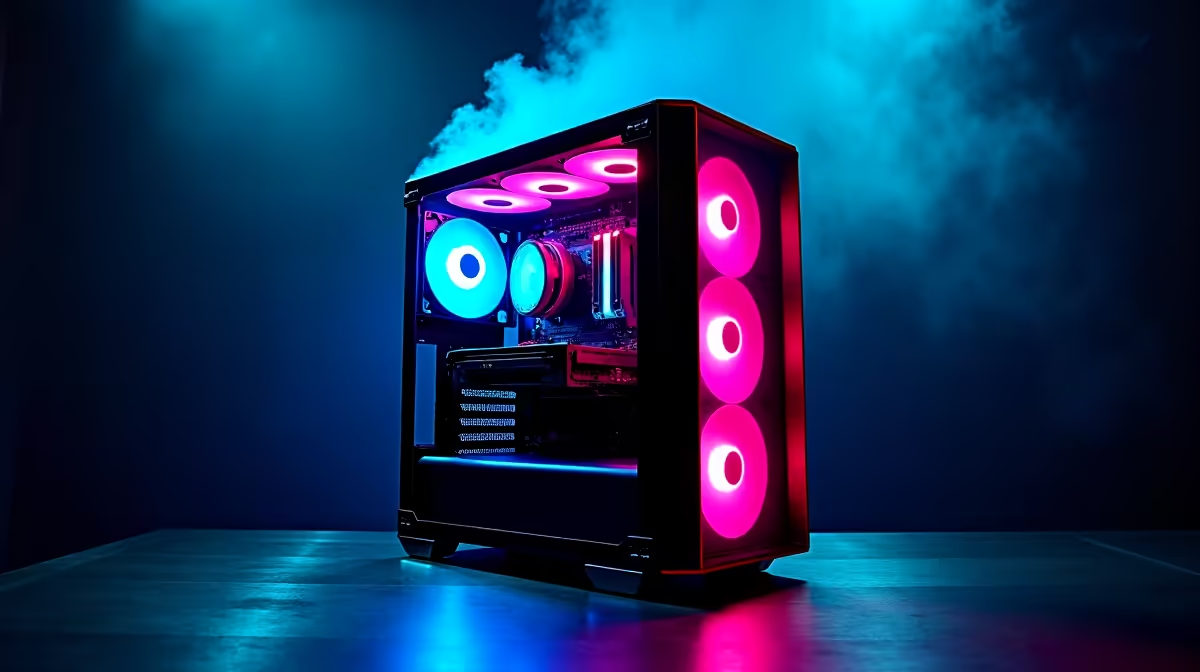
Before you even think about overclocking, monitor your temperatures under load with a tool like HWMonitor. If your CPU or GPU is already running hot with stock settings, you need to upgrade your cooling first. A quality air cooler or an All-in-One (AIO) liquid cooler is a must-have for safe overclocking in SA.
Is Your DeepSeek PC Ready for a Boost?
Not all PCs are created equal when it comes to overclocking. To get started, you generally need three key things:
An Unlocked CPU & Capable Motherboard
For Intel, you're looking for CPUs with a "K" or "KF" suffix (e.g., Core i7-14700K). For AMD, most Ryzen CPUs are unlocked from the get-go. You'll need to pair them with a motherboard that supports overclocking, like an Intel Z-series or an AMD B-series or X-series board.
A Willing Graphics Card
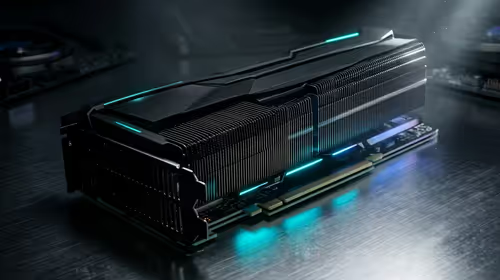
Most modern graphics cards can be overclocked using software like MSI Afterburner. Whether you're running one of the powerful NVIDIA GeForce gaming PCs or rocking Team Red, there’s usually some extra performance to be found. The cooling solution on the card itself is often the biggest limiting factor.
A Robust Power Supply (PSU)
An overclocked system draws more power. A cheap, low-wattage PSU can become unstable and fail, potentially taking other components with it. Don't skimp here! Many of the latest AMD Radeon gaming rigs come equipped with quality PSUs ready for the task.
Your Quick-Start Guide to Safe Overclocking ⚡
This isn't an exhaustive tutorial, but a roadmap to the process. Always do your research for your specific components!
- Establish a Baseline: Before you change anything, run a benchmark like Cinebench (for CPU) or 3DMark (for GPU) to get a performance score. This is your starting line.
- Enter the BIOS/UEFI: This is your command centre. Restart your PC and press the designated key (usually Del, F2, or F12) to enter.
- Tweak in Small Steps: Find the CPU Core Ratio or Multiplier. Increase it by a tiny increment (e.g., from 45 to 46, representing 4.5GHz to 4.6GHz). Save, reboot, and move to the next step.
- Stress Test & Monitor: Once back in Windows, run a stress-testing program like Prime95 for at least 30 minutes. Keep a close eye on your temperatures. If it's stable and cool, repeat step 3. If it crashes, you may need to add a tiny bit more voltage or dial back the clock speed.
Patience is everything. The goal of PC overclocking in South Africa isn't to hit a world record, but to find a stable, safe performance boost you can use every day.