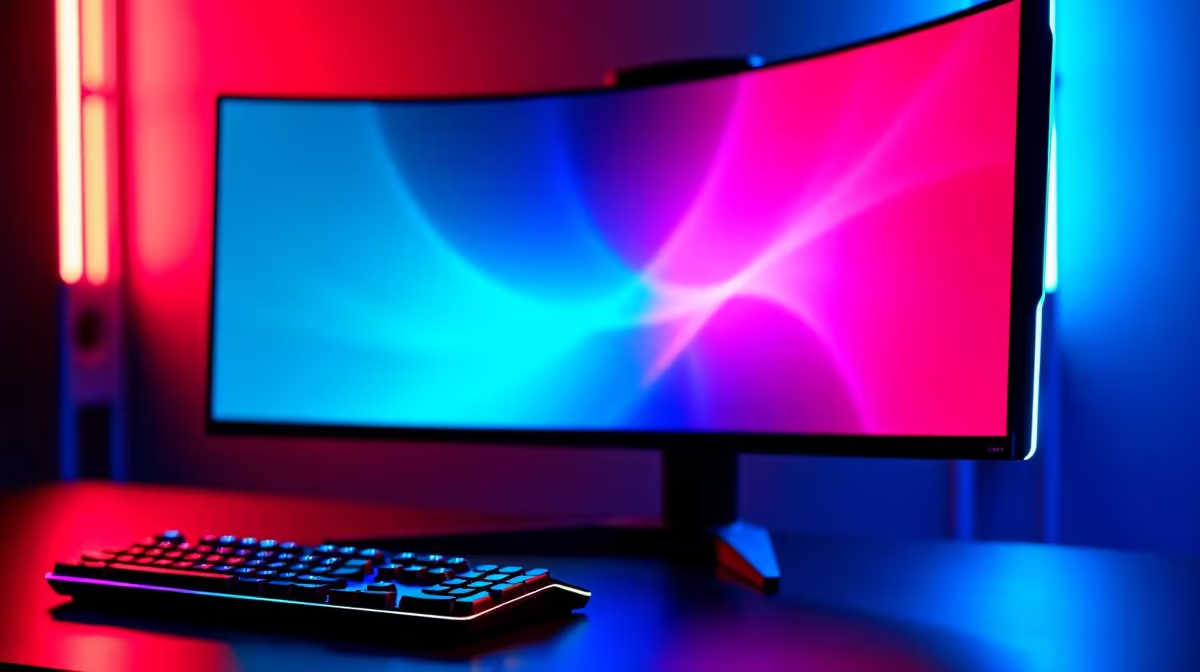
You've just dropped serious ZAR on a lightning-fast 360Hz IPS monitor, ready to dominate in Valorant or Apex Legends. The motion is incredibly smooth, but something's... off. You notice weird, bright trails behind moving objects, a bizarre halo effect that makes enemies harder to track. That, my friend, is reverse ghosting. It’s a frustrating issue on some of the fastest screens, but don't panic. We have the complete fix guide right here.
Understanding Reverse Ghosting on High-Refresh-Rate Panels
Unlike traditional ghosting, which leaves a blurry, faint trail, reverse ghosting (or pixel overshoot) is a sharp, often brightly coloured corona that appears on the leading edge of moving objects. Think of it as your monitor's pixels trying too hard. To achieve those insane 360Hz speeds, manufacturers use a technique called "overdrive" to force pixels to change colour faster. When this is too aggressive, the pixels overshoot their target colour, creating that distracting halo. It’s a common frustration for gamers seeking perfection from all gaming monitors.
Your Complete Fix Guide for Reverse Ghosting on 360Hz IPS Monitors
Getting rid of this distracting visual artifact is usually a matter of fine-tuning a few settings. Let’s walk through the solutions, from easiest to most advanced, to fix reverse ghosting and get your display looking perfect. 🔧
Step 1: Tame Your Monitor's Overdrive Setting
This is the number one cause and the most effective fix for reverse ghosting. Buried in your monitor’s on-screen display (OSD) menu, you'll find a setting likely called "Response Time," "Overdrive," or "Trace Free." It usually has levels like Off, Normal, Fast, and Fastest.
Manufacturers often set the default to the most aggressive option for marketing. Your mission is to dial it back one or two steps. For example, if it’s on "Fastest," try "Fast." The change is often dramatic, eliminating the overshoot with a barely noticeable impact on motion blur. Finding the sweet spot is key to getting the most out of the best PC monitor deals you can find.
Visual Confirmation is Key! 🚀
the free 'UFO Test: Ghosting' tool on the Blur Busters website. This simple browser test provides a perfect visual reference for tuning your overdrive. Watch the UFOs as you change the setting in your OSD. When the bright, coronated trail behind the UFO disappears, you've found the optimal setting for your specific panel.
Step 2: Check Your Cables and Refresh Rate
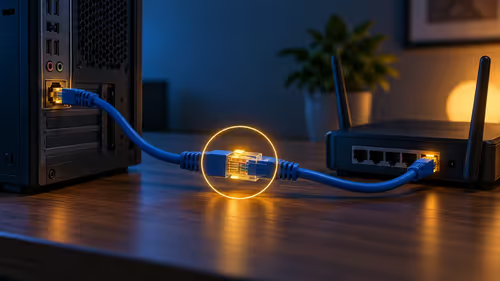
Sometimes, the simplest things are the cause. Ensure you're using a high-quality, certified DisplayPort 1.4 cable. An older or faulty cable can struggle with the massive bandwidth a 360Hz signal requires. You can find excellent options among various monitor accessories.
Also, double-check in your Windows Display Settings and your GPU's control panel (NVIDIA Control Panel or AMD Radeon Software) that your monitor is actually set to run at its full 360Hz refresh rate.
Step 3: Update Your Software & Firmware
While less common, outdated GPU drivers or monitor firmware can cause performance issues.
- GPU Drivers: Always keep your graphics card drivers up to date.
- Monitor Firmware: Check your monitor manufacturer's support page. Some models receive firmware updates that can improve response time performance and fix issues like severe IPS overshoot. This applies to a wide range of PC monitors, not just the high-end ones.
When a Fix Isn't Enough: Considering an Upgrade
You've tried everything, and the reverse ghosting on your 360Hz IPS monitor is still a problem. This can happen with some first-generation high-refresh-rate panels where the overdrive was poorly tuned from the factory. Panel technology is always improving, and newer models often have much more refined overdrive implementation.
Whether you're looking for the immersion of curved monitors or the crisp detail of 5K & 4K monitors, there's a perfect screen out there. Even specialised displays like portable monitors are seeing huge leaps in quality. Sometimes, the best fix is an upgrade to a panel that gets it right from the start. ✨
Ready for a Flawless Visual Experience?
Taming reverse ghosting can make your 360Hz monitor feel brand new. But if you're ready to upgrade to the latest panel technology with perfectly tuned pixel response, we've got you covered. Explore our massive range of gaming monitors and find the perfect screen for your setup.