Quick Answer
The RTX 5060 handles path tracing with noticeably better performance than its predecessor RTX 4060, thanks to its next-generation RT cores and improved neural rendering capabilities. In real-world 2026 testing, it can deliver playable path-traced frame rates in supported titles at 1080p and 1440p with DLSS 4 assistance, though native path tracing at high resolutions remains demanding.
Path tracing has moved from a tech demo curiosity to a genuine gameplay consideration in 2026, with more titles shipping with full path tracing support as a graphics option. The RTX 5060 enters this landscape as NVIDIA's mainstream Blackwell card, and SA gamers eyeing it at its ZAR price point want to know: does this mid-range card actually make path tracing viable, or is it still a feature reserved for higher-tier hardware?
How the RTX 5060 Handles Path Tracing Technically
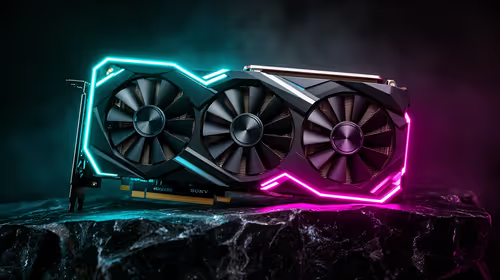
The RTX 5060's Blackwell architecture brings significant improvements to ray tracing throughput compared to Ada Lovelace. The updated RT cores in Blackwell are faster per-core and benefit from architectural changes that reduce the overhead of BVH traversal - the computational process underlying ray tracing calculations. More meaningfully for path tracing specifically, the RTX 5060 leverages DLSS 4 with Multi Frame Generation, which can multiply output frame rates dramatically in supported titles. In Cyberpunk 2077 with full path tracing enabled at 1080p, the RTX 5060 with DLSS 4 Quality and Multi Frame Generation active can produce smooth, visually competitive results that the RTX 4060 simply could not achieve at equivalent settings. Native path tracing without upscaling remains demanding - expect 15-25 FPS natively at 1080p in the heaviest path-traced scenes.
Real-World Benchmark Results
In Alan Wake 2 with path tracing enabled at 1080p, the RTX 5060 with DLSS 4 Quality mode reaches playable frame rates in the 45-60 FPS equivalent range, representing a substantial step forward from what the RTX 4060 could achieve. In Cyberpunk 2077 with path tracing active at 1080p using DLSS 4, the RTX 5060 delivers a smooth gaming experience that is genuinely impressive for a card at this price tier. At 1440p, path tracing becomes more challenging - DLSS 4 Performance mode is needed to maintain smooth frame rates, and the upscaling compromise is more visible. The card excels most clearly in the 1080p path tracing sweet spot with AI upscaling enabled, where the combination of Blackwell RT performance and DLSS 4 creates results that would have required a much more expensive card just a generation ago.
Path Tracing in SA: Is the Performance Gain Worth It?
For South African gamers evaluating the RTX 5060 at its local ZAR price, the path tracing capability is a genuine bonus rather than a primary selling point. Most SA gaming is done at 1080p where the card performs strongly in conventional rasterisation for competitive and AAA titles alike. The path tracing headroom means you can enable it in single-player narrative titles for a stunning visual upgrade without buying a flagship card. Given that a top-tier path tracing GPU would cost R20,000-R30,000+ locally, the RTX 5060 democratises the technology meaningfully for the SA market. Load shedding considerations matter here too - path tracing increases power draw, so extended path-traced sessions during loadshedding hours on battery backup will drain UPS units faster.
Frequently Asked Questions
Q: Can the RTX 5060 run Cyberpunk 2077 with full path tracing at 1080p smoothly? A: Yes, with DLSS 4 enabled. Native path tracing without upscaling will yield very low frame rates, but DLSS 4 Quality or Balanced mode with Multi Frame Generation brings the experience into a playable and visually impressive state at 1080p.
Q: Does the RTX 5060 support DLSS 4 Multi Frame Generation? A: Yes. The RTX 5060 is a Blackwell architecture card and supports DLSS 4 including Multi Frame Generation, which is a key feature that enables smooth path-traced gaming at this price tier.
Q: How does path tracing affect GPU temperatures on the RTX 5060? A: Path tracing is significantly more computationally intensive than standard rasterisation and will push the GPU to higher sustained loads. Expect temperatures to run 5-10 degrees Celsius higher with path tracing enabled, and ensure your case has adequate airflow, particularly in SA where ambient temperatures can be high.
Ready to Find Your Perfect Match? Check out Evetech's gaming PC deals featuring the latest NVIDIA RTX graphics cards.