Quick Answer
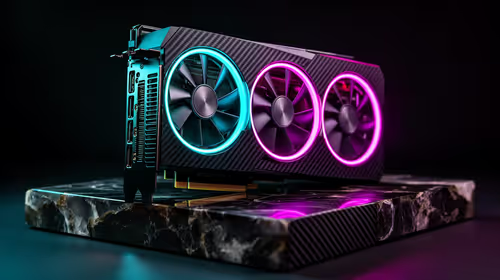
The RTX 5060 Ti and RTX 4090 are not realistic direct competitors: the 4090 is a flagship card that dominated high-end gaming since 2022, while the RTX 5060 Ti is a mid-range Blackwell generation card. The 4090 outperforms the 5060 Ti significantly in raw rasterisation, but the 5060 Ti offers DLSS 4 with Multi Frame Generation and delivers strong 1440p performance at a fraction of the cost. For South African buyers, the value argument heavily favours the 5060 Ti.
Raw Performance: RTX 4090 vs RTX 5060 Ti
The RTX 4090 remains one of the fastest gaming GPUs ever made. Built on Ada Lovelace with 16,384 CUDA cores and 24GB of GDDR6X memory on a 384-bit bus, it delivers 4K gaming at maximum settings in virtually every title. In native rasterisation, the RTX 4090 is roughly two to two-and-a-half times faster than the RTX 5060 Ti.
The RTX 5060 Ti brings NVIDIA's Blackwell architecture to the mid-range tier with DLSS 4 Multi Frame Generation, a technology that generates multiple AI frames between rendered frames. At 1440p with DLSS 4 Quality or Balanced mode enabled, the RTX 5060 Ti pushes framerates that look competitive on paper with the 4090 in DLSS 3 mode, though native rendering comparisons remain heavily one-sided.
Memory bandwidth is another clear difference. The RTX 4090's 384-bit bus with GDDR6X offers enormous data throughput for 4K textures and complex scenes. The RTX 5060 Ti's narrower memory interface is adequate for 1080p and 1440p but becomes a constraint at 4K with maximum texture settings.
Gaming Scenarios: Where Each Card Makes Sense
For 4K gaming at maximum settings with no frame generation, the RTX 4090 is the right tool. Titles like Cyberpunk 2077 with path tracing, Alan Wake 2 at max settings, and Microsoft Flight Simulator at ultra resolutions demand the 4090's muscle to maintain playable framerates without assistance.
For 1440p gaming, the RTX 5060 Ti is genuinely excellent. With DLSS 4 Multi Frame Generation enabled at 1440p, South African gamers can experience framerates that feel premium in titles like Apex Legends, Elden Ring, and Hogwarts Legacy. For competitive players who prioritise high framerates over maximum visual fidelity, the 5060 Ti competes strongly.
The RTX 5060 Ti also makes a compelling 1080p card for high-refresh gaming at 240Hz or above, where its ability to push extreme framerates in less demanding esports titles gives competitive players a fast and affordable GPU platform.
Price and Value in South Africa 2026
This is where the comparison becomes decisive for most South African buyers. The RTX 4090 launched in South Africa at prices between R28,000 and R35,000 and has not dropped significantly in value, remaining a premium purchase. The RTX 5060 Ti launches at a fraction of that cost.
For a South African gamer building a 1440p gaming PC, the RTX 5060 Ti paired with a capable CPU, 32GB of DDR5 memory, and a fast NVMe SSD totals a competitive gaming build for what a 4090 alone cost at launch. The value proposition is not subtle.
The only scenario where the RTX 4090 makes more sense in 2026 is for content creators doing GPU-accelerated AI work, 3D rendering, or video production at the highest levels, where the 24GB VRAM and raw throughput remain class-leading and no Blackwell mid-range card replaces it for those specific tasks.
DLSS 4 and Frame Generation: Does It Change the Equation?
DLSS 4 Multi Frame Generation is genuine technology that produces additional frames via AI inference, reducing the rendering load on the GPU. At 1440p, the results are impressive, with the RTX 5060 Ti reaching frame counts that would have required much more expensive hardware in the previous generation.
The caveat is latency: frame generation adds a small but measurable input lag increment. For competitive gaming at high framerates, this is negligible. For professional-level esports play where every millisecond matters, some players prefer native rendering. The RTX 4090 in native rendering mode has zero frame generation latency, though its native framerates are high enough that this is mostly an academic concern.
For the vast majority of South African gamers, DLSS 4 on the RTX 5060 Ti delivers a premium gaming experience that is difficult to fault in practice.
Frequently Asked Questions
Is the RTX 5060 Ti worth buying over a used RTX 4090 in South Africa? For 1440p gaming, yes. The RTX 5060 Ti's DLSS 4 Multi Frame Generation and lower power draw give it a strong case, and a new card with warranty is worth more than a used flagship without local coverage. If you are building a 4K gaming PC, a used 4090 from a reputable source is worth considering for the raw performance, but factor in no warranty and unknown workload history.
Does the RTX 5060 Ti support ray tracing? Yes. The RTX 5060 Ti includes dedicated RT cores for real-time ray tracing. Performance in fully path-traced games will be lower than the RTX 4090, but combined with DLSS 4 upscaling and frame generation, practical in-game results are acceptable at 1440p with medium RT settings.
What power supply do I need for the RTX 5060 Ti? A quality 650W to 750W PSU is sufficient for a system with an RTX 5060 Ti. The 4090 by contrast requires an 850W to 1000W PSU due to its 450W TDP. The lower power requirement of the 5060 Ti is a practical benefit for South African loadshedding-era UPS setups, where running a high-wattage gaming PC from a battery backup is expensive and heavy.
What resolution should I target with the RTX 5060 Ti? 1440p is the sweet spot. The card handles 1440p at high to maximum settings with excellent framerates across modern titles. For 4K gaming without frame generation, some titles will require quality compromises. With DLSS 4 at 4K Quality mode, the experience is good but not identical to the 4090's native 4K capability.
Ready to Find Your Perfect Match? Shop NVIDIA RTX 5060 Ti and the full range of graphics cards at Evetech, with ZAR pricing and local warranty.