

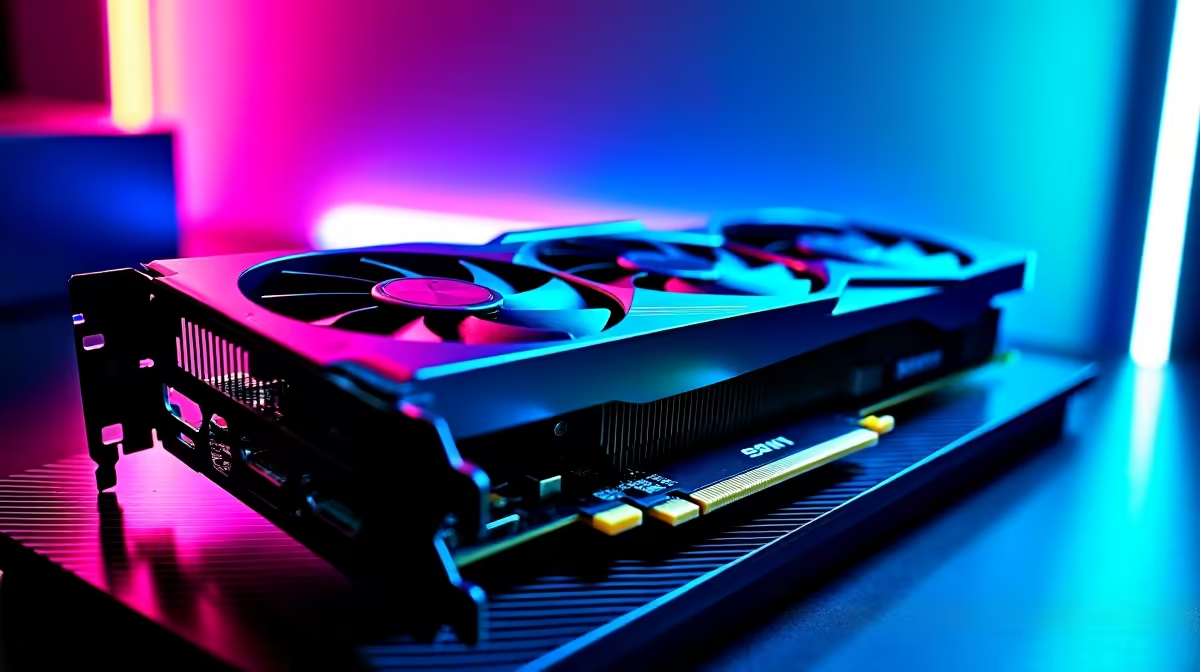
Two very different philosophies meet in this comparison: NVIDIA’s mainstream RTX 5060 brings Blackwell architecture, dedicated ray tracing hardware, and DLSS 4 with Multi Frame Generation, while Intel’s Arc A770 offers a mature RDNA-competitor with strong rasterisation, AV1 encoding hardware, and aggressive pricing. For South African gamers deciding between these GPUs in 2026, the question isn’t just about raw benchmarks - it’s about which platform delivers more over a 3–4 year ownership window at local prices.
Quick Answer
RTX 5060 vs Intel Arc A770: which is better for SA gaming in 2026? The RTX 5060 is the stronger gaming GPU with better driver maturity, DLSS 4 support, and superior ray tracing. The Arc A770 remains compelling if you find it at a significantly lower price point and primarily play DX12/Vulkan titles. For most SA gamers, the RTX 5060 is the safer long-term investment.
🔧 Architecture and Feature Comparison
The RTX 5060 is built on NVIDIA’s Blackwell architecture, featuring dedicated 5th-generation Tensor Cores for DLSS 4 and 4th-generation RT Cores for hardware ray tracing. Multi Frame Generation - NVIDIA’s latest frame interpolation technology - is available on Blackwell, allowing the GPU to generate multiple synthetic frames per rendered frame for dramatically higher display framerates when the base framerate is sufficient.
Intel’s Arc A770 uses the Xe-HPG architecture. Its standout differentiator is AV1 hardware encoding - the best AV1 encode quality available in a consumer GPU when it launched, which remains relevant for content creators, streamers, and anyone saving video in AV1 format. Intel XeSS provides upscaling similar to DLSS, though with lower quality at aggressive resolution scales.
Driver maturity is where Arc A770 still shows its origins. While Intel has made significant driver improvements since launch, some legacy DX9 and DX11 games still run with reduced performance or require workarounds on Arc hardware. NVIDIA’s driver ecosystem is far more mature across the full spectrum of game ages and APIs.
📊 Gaming Performance: Benchmarks at 1080p and 1440p
At 1080p using rasterisation (no ray tracing):
| Game | RTX 5060 | Arc A770 |
|---|---|---|
| Cyberpunk 2077 (High) | ~115fps | ~94fps |
| The Witcher 4 (High) | ~108fps | ~88fps |
| CS2 (Competitive) | ~380fps | ~310fps |
| Forza Horizon 5 (Ultra) | ~140fps | ~118fps |
| Baldur’s Gate 3 (High) | ~130fps | ~112fps |
At 1440p, the RTX 5060’s advantage grows slightly, and DLSS Quality mode pushes it further ahead. The Arc A770 handles 1440p well in DX12 titles but struggles more than expected in DX11 games at this resolution.
With ray tracing enabled, the gap widens significantly. Arc A770’s ray tracing performance is noticeably behind - in Cyberpunk 2077 with path tracing enabled, the RTX 5060 is roughly 40–50% faster. If ray tracing is a priority, the choice is clear.
💡 Value Analysis for the South African Market
The Rand-Dollar exchange rate makes GPU pricing volatile in South Africa, but the relative price positioning matters: the Arc A770 typically retails at 10–20% less than the RTX 5060 locally. Whether that saving justifies the performance gap depends on your specific use case.
Choose the RTX 5060 if:
- You play a variety of games including older DX9/DX11 titles
- Ray tracing is part of your gaming experience
- You want the best DLSS upscaling quality
- You stream and prefer NVENC’s broad compatibility
- You want reliable driver support across the widest game library
Consider the Arc A770 if:
- You find it at a significant price discount locally
- You primarily play modern DX12 or Vulkan titles
- AV1 encoding quality is a priority for content creation
- You’re pairing it with an Intel platform (better resizable BAR support)
Power consumption: Both cards run in a similar TDP range (150–175W), meaning no significant electricity cost difference over a billing cycle - a relevant consideration for SA gaming households.
🎮 Platform and Ecosystem Considerations
NVIDIA’s GeForce Experience and NVIDIA App provide game optimization, overlay, and driver updates in a polished ecosystem. Shadowplay for clip capture is reliable and widely used.
Intel’s Arc Control software has improved substantially. ARC’s Xe Media Engine advantage - dual AV1 encode engines - is a genuine differentiator for streamers using AV1 encoding on platforms that support it.
For South African online gaming, neither card has a meaningful latency advantage - network infrastructure (Vumatel, Afrihost, MTN fibre) and server location matter far more than GPU brand for online responsiveness.
❓ Frequently Asked Questions
Is the RTX 5060 a major upgrade over the RTX 4060? Yes. Blackwell’s architectural improvements and Multi Frame Generation make the RTX 5060 noticeably faster than the RTX 4060 in supported titles. For existing RTX 4060 owners the upgrade case is moderate; for RTX 3060 or older owners, the jump is substantial.
Does the Arc A770 have driver issues in 2026? Driver stability has improved significantly since launch. Most modern DX12 and Vulkan games run without issues. However, some older DX9 and DX11 titles still experience occasional compatibility problems. Check compatibility for your specific game library before purchasing.
Which GPU is easier to resell in South Africa? NVIDIA GPUs hold secondhand value better in the SA market due to wider brand recognition and larger buyer pool. Arc hardware, while capable, has lower brand awareness among casual buyers which can affect resale price if you plan to upgrade in 2–3 years.
Evetech stocks RTX 5060 Gaming PCs and All Graphics Cards — browse current SA pricing and availability online.
Ready to Find Your Perfect Match? Shop at Evetech











