

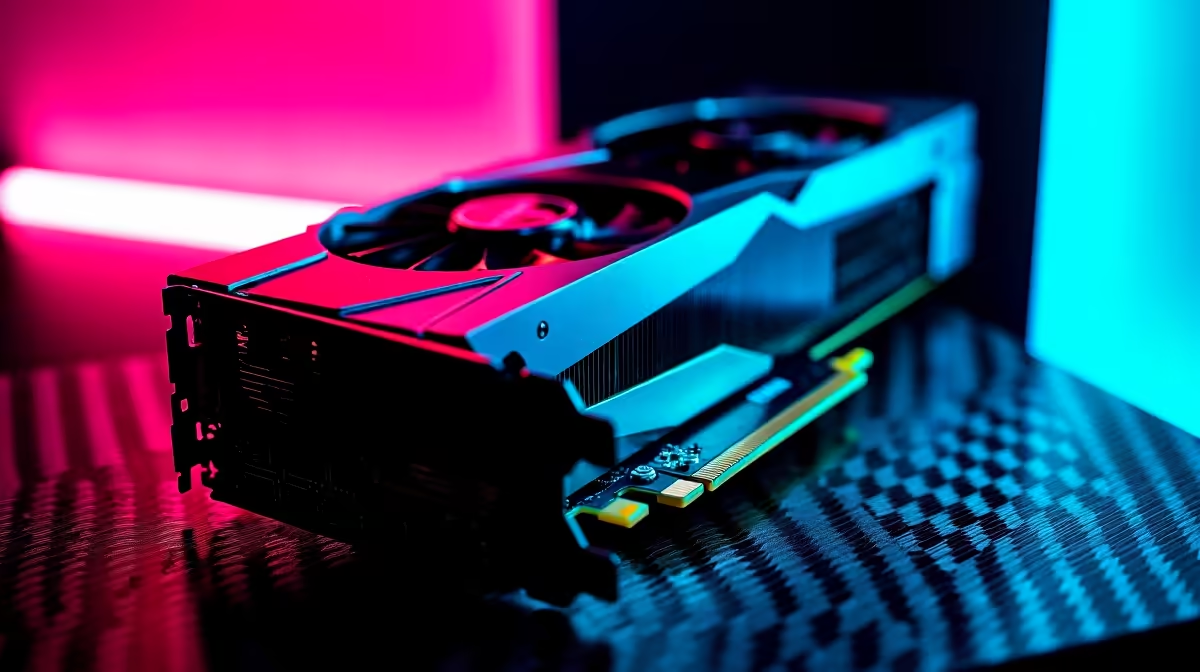
Quick Answer
In South Africa's 2026 market, the RTX 5060 offers better driver maturity, DLSS 4 support, and Frame Generation on NVIDIA's new Blackwell architecture, while the RX 7600 delivers strong value at a lower price point using AMD's proven RDNA 3 architecture. For most SA gamers gaming at 1080p, the RX 7600 is the better value purchase, but the RTX 5060's newer feature set makes it worth the premium for those who want DLSS 4 and future-proofed rendering technology.
Performance Comparison at 1080p and 1440p
At 1080p with high or ultra settings, both cards perform in a similar tier for esports and mainstream AAA titles. The RX 7600 with its 8GB of GDDR6 VRAM is well-suited to 1080p and handles most current titles without memory bottlenecks at that resolution. The RTX 5060, depending on its VRAM configuration, has an advantage in titles that push 8GB limits at 1440p ultra settings. At 1440p, the RTX 5060 pulls ahead in DLSS-supported titles because DLSS 4 Quality mode reconstructs the image from a lower internal resolution while maintaining perceptible visual quality, effectively giving the RTX 5060 the performance of a higher-tier card in supported games. AMD's FSR 4 is available on the RX 7600 as well, but DLSS 4 with Neural rendering quality tends to produce cleaner upscaled output on NVIDIA hardware. For competitive esports titles at 1080p where neither card uses upscaling and both target the highest possible frame rates, the performance gap narrows significantly and the RX 7600's lower price becomes more compelling.
Price and Value Analysis for South Africa
In South Africa's 2026 pricing environment, the RX 7600 has settled into a more established price range compared to the RTX 5060, which carries a premium as a newer generation card. The price difference between the two in the local market typically ranges from R1,000 to R2,000. Whether that premium is justified depends on your use case. A South African student at a res in Pretoria who primarily games at 1080p in Fortnite, Valorant, and FIFA gets excellent value from the RX 7600 and will not feel a meaningful difference in daily gameplay. A creator-gamer who also uses video encoding features, runs AI-accelerated tools, or wants the longevity of a newer architecture gets more from the RTX 5060's Blackwell underpinnings. NSFAS-funded students working within a tight laptop upgrade budget should note that these are desktop GPU prices; at R7,600 or above for a discrete GPU alone, the priority might instead be a complete laptop rather than a desktop GPU upgrade.
Driver Stability and Software Ecosystem
The RX 7600 has been on the market longer and benefits from mature RDNA 3 driver support. AMD's drivers have improved substantially over the years, and the RX 7600 is unlikely to encounter significant instability in supported titles. The RTX 5060, being newer, went through an early driver maturation phase, though by mid-2026 these concerns should be largely resolved for most gaming workloads. NVIDIA's GeForce Experience and AMD's Adrenalin software both offer overlay monitoring, shader caching management, and one-click optimisation for common titles. Neither is decisively better as a software experience in 2026, making it a personal preference factor rather than a technical differentiator.
Loadshedding and Power Efficiency
Both cards are efficient by the standards of their generation. The RX 7600 has a rated TDP of around 165W, which is low enough to be powered by a quality 500W or 550W PSU in a mid-range system. The RTX 5060's TDP is higher at closer to 180-200W depending on the board partner's factory clock settings, but still manageable within a 600W or 650W PSU. For South African homes relying on a UPS during loadshedding stages, the RX 7600's lower sustained power draw is a meaningful practical advantage since it extends UPS runtime during stage 4 or higher loadshedding.
FAQ
Does the RX 7600 support ray tracing?
Yes. The RX 7600 includes hardware ray tracing cores as part of RDNA 3. Performance with ray tracing at 1080p is playable in most titles when used alongside FSR upscaling.
Is DLSS 4 worth the price premium of the RTX 5060 over the RX 7600?
For 1080p gaming in non-DLSS titles, no. For 1440p gaming in DLSS-supported AAA titles, the quality improvement and frame rate boost make the premium more justifiable.
Which card is better for game streaming on South African internet connections?
Both cards include hardware video encoding. NVIDIA's NVENC encoder in the RTX 5060 has a reputation for producing cleaner output at lower bitrates, which helps on South Africa's variable upload speeds. This is a genuine advantage for streamers.
Will the RX 7600 still be supported with driver updates in 2027 and beyond?
AMD has committed to multi-year driver support for RDNA 3 cards, so the RX 7600 will continue to receive updates and game-ready profiles for the foreseeable future.
Ready to Find Your Perfect Match? Compare and shop NVIDIA RTX 5060 and AMD RX 7600 graphics cards available for delivery across South Africa. Shop Graphics Cards at Evetech











