

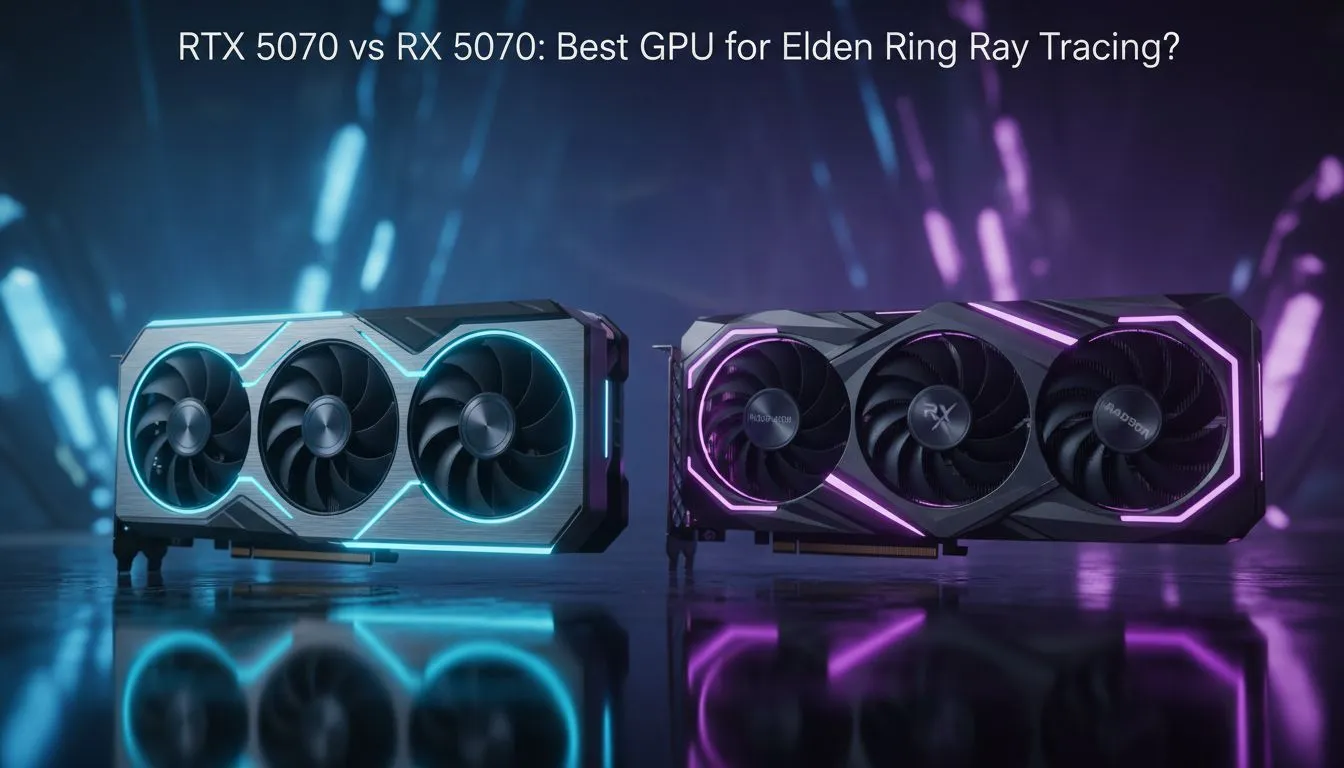
The Battle for the Lands Between: RTX 5070 vs RX 9070
Trekking through the Lands Between is a visual feast... but it can also be a hardware nightmare. If you want to see every glint of light off Malenia’s armour, you need serious power. The RTX 5070 vs RX 9070 battle is the new frontline for performance seekers. Both cards promise to handle Ray Tracing with ease... but only one can truly claim the throne for Elden Ring fans in South Africa. 🔧
Finding the right balance between price and performance is essential when building a new rig. Whether you are upgrading an old system or starting from scratch, choosing from the latest graphics cards requires a look at more than just raw clock speeds.
Ray Tracing Performance in Elden Ring
Elden Ring’s Ray Tracing implementation focuses heavily on ambient occlusion and shadows. This adds incredible depth to the crumbling ruins of Limgrave. Historically, Nvidia has held the crown for Ray Tracing efficiency. The RTX 5070 continues this trend with its dedicated third-generation RT cores. These cores handle the complex light calculations without tanking your frame rate.
However, the RX 9070 is no slouch. AMD has made massive strides in their Ray Accelerator technology. While Nvidia might offer a smoother experience at 4K, the RX 9070 often provides better value for those playing at 1440p. Many local gamers prefer the cooling solutions found on MSI graphics cards to keep these high-end chips running optimally during a summer heatwave in Gauteng.
Optimising Elden Ring ⚡
When enabling Ray Tracing in Elden Ring, always ensure your 'Shadow Quality' is set to High rather than Maximum. It saves significant VRAM without a noticeable loss in visual fidelity on 1440p displays, keeping your frame delivery much smoother during boss fights.
Upscaling Tech: DLSS vs FSR
In the RTX 5070 vs RX 9070 comparison, software plays a massive role. Nvidia’s DLSS 4 is a powerhouse for maintaining high frame rates with Ray Tracing enabled. It uses AI to reconstruct frames, making the game look sharper than native resolution in some cases. 🚀
AMD counters this with FSR (FidelityFX Super Resolution). It is an open-source solution that works across almost all hardware. While some argue that DLSS looks slightly cleaner, FSR has become incredibly competitive. If you are on a tighter budget, you might even consider Intel Arc graphics cards as a secondary option for less demanding titles, though they struggle to match the top-tier Ray Tracing of the 5070 or 9070.
VRAM and Future-Proofing for Open Worlds
Elden Ring is an expansive open world that loves to gobble up video memory. The RX 9070 typically ships with more VRAM than its Nvidia counterpart. This extra buffer is great for modding or running high-resolution texture packs. If your PC is a dual-purpose machine for 3D rendering or video editing, you might even look into workstation graphics cards for their stability... though they aren't the primary choice for pure gaming. ✨
For most South African gamers, the decision comes down to the "Frames per Rand" metric. If you want the absolute best Ray Tracing experience, Nvidia is the way to go. If you want more memory and better raw rasterisation performance, you should buy AMD Radeon graphics cards to get the most out of your budget.
Which GPU Should You Choose?
The RTX 5070 is the precision tool for the enthusiast who wants every lighting effect turned to the max. The RX 9070 is the powerhouse for the player who wants high frame rates and longevity. Both will make Elden Ring look spectacular... it just depends on which technology suite you prefer. ⚡
Ready to Conquer the Lands Between? Whether you choose the AI-powered brilliance of Nvidia or the raw strength of AMD, we have the stock to get you back into the game. Explore our massive range of GPU specials and find the perfect card to elevate your Elden Ring experience today.











