

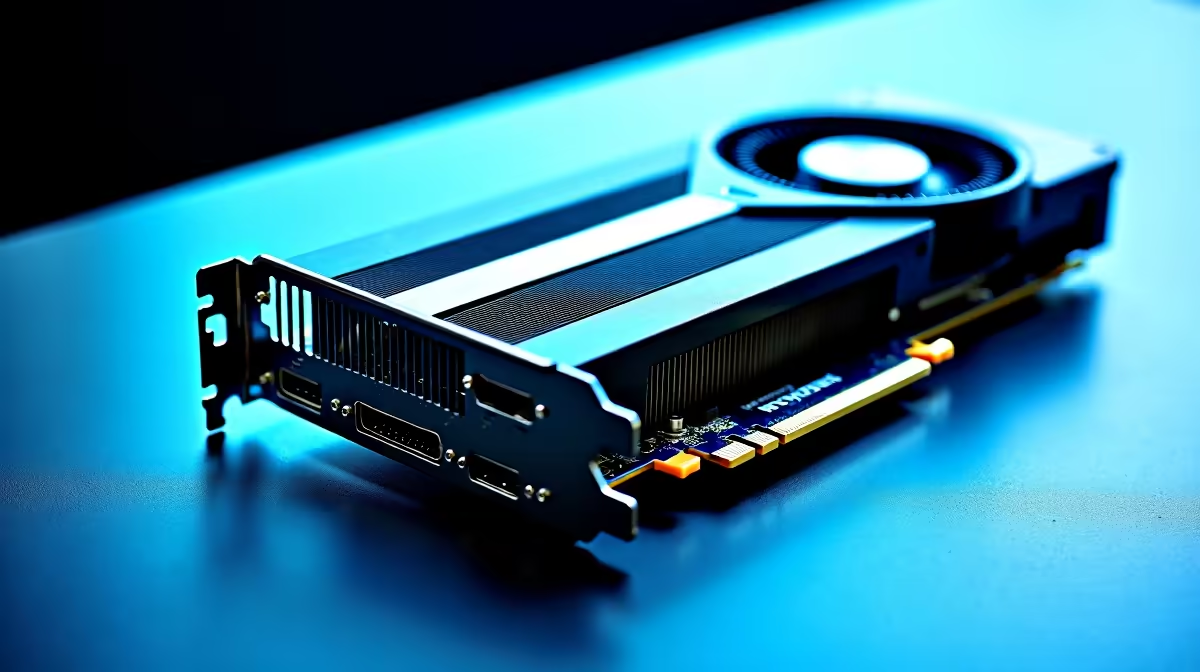
Photogrammetry - the process of reconstructing 3D models from photographs - is increasingly being adopted by South African architects, surveyors, game developers, and forensic analysts. It's a GPU-intensive workload, and the AMD RX 7700 XT sits at an interesting price-to-performance point for professionals evaluating a mid-range card for this purpose in 2026.
Quick Answer
The RX 7700 XT performs competently in photogrammetry workloads, particularly in software that leverages OpenCL or Vulkan compute. It delivers strong results in Reality Capture and Metashape at medium to large dataset sizes, though it trails NVIDIA equivalents in CUDA-accelerated pipelines. For non-CUDA workflows, it's a strong value choice.
📐 RX 7700 XT Photogrammetry Performance in Real Workflows
In Agisoft Metashape, the RX 7700 XT handles alignment and dense cloud generation using OpenCL compute. At a 500-image dataset (100MP equivalent), alignment completes in roughly 12–18 minutes depending on accuracy settings, with dense cloud generation taking 25–40 minutes at high quality. These are practical numbers for studio or field work. Reality Capture, which uses CUDA natively on NVIDIA hardware, falls back to CPU on AMD cards - this is a known limitation and a significant disadvantage if Reality Capture is your primary tool. Meshroom, the open-source option, runs on OpenCL and shows the RX 7700 XT performing within 10–15% of NVIDIA RTX 4060-class cards on equivalent datasets.
🧠 VRAM, Driver Stability, and Professional Considerations
The RX 7700 XT ships with 12GB of GDDR6 VRAM - a meaningful advantage over 8GB NVIDIA counterparts for large-scale photogrammetry projects where the depth maps and dense clouds exceed 8GB of VRAM headroom. AMD's ROCm stack continues to mature in 2026, expanding compatibility with Python-based photogrammetry pipelines and tools like Open3D. Driver stability on Windows for professional workloads has improved considerably in the RDNA 3 generation. If your workflow includes CUDA-dependent software exclusively, the RX 7700 XT is not the right card - but for studios using Metashape, Meshroom, or 3DF Zephyr, it delivers genuine professional value. Pair it with a fast CPU and 32GB+ RAM for optimal pipeline throughput.
💰 Value Assessment for SA Professionals
When priced in Rands, the RX 7700 XT offers strong VRAM-per-rand value in the mid-range segment. Compared to NVIDIA's RTX 4060 Ti (which has less VRAM on most SKUs), the RX 7700 XT's 12GB makes it preferable for professionals handling large datasets. Browse GPUs at Evetech to compare current pricing and availability.
FAQ
Q: Can I use the RX 7700 XT with Agisoft Metashape professionally? A: Yes. Metashape supports OpenCL GPU processing, and the RX 7700 XT performs reliably for datasets up to several hundred images at high quality settings.
Q: Does the RX 7700 XT support CUDA? A: No. CUDA is exclusive to NVIDIA hardware. If your photogrammetry software requires CUDA (like Reality Capture in GPU mode), you'll need an NVIDIA card.
Q: Is 12GB VRAM enough for professional photogrammetry? A: For most mid-to-large datasets in typical studio workflows, yes. Extremely large aerial survey datasets (thousands of images) may exceed 12GB, but for the majority of SA professional use cases, 12GB is sufficient.
Evetech stocks All Graphics Cards and All RAM & Memory — browse current SA pricing and availability online.
Ready to Find Your Perfect Match? Build a professional photogrammetry workstation with hardware from Evetech.











