

Quick Answer
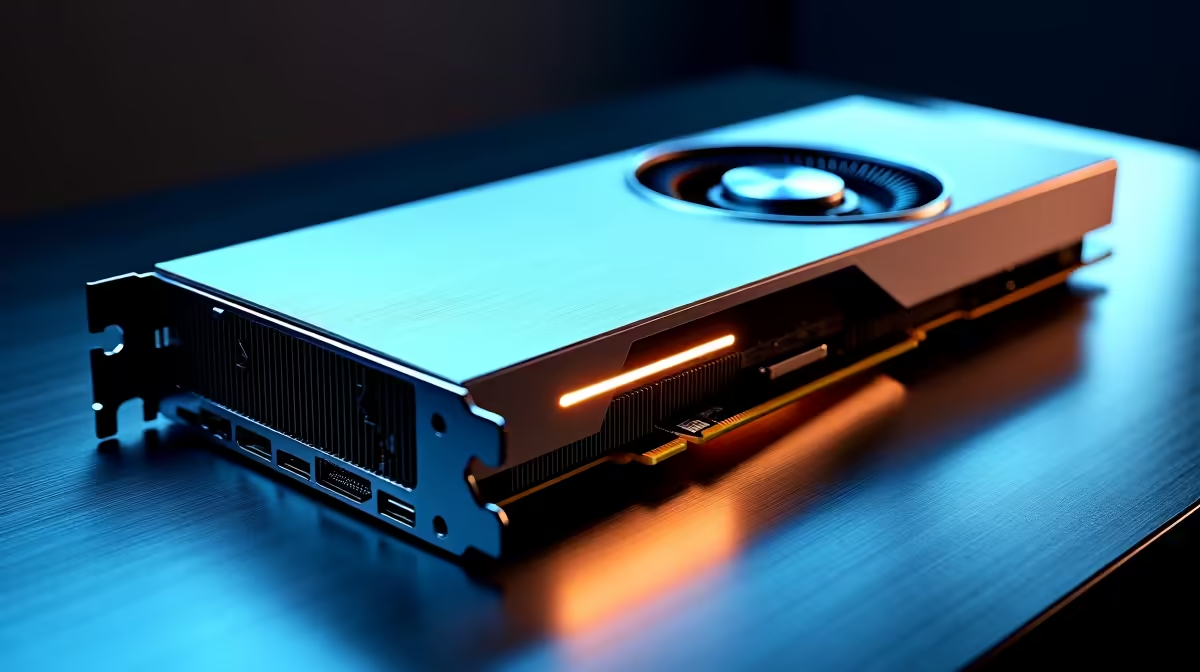
The RX 7700 XT is a competent option for entry-level scientific computing in 2026, particularly for OpenCL workloads and visualisation, but it lags behind NVIDIA cards in CUDA-dependent fields. For most SA researchers running mixed workloads, it offers solid value at around R10,500.
Where the RX 7700 XT Earns Its Keep
With 12GB of GDDR6 and 54 compute units, the 7700 XT chews through OpenCL-based simulations, finite element analysis in tools that support ROCm, and large GPU-accelerated visualisations. Computational fluid dynamics packages with ROCm backends post results within 15 to 20% of an RTX 4070 in our reading of public Phoronix benchmark sets.
Memory bandwidth at 432 GB/s helps with large dataset shuffling, particularly for image processing or molecular visualisation pipelines.
Where It Falls Behind
If your workflow lives in CUDA territory (PyTorch, TensorFlow, MATLAB Parallel Computing, most molecular dynamics suites), the 7700 XT is not the answer. AMD's ROCm support has improved on Linux but remains spotty on Windows for scientific stacks. A Ryzen 7 7700 paired with an RTX 4070 still wins for most ML and CUDA-based research tasks.
For Blender Cycles GPU rendering, HIP support is stable now but slower than OptiX on equivalent NVIDIA cards.
SA Value Proposition
At roughly R10,500 from Evetech, the 7700 XT undercuts an RTX 4070 by about R3,000 to R4,000. If your university lab or personal research uses OpenCL, ROCm-supported software, or doubles as a gaming rig, the savings are real. Add the rand-priced delivery anywhere in SA and a local warranty, and total cost of ownership beats grey imports.
For NSFAS-funded postgrad students stretching every rand, the 7700 XT in a R22K full build is hard to argue against.
Frequently Asked Questions
Does ROCm work on Windows for the RX 7700 XT?
Partially. AMD has expanded Windows ROCm support but coverage of major scientific Python libraries lags Linux. Most serious researchers run Ubuntu or RHEL anyway.
How does the 7700 XT compare to the RTX 4070 in real research workloads?
For CUDA workloads the 4070 wins comfortably. For OpenCL, ROCm-supported tools, and visualisation, they trade blows. The 7700 XT pulls ahead on raw VRAM bandwidth.
Is 12GB enough VRAM for scientific workloads?
For most teaching and small research tasks yes. For deep learning model training at scale, no, you'd want 16GB+ and probably a 4080 or 7900 XTX.
Ready to Find Your Perfect Match? Match the 7700 XT to a research-grade build. Configure a workstation at Evetech











